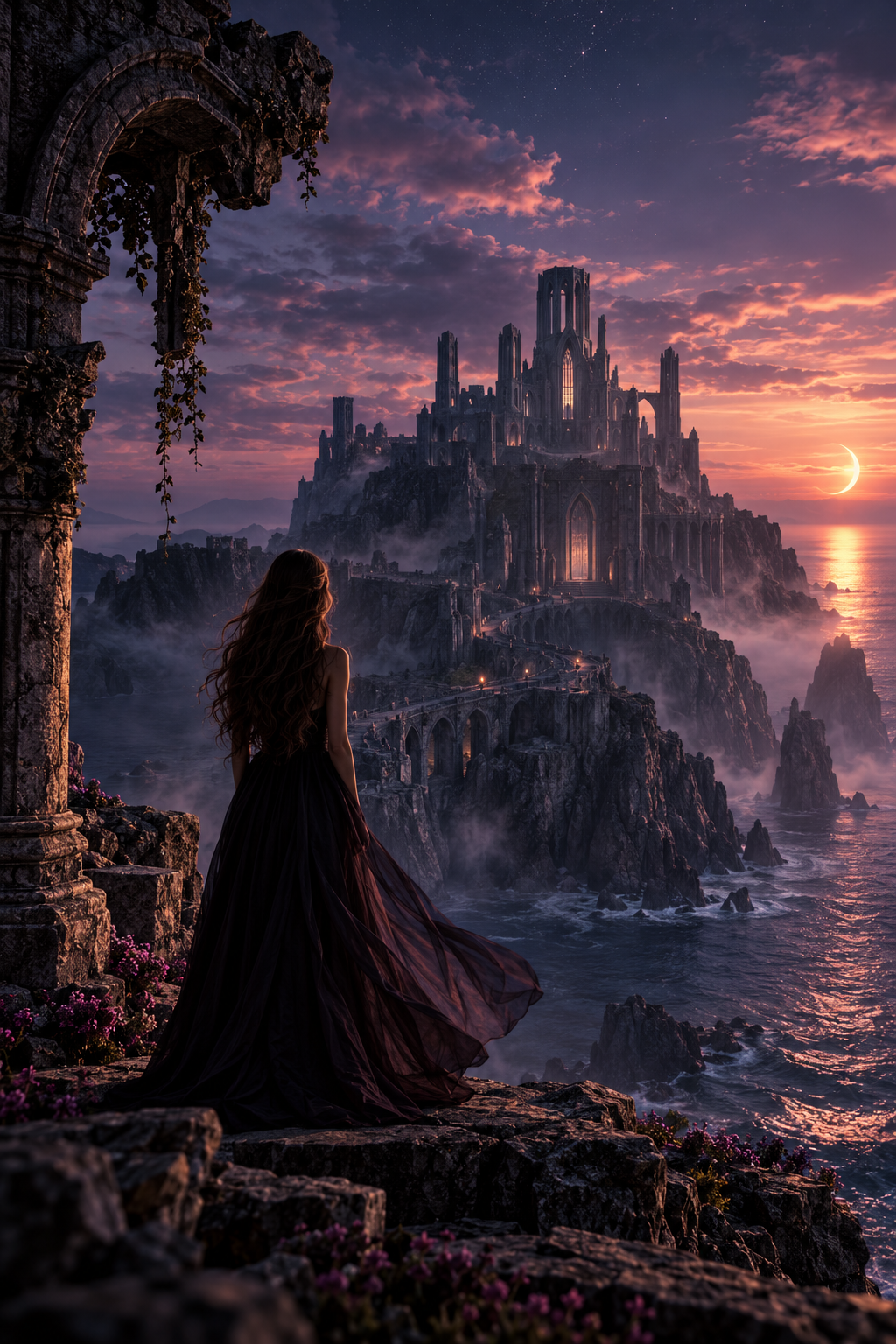
For years, readers of Sarah J. Maas’s A Court of Thorns and Roses series believed they understood the geography of Prythian. Seven courts, seven High Lords and enough political drama to keep several kingdoms permanently on the brink of collapse. But hidden beneath the familiar territories is a mystery that could change everything: the lost Dusk Court. And as we explored in our guide to how ACOTAR, Crescent City and Throne of Glass connect, the revelations about Prythian’s ancient history are now much bigger than a few intriguing Easter eggs.
The Dusk Court has become one of the most fascinating mysteries in the entire ACOTAR universe, connecting Nesta Archeron, Bryce Quinlan, the mysterious Prison island, the Dread Trove and a forgotten history that stretches back thousands of years. What initially appeared to be a passing reference to an eighth court has developed into something considerably more important, particularly following the events of House of Flame and Shadow.
With Sarah J. Maas expanding the series through A Court of Splintered Harmony and A Court of Forgotten Melody, the question is no longer simply whether the Dusk Court ever existed. The books have given us a surprisingly definitive answer to that. The real mystery is what happened to it, whether it could return and who might possess the power to restore it.
And if the fan theories are correct, one of the most important characters in its future might be a woman who has never shown much interest in ruling anything at all.
Spoiler warning: This article contains major spoilers for A Court of Silver Flames, House of Sky and Breath and House of Flame and Shadow, including significant revelations about the history of Prythian and the wider Sarah J. Maas universe.
What Is the Dusk Court in ACOTAR?
The Dusk Court was an ancient Fae territory associated with twilight, starlight and a powerful connection between its land and the people who ruled it. Its history predates the familiar political arrangement of the seven courts, and much of what we now know about it comes from revelations in Sarah J. Maas’s Crescent City series.
Throughout most of ACOTAR, Prythian is presented as a kingdom divided into seven territories. Spring, Summer, Autumn and Winter are seasonal courts, while Dawn, Day and Night represent different periods of the day. Each court possesses its own magical characteristics, ruling family, customs and political allegiances.
It is an elegant arrangement, until you notice what is missing.
Between Day and Night, there should logically be Dusk.
For a long time, that absence was little more than an interesting observation. Maas’s world-building often draws upon natural cycles, mythology and symbolism, so the missing period between daylight and darkness attracted attention among readers who suspected the seven courts might not represent the complete history of Prythian.
What makes the Dusk Court especially intriguing is that it is not simply an eighth territory that modern characters have somehow overlooked. Its history is tied to the earliest rulers of the Fae, the overthrow of ancient conquerors and the movement of entire populations between worlds.
If you need a refresher on the existing territories, our guide to the seven ACOTAR courts explores their rulers, powers and personalities.
The Dusk Court, however, belongs to an older and more complicated version of that history.
The First Major Clue Was Hidden in A Court of Silver Flames
Long before Crescent City provided a more complete explanation, A Court of Silver Flames introduced one of the strongest clues about the Dusk Court’s existence.
During Nesta and Cassian’s journey to the Prison to retrieve the Harp, they discover an extraordinary chamber containing ancient carvings and an eight-pointed star. The Harp, one of the immensely powerful objects belonging to the Dread Trove, rests at the centre of the symbol.
There is something unusual about the place.
Nesta senses a form of magic that does not feel entirely like the Night Court, despite the Prison being situated within Rhysand’s territory. The carvings suggest a connection to the stars, while the chamber itself appears to belong to a history far older than the current High Lords.
Cassian also mentions that Rhysand once suggested the island might originally have belonged to an eighth court.
At the time, the comment seems almost casual. ACOTAR is full of ancient ruins, magical objects and half-forgotten legends, and the Prison already has enough disturbing inhabitants to occupy anyone’s attention. Readers are hardly short of mysteries.
But the detail becomes enormously significant when viewed alongside the revelations in House of Flame and Shadow.
Because the Prison is not simply an ancient building that happens to contain dangerous beings.
It is connected to the ruins of an entire lost civilisation.
The Prison Island Was Once the Heart of the Dusk Court
One of the biggest revelations in House of Flame and Shadow concerns the true history of the island now known as the Prison.
In the modern ACOTAR world, the Prison is a remote and deeply unsettling location under the jurisdiction of the Night Court. It is a place where immensely powerful and dangerous beings are confined, including the Bone Carver, who spends much of the series imprisoned there.
The island is protected by ancient magic, and its interior contains an elaborate network of passages, chambers and cells. Access is tightly controlled, and even the most powerful members of the Inner Circle approach it with considerable caution.
Yet thousands of years earlier, this same territory was associated with Dusk.
Rather than being a barren place devoted to confinement, the island was once a centre of extraordinary magical power and royal authority. Its ruling family possessed a deep connection to the land, which responded to their power.
The transformation from ancient court to supernatural prison is therefore one of the most dramatic examples of lost history in the entire series.
A place that once represented life, power and belonging became a place associated with darkness, isolation and punishment.
There is also something rather fitting about the location. Dusk is the boundary between day and night, neither entirely light nor completely dark. The Prison, with its ancient wards and strange magical properties, exists almost as a boundary between different eras of Prythian’s history.
Whether Maas intends that symbolism to have a further magical significance remains uncertain, but the contrast between what the island once was and what it became is unmistakable.
Queen Theia, High King Fionn and the Forgotten History of Prythian
To understand the Dusk Court, we need to return to a period long before Feyre arrived in Prythian, before Rhysand ruled the Night Court and before the political structures familiar to modern ACOTAR readers existed.
It begins with the Daglan.
These ancient beings ruled over the Fae of Prythian for thousands of years, exploiting their power and treating them as subjects to be controlled. Readers of Crescent City will recognise their true identity: the Daglan were the same kind of parasitic conquerors known as the Asteri.
Their rule eventually ended through a rebellion involving Theia and Fionn, two powerful Fae who helped overthrow them.
Fionn became High King, while Theia rose to extraordinary power alongside him. Together, they possessed magical weapons and objects capable of challenging beings who had previously seemed almost impossible to defeat.
Among these were the objects later known as the Dread Trove, as well as the legendary sword Gwydion.
Theia established her court on the island associated with Dusk, where the magic of the land became closely connected to her own power.
But their victory did not lead to a peaceful new age.
Theia and Fionn’s relationship deteriorated, particularly over questions of succession and authority. Theia eventually became involved in Fionn’s death, and her ambition helped set in motion another disastrous chapter in the history of the Fae.
Encouraged by her general Pelias, she opened a passage to another world, hoping to establish a new realm for her people and expand her power.
That world was Midgard, the setting of Crescent City.
Unfortunately, the expedition led Theia and her followers into another confrontation with the Asteri, who had established themselves in Midgard under different identities.
The consequences were devastating. Theia was killed, her people were divided and the surviving members of her family became separated across worlds.
This is one of the most important revelations in the wider Sarah J. Maas universe because it establishes that the lost history of Prythian is directly connected to the origins of the Fae in Crescent City.
The two stories are not merely similar. They share a history.
Who Was Silene, and What Did She Do to the Dusk Court?
One of the most important figures in the Dusk Court’s history is Silene, the daughter of Theia and Fionn.
In House of Flame and Shadow, Bryce Quinlan, Nesta Archeron and Azriel discover a magical recording left behind by Silene within the ancient chambers of the Prison. Through it, they learn much of the history that had been hidden from Prythian for thousands of years.
Silene and her sister Helena played crucial roles in the aftermath of their mother’s disastrous campaign in Midgard.
When Theia’s forces were defeated, the sisters were entrusted with powerful magical objects and the responsibility of escaping the conflict. Silene eventually returned to Prythian, while Helena remained in Midgard.
Their separation created two branches of a family whose descendants would become important in entirely different worlds.
Back in Prythian, Silene faced a terrifying problem.
The land she had known was no longer safe, and powerful creatures associated with the Daglan still remained. Rather than restoring her family’s territory to its former glory, she began transforming the island into a place of confinement.
Over time, she imprisoned dangerous beings within its depths and concealed much of the island’s history.
The former royal territory became the Prison.
Silene eventually married into the ruling family of the Night Court, establishing an ancestral connection to Rhysand.
That detail changes how we understand both the Prison and the modern Night Court. Rhysand’s family connection to the island is not simply political. It reaches back into the ancient royal history that Silene worked so hard to conceal.
It also raises an uncomfortable question.
If the history of the Dusk Court was deliberately hidden, how much else about Prythian’s past has been forgotten, distorted or misunderstood?
Why Was the Dusk Court Forgotten?
One of the most interesting things about the Dusk Court is that its disappearance was not simply the result of an ancient civilisation gradually fading into obscurity.
Its history was deliberately concealed.
Silene returned to Prythian carrying knowledge of the Daglan, the Dread Trove, her mother’s ambitions and the disastrous consequences of opening passages between worlds. She understood the danger that this knowledge could represent, particularly if it fell into the wrong hands.
Transforming the island into a prison served an obvious practical purpose, but it also helped bury the history of what the territory had once been.
Over thousands of years, the Dusk Court’s identity disappeared from common knowledge. Prythian’s rulers came to understand the island primarily as a dangerous place belonging to the Night Court rather than the former centre of a powerful territory.
This matters because history is closely connected to authority in ACOTAR.
The High Lords inherit their positions through powerful magical bloodlines and traditions that appear ancient and unquestionable. Their territories possess their own distinct forms of magic, and much of the political system relies on the idea that these arrangements have existed for generations.
But what happens when an entire court has been erased from that understanding?
If the modern political map is incomplete, it raises questions about how the current territories were established, who has legitimate authority over them and whether the powers of the ancient rulers still exist somewhere within the land.
The Dusk Court is not simply a lost place.
It is evidence that the history of Prythian has been rewritten.
What Was the Magic of the Dusk Court?
The Dusk Court’s magic appears to have been closely associated with twilight and the power of the land itself.
Silene’s account suggests that the island responded to Theia’s magic in a particularly intimate way. As the Fae recovered from the Daglan’s long occupation, the land itself began to regain its strength, and its powers became linked to Theia.
That connection makes the Dusk Court different from how readers generally understand the modern courts.
The Night Court is associated with darkness, starlight, shadows and the extraordinary powers wielded by Rhysand and his family. The Day Court has its own distinctive magic, while the seasonal courts reflect the natural qualities of their territories.
The Dusk Court appears to represent the transitional space between light and darkness.
There is a temptation to imagine an entire range of abilities connected to twilight, portals, transformation and the movement between worlds. Some of those ideas are certainly plausible given Theia’s history, the Dread Trove and the island’s unusual magical properties.
However, the books have not established a complete list of Dusk Court powers.
It would be a mistake to assume that every ability associated with Theia, Bryce or the ancient magical objects automatically belongs to Dusk magic itself.
What we do know is that the territory once possessed an extraordinary connection between ruler and land, and that its ancient magic was powerful enough to remain significant thousands of years later. The mystery is whether that connection could be awakened again.
The Eight-Pointed Star Could Be One of the Biggest Clues
If there is one symbol worth remembering when exploring the Dusk Court, it is the eight-pointed star.
The symbol appears repeatedly throughout the interconnected stories, most notably in connection with Nesta, Bryce and the ancient chamber beneath the Prison.
In A Court of Silver Flames, the Harp rests upon an eight-pointed star surrounded by carvings of constellations. Nesta experiences an extraordinary sense of being drawn towards the object, as though forces beyond her understanding have guided her there.
The symbol also has an association with the Valkyries, appearing in their training through a distinctive sword movement.
Then there is Bryce Quinlan.
Bryce bears an eight-pointed star on her chest, a mark connected to her Starborn heritage and magical abilities. Her arrival in Prythian and her subsequent journey into the Prison reveal that the symbol has a significance extending across worlds.
During House of Flame and Shadow, the relationship between Bryce’s star and the ancient chamber becomes impossible to ignore.
Nesta also has an eight-pointed star associated with a magical bargain, creating another striking connection between her and the island.
These repetitions have led readers to speculate that the symbol could represent a lost magical inheritance, a connection to the Dusk Court or a role that certain characters have yet to fulfil.
The important distinction is that the books have not confirmed a single universal meaning for every appearance of the star.
It is clearly significant, and its repeated connection to ancient magic is unlikely to be accidental. But whether it identifies a ruler, represents a particular power or serves some larger purpose remains unresolved.
It could be a marker of magical inheritance.
It could be connected to the ancient Starborn Fae.
Or it could represent a relationship between certain people and powers that predates the modern courts.
For readers looking for clues about the future of ACOTAR, it remains one of the most interesting symbols in the series.
Why Nesta Archeron Is So Closely Connected to the Dusk Court
Of all the characters who could become important to the future of the Dusk Court, Nesta Archeron is one of the strongest possibilities.
Her involvement begins in A Court of Silver Flames, when she discovers the Harp beneath the Prison and experiences the strange pull of the ancient chamber.
Unlike most other characters, Nesta has a profound connection to Made objects, particularly those associated with the Cauldron.
After being forcibly transformed into High Fae, she emerges possessing extraordinary power taken from the Cauldron itself. Her abilities become central to the search for the Dread Trove, and she demonstrates an unusual capacity to locate and wield objects that would be dangerous or inaccessible to others.
But Nesta’s importance extends beyond her magical abilities.
Her story has increasingly become one of independence, identity and finding a place in a world she never chose to enter.
She begins her Fae life furious about what has been taken from her. She has little interest in becoming part of the Night Court’s carefully organised hierarchy, and her relationship with Rhysand and the Inner Circle remains complicated even after she begins rebuilding her life.
Through her friendships with Gwyn and Emerie, Nesta creates something of her own: a revived order of Valkyries built around strength, loyalty and chosen sisterhood.
Our complete guide to the ACOTAR Valkyries explores how the three women rebuilt the ancient warrior tradition and why their story could become even more significant.
The possibility of Nesta developing a relationship with the lost Dusk Court is compelling because it would fit naturally into that larger character journey.
She has spent much of the series trying to find a place where she belongs.
What if the place she is searching for has itself been forgotten?
It would be a satisfying thematic development, particularly given the way Maas frequently links magical transformations to emotional growth and personal identity.
Of course, thematic suitability is not proof that Nesta is destined to restore the court.
But the connections are becoming difficult to dismiss.
Could Nesta Become High Lady of the Dusk Court?
This is one of the most popular theories surrounding the lost court, and it is easy to understand the appeal.
Nesta possesses unusual power, has already accessed the ancient chambers beneath the Prison and shares an intriguing connection with the eight-pointed star. She has also demonstrated an ability to lead, even if that leadership has emerged through friendship and shared experience rather than political ambition.
The idea that she might become High Lady of a restored Dusk Court offers an interesting alternative to the existing structure of Prythian.
Rather than existing under the authority of the Night Court, Nesta could theoretically establish a new centre of power.
There are several problems with the theory, however.
First, the books have not confirmed that the Dusk Court currently possesses an independent political identity capable of being restored. Its ancient territory exists, but the relationship between that territory and the present-day Night Court would need to be resolved.
Second, Nesta’s unusual connection to the island does not automatically establish that she has a legitimate claim to rule it.
Third, she is mated to Cassian, whose life, loyalties and responsibilities are deeply connected to the Night Court.
That does not make a new political role impossible, but it would introduce complicated questions about their future.
And perhaps most importantly, Nesta has not expressed any particular ambition to become a ruler.
Yet that might be exactly why some readers find the theory so appealing.
ACOTAR has repeatedly shown that the characters most suited to power are not always the ones most eager to claim it.
For now, the Nesta-as-High-Lady theory remains speculation. Still, whether she becomes a ruler, protector or simply someone capable of understanding the island’s magic, her future appears closely connected to some of Prythian’s oldest secrets.
Bryce Quinlan Has Already Changed Everything
The Dusk Court mystery would be considerably less developed without Bryce Quinlan.
Bryce’s arrival in Prythian during the Crescent City crossover transforms what readers know about the Fae, the Prison and the ancient history of the courts.
Her Starborn heritage connects her to Theia’s family, while her ability to interact with ancient magical objects allows her to uncover secrets that have remained hidden for thousands of years.
She also possesses the Starsword, known in Prythian as Gwydion, a legendary weapon associated with the ancient rulers and the defeat of the Daglan.
During her time in the Prison, Bryce discovers Silene’s recording and learns the truth about her family’s origins. She also accesses ancient power hidden within the island, briefly revealing something of the extraordinary place the Prison once was.
That moment is especially important because it demonstrates that the territory’s former magic has not simply disappeared without a trace.
There is still something there.
The island’s ancient power can respond to the right circumstances, even after thousands of years of concealment.
At the end of House of Flame and Shadow, Bryce returns Gwydion to Prythian and leaves the sword with Nesta, suggesting that Nesta’s connection to the eight-pointed star deserves further investigation.
The gesture is significant for several reasons.
Gwydion is not merely a powerful weapon. It is a symbol of Prythian’s lost royal history, its ancient struggle against the Daglan and the extraordinary magical traditions that existed before the modern courts.
By placing it in Nesta’s hands, Maas creates another connection between the Archeron sister and the mysteries surrounding the Dusk Court.
That does not mean Bryce has formally appointed Nesta as an heir or transferred any royal authority to her. The books establish no such succession.
But in a series where legendary weapons rarely change hands without consequences, the decision is certainly worth remembering.
For readers who have only followed ACOTAR, our Crescent City reading guide is a useful place to begin exploring Bryce’s story.
Could the Dusk Court Actually Be Restored?
This is arguably the most interesting question of all.
The Dusk Court existed. Its ancient territory survives. Its magical history has been revealed, and there are indications that its former power has not vanished entirely.
But restoring an ancient territory is not necessarily the same thing as restoring a functioning court.
The modern system of Prythian consists of seven High Lords and their territories. The Prison falls under Night Court authority, and Rhysand’s family has an ancestral connection to the island through Silene.
Creating a new court would potentially require an enormous political and magical transformation.
Who would rule it? Would the land recognise a new ruler? Would the territory become independent of the Night Court? And what would happen to the dangerous beings and ancient wards that still define the Prison?
There is also the question of whether the island could physically return to its former state.
Bryce’s experience suggests that its ancient magic can be awakened, at least temporarily. But a momentary transformation is very different from rebuilding a populated territory with its own government, culture and alliances.
A restored Dusk Court might require more than one powerful person.
It could require the recovery of lost knowledge, the release or transformation of ancient magic and a fundamental reconsideration of Prythian’s history.
In narrative terms, however, that is precisely what makes the possibility so interesting.
The return of an eighth court would not simply give readers another beautiful location to imagine.
It could alter the political and magical foundations of the entire series.
What Does the Dusk Court Have to Do With Koschei the Deathless?
At first glance, the Dusk Court and Koschei appear to belong to different mysteries.
The Dusk Court is tied to ancient Fae history, forgotten royal power and the Prison. Koschei is an immensely powerful death-god confined to a remote lake on the continent, whose influence has increasingly threatened Prythian and the human lands.
There is no confirmed direct connection between Koschei and the restoration of the Dusk Court.
However, both storylines concern ancient forms of magic that the modern inhabitants of Prythian do not fully understand.
Koschei and his siblings are beings whose origins lie beyond the familiar world. The Bone Carver, one of those siblings, spends much of the series confined within the Prison itself.
That detail creates an intriguing overlap between the two mysteries.
The Prison was once the centre of the Dusk Court, and it later became a place capable of holding extraordinarily dangerous beings. Koschei, meanwhile, remains bound by ancient magic that has apparently restricted him for thousands of years.
It is possible that understanding the magic behind ancient prisons, wards and supernatural confinement could become useful as Prythian confronts Koschei’s growing threat.
But that remains a possibility rather than a confirmed connection.
The official storyline for A Court of Splintered Harmony places Koschei at the centre of an emerging conflict involving weakened alliances, threatened human territories and deep divisions within the Night Court.
As our guide to Koschei the Deathless explains, his history is already closely connected to several of ACOTAR’s most important unresolved storylines.
The Dusk Court may eventually prove relevant to that conflict.
For now, it is more accurate to say the two mysteries occupy the same increasingly dangerous world of ancient magic, lost knowledge and powerful beings who refuse to remain safely in the past.
What Could the Lost Dusk Court Mean for the New ACOTAR Books?
The next phase of ACOTAR has been officially named The Valkyrie Cycle, beginning with A Court of Splintered Harmony and continuing through A Court of Forgotten Melody.
Bloomsbury announced publication dates of 27 October 2026 and 12 January 2027 respectively, with the story unfolding through several interconnected movements.
Those titles have encouraged considerable speculation about what Maas might be planning.
Splintered Harmony suggests something fractured that may need to be repaired, while Forgotten Melody evokes the return of something that has been lost.
It is tempting to connect those ideas to the Dusk Court, particularly given the wider series’ growing emphasis on forgotten histories, divided families and ancient powers returning to prominence.
But the official descriptions do not confirm that the Dusk Court will be restored or that it will become the central focus of the new books.
What they do establish is that Prythian is facing a dangerous period of instability.
Koschei’s influence is spreading. The human lands are threatened. Alliances are struggling to hold, and the Night Court is dealing with fractures that may prove difficult to repair.
Meanwhile, Nesta, Gwyn and Emerie have revived the Valkyries, bringing an ancient warrior tradition back into the present.
The connection between the Valkyries and the Dusk Court is not yet fully understood, but Nesta’s involvement in both storylines makes the possibility particularly intriguing.
The Dusk Court might be restored as an independent territory. Its magic might become important without its political identity ever returning. The Prison could hold further revelations about Prythian’s earliest rulers. Or Nesta’s connection to the island might ultimately serve a completely different purpose.
The most interesting possibility is that the Dusk Court could become part of a larger transformation of Prythian itself.
After all, the series has already moved beyond the story of one human woman discovering the Fae world. It now encompasses multiple generations, ancient civilisations, lost royal bloodlines and the existence of other worlds.
Restoring something deliberately erased from history would feel like a natural extension of that evolution.
Could the Dusk Court Change the Balance of Power in Prythian?
The political implications of a restored Dusk Court could be enormous.
For centuries, the High Lords have ruled within a structure that appears fixed. Each court has its own territory, identity and magical traditions, and disputes are generally fought within that established system.
An eighth court would challenge the assumption that the existing arrangement is permanent.
It could also create questions about the relationship between Rhysand and the island’s ancient rulers.
Theia’s descendants became connected to the Night Court through Silene, but their history is far older than the current system. If the island’s magic were to recognise a new ruler, it is not clear how that would interact with the authority Rhysand already possesses.
There could also be consequences for the wider relationships between the courts.
Prythian’s political balance is already fragile. The Spring Court has been weakened, the Autumn Court remains troubled by its own internal conflicts, and the aftermath of the war with Hybern continues to affect relations between Fae and humans.
The introduction of another centre of magical power could be stabilising, particularly if it helped unite the courts against a common enemy.
Or it could introduce a completely new struggle for territory and authority.
Either way, the Dusk Court would be much more than an attractive addition to the map.
It could force Prythian to reconsider who holds power, how that power is inherited and whether the arrangements everyone has accepted for generations are as permanent as they appear.
Does the Dusk Court Connect to Elain Archeron?
Elain is another character whose future remains surrounded by unanswered questions, although her connection to the Dusk Court is much less direct than Nesta’s.
Her transformation in the Cauldron gives her the rare ability to see events and possibilities beyond ordinary perception. Those abilities have already connected her to important developments involving Vassa, Koschei and the wider political situation.
Yet much about the extent of her powers remains unknown.
Some fans have speculated that Elain’s abilities could eventually reveal hidden places, forgotten histories or magical truths that other characters cannot access.
In theory, that could make her useful in understanding an ancient territory such as the Dusk Court.
There is no established evidence, however, that Elain is specifically connected to Dusk magic or destined to play a role in restoring the court.
Her more obvious unresolved storylines involve her Seer abilities, her mating bond with Lucien and her complicated relationship with Azriel.
The important point is that the Dusk Court’s possible return would not necessarily affect only Nesta.
A discovery capable of changing the political and magical history of Prythian could eventually involve almost every major character in the series.
Why the Dusk Court Mystery Matters Beyond ACOTAR
Perhaps the most fascinating aspect of the Dusk Court is what it represents within Sarah J. Maas’s wider fictional universe.
For much of ACOTAR, Prythian appears to be a largely self-contained world. Its history is ancient, its rulers powerful and its mythology expansive enough to sustain an entire series without looking beyond its borders.
Crescent City changes that.
The revelation that Fae populations travelled between worlds, that ancient conquerors operated across different realms and that the same magical objects appear in more than one series transforms how readers understand the past.
It suggests that the histories characters have inherited are only fragments of a much larger story.
The Dusk Court is a particularly striking example because it demonstrates how thoroughly an important civilisation can disappear from collective memory.
The territory was real. Its rulers were powerful. Its people played a role in events that affected multiple worlds.
Yet thousands of years later, the place is known primarily as a prison, and much of its former identity has been lost.
That raises an interesting possibility about the future of the Maasverse.
If one entire court could be forgotten, what other places, peoples or powers might still be waiting to be rediscovered?
The answer could reshape far more than Prythian.
Will the Dusk Court Return? What We Know and What Remains a Theory
For all the excitement surrounding the Dusk Court, it is important to separate what Sarah J. Maas has established from what readers believe might happen next.
The books confirm that the Prison island has a history connected to an ancient Dusk territory ruled by Theia. They establish that Silene deliberately concealed much of that history and transformed the island into a place of confinement. They also reveal a connection between the ancient Fae of Prythian and the Starborn bloodlines of Midgard.
We know that Bryce was able to access extraordinary power within the island, and that Nesta has repeatedly been drawn into mysteries involving its ancient chambers, the eight-pointed star and Made objects.
We also know that Gwydion, a legendary weapon connected to this history, has returned to Prythian and been entrusted to Nesta.
What we do not know is whether the Dusk Court will be restored as an independent political territory, whether its magic will recognise a new ruler or whether Nesta will ultimately have a formal role in its future.
Nor has Maas confirmed that the Dusk Court will become central to The Valkyrie Cycle.
Those possibilities remain theories.
And that distinction makes the mystery more compelling rather than less.
There are enough confirmed details to suggest that the Dusk Court is important, but enough unanswered questions to leave readers genuinely uncertain about its ultimate significance.
The Biggest ACOTAR Mystery May Be Hiding in Plain Sight
One of the cleverest things about the lost Dusk Court is how naturally its clues fit into stories readers already know.
The Prison has been part of ACOTAR for years. The Bone Carver’s imprisonment, the Dread Trove, the eight-pointed star and Nesta’s unusual relationship with ancient magic all existed before the full significance of the island became apparent.
Then House of Flame and Shadow changed the context.
Suddenly, a sinister prison became the remains of an ancient court. A mysterious symbol became part of a much larger history. A legendary sword returned to Prythian, and Nesta’s connection to the island began to look less like coincidence.
That does not mean every detail is pointing towards a single grand reveal. Sarah J. Maas has created a world complicated enough to support several different explanations, and there is no guarantee that the most popular fan theory will turn out to be correct.
But the Dusk Court has already demonstrated something important about ACOTAR.
The world Feyre first discovered is only one version of Prythian.
Beneath its familiar courts, ancient castles, powerful rulers and carefully maintained histories lies a much older world, one shaped by forces its current inhabitants are only beginning to understand.
And as the series continues, the greatest threat to Prythian’s future may not come solely from a powerful enemy or a gathering army.
It may come from discovering that everything its rulers believed about the past was incomplete. The Dusk Court was lost once. Whether it remains forgotten is another question entirely.
What to Read Next
For more on the characters, mysteries and mythology shaping Sarah J. Maas’s fantasy universe, explore:


For years, readers of Sarah J. Maas’s A Court of Thorns and Roses series believed they understood the geography of Prythian. Seven courts, seven High Lords and enough political drama to keep several kingdoms permanently on the brink of collapse. But hidden beneath the familiar territories is a mystery that could change everything: the lost Dusk Court. And as we explored in our guide to how ACOTAR, Crescent City and Throne of Glass connect, the revelations about Prythian’s ancient history are now much bigger than a few intriguing Easter eggs.
The Dusk Court has become one of the most fascinating mysteries in the entire ACOTAR universe, connecting Nesta Archeron, Bryce Quinlan, the mysterious Prison island, the Dread Trove and a forgotten history that stretches back thousands of years. What initially appeared to be a passing reference to an eighth court has developed into something considerably more important, particularly following the events of House of Flame and Shadow.
With Sarah J. Maas expanding the series through A Court of Splintered Harmony and A Court of Forgotten Melody, the question is no longer simply whether the Dusk Court ever existed. The books have given us a surprisingly definitive answer to that. The real mystery is what happened to it, whether it could return and who might possess the power to restore it.
And if the fan theories are correct, one of the most important characters in its future might be a woman who has never shown much interest in ruling anything at all.
Spoiler warning: This article contains major spoilers for A Court of Silver Flames, House of Sky and Breath and House of Flame and Shadow, including significant revelations about the history of Prythian and the wider Sarah J. Maas universe.
What Is the Dusk Court in ACOTAR?
The Dusk Court was an ancient Fae territory associated with twilight, starlight and a powerful connection between its land and the people who ruled it. Its history predates the familiar political arrangement of the seven courts, and much of what we now know about it comes from revelations in Sarah J. Maas’s Crescent City series.
Throughout most of ACOTAR, Prythian is presented as a kingdom divided into seven territories. Spring, Summer, Autumn and Winter are seasonal courts, while Dawn, Day and Night represent different periods of the day. Each court possesses its own magical characteristics, ruling family, customs and political allegiances.
It is an elegant arrangement, until you notice what is missing.
Between Day and Night, there should logically be Dusk.
For a long time, that absence was little more than an interesting observation. Maas’s world-building often draws upon natural cycles, mythology and symbolism, so the missing period between daylight and darkness attracted attention among readers who suspected the seven courts might not represent the complete history of Prythian.
What makes the Dusk Court especially intriguing is that it is not simply an eighth territory that modern characters have somehow overlooked. Its history is tied to the earliest rulers of the Fae, the overthrow of ancient conquerors and the movement of entire populations between worlds.
If you need a refresher on the existing territories, our guide to the seven ACOTAR courts explores their rulers, powers and personalities.
The Dusk Court, however, belongs to an older and more complicated version of that history.
The First Major Clue Was Hidden in A Court of Silver Flames
Long before Crescent City provided a more complete explanation, A Court of Silver Flames introduced one of the strongest clues about the Dusk Court’s existence.
During Nesta and Cassian’s journey to the Prison to retrieve the Harp, they discover an extraordinary chamber containing ancient carvings and an eight-pointed star. The Harp, one of the immensely powerful objects belonging to the Dread Trove, rests at the centre of the symbol.
There is something unusual about the place.
Nesta senses a form of magic that does not feel entirely like the Night Court, despite the Prison being situated within Rhysand’s territory. The carvings suggest a connection to the stars, while the chamber itself appears to belong to a history far older than the current High Lords.
Cassian also mentions that Rhysand once suggested the island might originally have belonged to an eighth court.
At the time, the comment seems almost casual. ACOTAR is full of ancient ruins, magical objects and half-forgotten legends, and the Prison already has enough disturbing inhabitants to occupy anyone’s attention. Readers are hardly short of mysteries.
But the detail becomes enormously significant when viewed alongside the revelations in House of Flame and Shadow.
Because the Prison is not simply an ancient building that happens to contain dangerous beings.
It is connected to the ruins of an entire lost civilisation.
The Prison Island Was Once the Heart of the Dusk Court
One of the biggest revelations in House of Flame and Shadow concerns the true history of the island now known as the Prison.
In the modern ACOTAR world, the Prison is a remote and deeply unsettling location under the jurisdiction of the Night Court. It is a place where immensely powerful and dangerous beings are confined, including the Bone Carver, who spends much of the series imprisoned there.
The island is protected by ancient magic, and its interior contains an elaborate network of passages, chambers and cells. Access is tightly controlled, and even the most powerful members of the Inner Circle approach it with considerable caution.
Yet thousands of years earlier, this same territory was associated with Dusk.
Rather than being a barren place devoted to confinement, the island was once a centre of extraordinary magical power and royal authority. Its ruling family possessed a deep connection to the land, which responded to their power.
The transformation from ancient court to supernatural prison is therefore one of the most dramatic examples of lost history in the entire series.
A place that once represented life, power and belonging became a place associated with darkness, isolation and punishment.
There is also something rather fitting about the location. Dusk is the boundary between day and night, neither entirely light nor completely dark. The Prison, with its ancient wards and strange magical properties, exists almost as a boundary between different eras of Prythian’s history.
Whether Maas intends that symbolism to have a further magical significance remains uncertain, but the contrast between what the island once was and what it became is unmistakable.
Queen Theia, High King Fionn and the Forgotten History of Prythian
To understand the Dusk Court, we need to return to a period long before Feyre arrived in Prythian, before Rhysand ruled the Night Court and before the political structures familiar to modern ACOTAR readers existed.
It begins with the Daglan.
These ancient beings ruled over the Fae of Prythian for thousands of years, exploiting their power and treating them as subjects to be controlled. Readers of Crescent City will recognise their true identity: the Daglan were the same kind of parasitic conquerors known as the Asteri.
Their rule eventually ended through a rebellion involving Theia and Fionn, two powerful Fae who helped overthrow them.
Fionn became High King, while Theia rose to extraordinary power alongside him. Together, they possessed magical weapons and objects capable of challenging beings who had previously seemed almost impossible to defeat.
Among these were the objects later known as the Dread Trove, as well as the legendary sword Gwydion.
Theia established her court on the island associated with Dusk, where the magic of the land became closely connected to her own power.
But their victory did not lead to a peaceful new age.
Theia and Fionn’s relationship deteriorated, particularly over questions of succession and authority. Theia eventually became involved in Fionn’s death, and her ambition helped set in motion another disastrous chapter in the history of the Fae.
Encouraged by her general Pelias, she opened a passage to another world, hoping to establish a new realm for her people and expand her power.
That world was Midgard, the setting of Crescent City.
Unfortunately, the expedition led Theia and her followers into another confrontation with the Asteri, who had established themselves in Midgard under different identities.
The consequences were devastating. Theia was killed, her people were divided and the surviving members of her family became separated across worlds.
This is one of the most important revelations in the wider Sarah J. Maas universe because it establishes that the lost history of Prythian is directly connected to the origins of the Fae in Crescent City.
The two stories are not merely similar. They share a history.
Who Was Silene, and What Did She Do to the Dusk Court?
One of the most important figures in the Dusk Court’s history is Silene, the daughter of Theia and Fionn.
In House of Flame and Shadow, Bryce Quinlan, Nesta Archeron and Azriel discover a magical recording left behind by Silene within the ancient chambers of the Prison. Through it, they learn much of the history that had been hidden from Prythian for thousands of years.
Silene and her sister Helena played crucial roles in the aftermath of their mother’s disastrous campaign in Midgard.
When Theia’s forces were defeated, the sisters were entrusted with powerful magical objects and the responsibility of escaping the conflict. Silene eventually returned to Prythian, while Helena remained in Midgard.
Their separation created two branches of a family whose descendants would become important in entirely different worlds.
Back in Prythian, Silene faced a terrifying problem.
The land she had known was no longer safe, and powerful creatures associated with the Daglan still remained. Rather than restoring her family’s territory to its former glory, she began transforming the island into a place of confinement.
Over time, she imprisoned dangerous beings within its depths and concealed much of the island’s history.
The former royal territory became the Prison.
Silene eventually married into the ruling family of the Night Court, establishing an ancestral connection to Rhysand.
That detail changes how we understand both the Prison and the modern Night Court. Rhysand’s family connection to the island is not simply political. It reaches back into the ancient royal history that Silene worked so hard to conceal.
It also raises an uncomfortable question.
If the history of the Dusk Court was deliberately hidden, how much else about Prythian’s past has been forgotten, distorted or misunderstood?
Why Was the Dusk Court Forgotten?
One of the most interesting things about the Dusk Court is that its disappearance was not simply the result of an ancient civilisation gradually fading into obscurity.
Its history was deliberately concealed.
Silene returned to Prythian carrying knowledge of the Daglan, the Dread Trove, her mother’s ambitions and the disastrous consequences of opening passages between worlds. She understood the danger that this knowledge could represent, particularly if it fell into the wrong hands.
Transforming the island into a prison served an obvious practical purpose, but it also helped bury the history of what the territory had once been.
Over thousands of years, the Dusk Court’s identity disappeared from common knowledge. Prythian’s rulers came to understand the island primarily as a dangerous place belonging to the Night Court rather than the former centre of a powerful territory.
This matters because history is closely connected to authority in ACOTAR.
The High Lords inherit their positions through powerful magical bloodlines and traditions that appear ancient and unquestionable. Their territories possess their own distinct forms of magic, and much of the political system relies on the idea that these arrangements have existed for generations.
But what happens when an entire court has been erased from that understanding?
If the modern political map is incomplete, it raises questions about how the current territories were established, who has legitimate authority over them and whether the powers of the ancient rulers still exist somewhere within the land.
The Dusk Court is not simply a lost place.
It is evidence that the history of Prythian has been rewritten.
What Was the Magic of the Dusk Court?
The Dusk Court’s magic appears to have been closely associated with twilight and the power of the land itself.
Silene’s account suggests that the island responded to Theia’s magic in a particularly intimate way. As the Fae recovered from the Daglan’s long occupation, the land itself began to regain its strength, and its powers became linked to Theia.
That connection makes the Dusk Court different from how readers generally understand the modern courts.
The Night Court is associated with darkness, starlight, shadows and the extraordinary powers wielded by Rhysand and his family. The Day Court has its own distinctive magic, while the seasonal courts reflect the natural qualities of their territories.
The Dusk Court appears to represent the transitional space between light and darkness.
There is a temptation to imagine an entire range of abilities connected to twilight, portals, transformation and the movement between worlds. Some of those ideas are certainly plausible given Theia’s history, the Dread Trove and the island’s unusual magical properties.
However, the books have not established a complete list of Dusk Court powers.
It would be a mistake to assume that every ability associated with Theia, Bryce or the ancient magical objects automatically belongs to Dusk magic itself.
What we do know is that the territory once possessed an extraordinary connection between ruler and land, and that its ancient magic was powerful enough to remain significant thousands of years later. The mystery is whether that connection could be awakened again.
The Eight-Pointed Star Could Be One of the Biggest Clues
If there is one symbol worth remembering when exploring the Dusk Court, it is the eight-pointed star.
The symbol appears repeatedly throughout the interconnected stories, most notably in connection with Nesta, Bryce and the ancient chamber beneath the Prison.
In A Court of Silver Flames, the Harp rests upon an eight-pointed star surrounded by carvings of constellations. Nesta experiences an extraordinary sense of being drawn towards the object, as though forces beyond her understanding have guided her there.
The symbol also has an association with the Valkyries, appearing in their training through a distinctive sword movement.
Then there is Bryce Quinlan.
Bryce bears an eight-pointed star on her chest, a mark connected to her Starborn heritage and magical abilities. Her arrival in Prythian and her subsequent journey into the Prison reveal that the symbol has a significance extending across worlds.
During House of Flame and Shadow, the relationship between Bryce’s star and the ancient chamber becomes impossible to ignore.
Nesta also has an eight-pointed star associated with a magical bargain, creating another striking connection between her and the island.
These repetitions have led readers to speculate that the symbol could represent a lost magical inheritance, a connection to the Dusk Court or a role that certain characters have yet to fulfil.
The important distinction is that the books have not confirmed a single universal meaning for every appearance of the star.
It is clearly significant, and its repeated connection to ancient magic is unlikely to be accidental. But whether it identifies a ruler, represents a particular power or serves some larger purpose remains unresolved.
It could be a marker of magical inheritance.
It could be connected to the ancient Starborn Fae.
Or it could represent a relationship between certain people and powers that predates the modern courts.
For readers looking for clues about the future of ACOTAR, it remains one of the most interesting symbols in the series.
Why Nesta Archeron Is So Closely Connected to the Dusk Court
Of all the characters who could become important to the future of the Dusk Court, Nesta Archeron is one of the strongest possibilities.
Her involvement begins in A Court of Silver Flames, when she discovers the Harp beneath the Prison and experiences the strange pull of the ancient chamber.
Unlike most other characters, Nesta has a profound connection to Made objects, particularly those associated with the Cauldron.
After being forcibly transformed into High Fae, she emerges possessing extraordinary power taken from the Cauldron itself. Her abilities become central to the search for the Dread Trove, and she demonstrates an unusual capacity to locate and wield objects that would be dangerous or inaccessible to others.
But Nesta’s importance extends beyond her magical abilities.
Her story has increasingly become one of independence, identity and finding a place in a world she never chose to enter.
She begins her Fae life furious about what has been taken from her. She has little interest in becoming part of the Night Court’s carefully organised hierarchy, and her relationship with Rhysand and the Inner Circle remains complicated even after she begins rebuilding her life.
Through her friendships with Gwyn and Emerie, Nesta creates something of her own: a revived order of Valkyries built around strength, loyalty and chosen sisterhood.
Our complete guide to the ACOTAR Valkyries explores how the three women rebuilt the ancient warrior tradition and why their story could become even more significant.
The possibility of Nesta developing a relationship with the lost Dusk Court is compelling because it would fit naturally into that larger character journey.
She has spent much of the series trying to find a place where she belongs.
What if the place she is searching for has itself been forgotten?
It would be a satisfying thematic development, particularly given the way Maas frequently links magical transformations to emotional growth and personal identity.
Of course, thematic suitability is not proof that Nesta is destined to restore the court.
But the connections are becoming difficult to dismiss.
Could Nesta Become High Lady of the Dusk Court?
This is one of the most popular theories surrounding the lost court, and it is easy to understand the appeal.
Nesta possesses unusual power, has already accessed the ancient chambers beneath the Prison and shares an intriguing connection with the eight-pointed star. She has also demonstrated an ability to lead, even if that leadership has emerged through friendship and shared experience rather than political ambition.
The idea that she might become High Lady of a restored Dusk Court offers an interesting alternative to the existing structure of Prythian.
Rather than existing under the authority of the Night Court, Nesta could theoretically establish a new centre of power.
There are several problems with the theory, however.
First, the books have not confirmed that the Dusk Court currently possesses an independent political identity capable of being restored. Its ancient territory exists, but the relationship between that territory and the present-day Night Court would need to be resolved.
Second, Nesta’s unusual connection to the island does not automatically establish that she has a legitimate claim to rule it.
Third, she is mated to Cassian, whose life, loyalties and responsibilities are deeply connected to the Night Court.
That does not make a new political role impossible, but it would introduce complicated questions about their future.
And perhaps most importantly, Nesta has not expressed any particular ambition to become a ruler.
Yet that might be exactly why some readers find the theory so appealing.
ACOTAR has repeatedly shown that the characters most suited to power are not always the ones most eager to claim it.
For now, the Nesta-as-High-Lady theory remains speculation. Still, whether she becomes a ruler, protector or simply someone capable of understanding the island’s magic, her future appears closely connected to some of Prythian’s oldest secrets.
Bryce Quinlan Has Already Changed Everything
The Dusk Court mystery would be considerably less developed without Bryce Quinlan.
Bryce’s arrival in Prythian during the Crescent City crossover transforms what readers know about the Fae, the Prison and the ancient history of the courts.
Her Starborn heritage connects her to Theia’s family, while her ability to interact with ancient magical objects allows her to uncover secrets that have remained hidden for thousands of years.
She also possesses the Starsword, known in Prythian as Gwydion, a legendary weapon associated with the ancient rulers and the defeat of the Daglan.
During her time in the Prison, Bryce discovers Silene’s recording and learns the truth about her family’s origins. She also accesses ancient power hidden within the island, briefly revealing something of the extraordinary place the Prison once was.
That moment is especially important because it demonstrates that the territory’s former magic has not simply disappeared without a trace.
There is still something there.
The island’s ancient power can respond to the right circumstances, even after thousands of years of concealment.
At the end of House of Flame and Shadow, Bryce returns Gwydion to Prythian and leaves the sword with Nesta, suggesting that Nesta’s connection to the eight-pointed star deserves further investigation.
The gesture is significant for several reasons.
Gwydion is not merely a powerful weapon. It is a symbol of Prythian’s lost royal history, its ancient struggle against the Daglan and the extraordinary magical traditions that existed before the modern courts.
By placing it in Nesta’s hands, Maas creates another connection between the Archeron sister and the mysteries surrounding the Dusk Court.
That does not mean Bryce has formally appointed Nesta as an heir or transferred any royal authority to her. The books establish no such succession.
But in a series where legendary weapons rarely change hands without consequences, the decision is certainly worth remembering.
For readers who have only followed ACOTAR, our Crescent City reading guide is a useful place to begin exploring Bryce’s story.
Could the Dusk Court Actually Be Restored?
This is arguably the most interesting question of all.
The Dusk Court existed. Its ancient territory survives. Its magical history has been revealed, and there are indications that its former power has not vanished entirely.
But restoring an ancient territory is not necessarily the same thing as restoring a functioning court.
The modern system of Prythian consists of seven High Lords and their territories. The Prison falls under Night Court authority, and Rhysand’s family has an ancestral connection to the island through Silene.
Creating a new court would potentially require an enormous political and magical transformation.
Who would rule it? Would the land recognise a new ruler? Would the territory become independent of the Night Court? And what would happen to the dangerous beings and ancient wards that still define the Prison?
There is also the question of whether the island could physically return to its former state.
Bryce’s experience suggests that its ancient magic can be awakened, at least temporarily. But a momentary transformation is very different from rebuilding a populated territory with its own government, culture and alliances.
A restored Dusk Court might require more than one powerful person.
It could require the recovery of lost knowledge, the release or transformation of ancient magic and a fundamental reconsideration of Prythian’s history.
In narrative terms, however, that is precisely what makes the possibility so interesting.
The return of an eighth court would not simply give readers another beautiful location to imagine.
It could alter the political and magical foundations of the entire series.
What Does the Dusk Court Have to Do With Koschei the Deathless?
At first glance, the Dusk Court and Koschei appear to belong to different mysteries.
The Dusk Court is tied to ancient Fae history, forgotten royal power and the Prison. Koschei is an immensely powerful death-god confined to a remote lake on the continent, whose influence has increasingly threatened Prythian and the human lands.
There is no confirmed direct connection between Koschei and the restoration of the Dusk Court.
However, both storylines concern ancient forms of magic that the modern inhabitants of Prythian do not fully understand.
Koschei and his siblings are beings whose origins lie beyond the familiar world. The Bone Carver, one of those siblings, spends much of the series confined within the Prison itself.
That detail creates an intriguing overlap between the two mysteries.
The Prison was once the centre of the Dusk Court, and it later became a place capable of holding extraordinarily dangerous beings. Koschei, meanwhile, remains bound by ancient magic that has apparently restricted him for thousands of years.
It is possible that understanding the magic behind ancient prisons, wards and supernatural confinement could become useful as Prythian confronts Koschei’s growing threat.
But that remains a possibility rather than a confirmed connection.
The official storyline for A Court of Splintered Harmony places Koschei at the centre of an emerging conflict involving weakened alliances, threatened human territories and deep divisions within the Night Court.
As our guide to Koschei the Deathless explains, his history is already closely connected to several of ACOTAR’s most important unresolved storylines.
The Dusk Court may eventually prove relevant to that conflict.
For now, it is more accurate to say the two mysteries occupy the same increasingly dangerous world of ancient magic, lost knowledge and powerful beings who refuse to remain safely in the past.
What Could the Lost Dusk Court Mean for the New ACOTAR Books?
The next phase of ACOTAR has been officially named The Valkyrie Cycle, beginning with A Court of Splintered Harmony and continuing through A Court of Forgotten Melody.
Bloomsbury announced publication dates of 27 October 2026 and 12 January 2027 respectively, with the story unfolding through several interconnected movements.
Those titles have encouraged considerable speculation about what Maas might be planning.
Splintered Harmony suggests something fractured that may need to be repaired, while Forgotten Melody evokes the return of something that has been lost.
It is tempting to connect those ideas to the Dusk Court, particularly given the wider series’ growing emphasis on forgotten histories, divided families and ancient powers returning to prominence.
But the official descriptions do not confirm that the Dusk Court will be restored or that it will become the central focus of the new books.
What they do establish is that Prythian is facing a dangerous period of instability.
Koschei’s influence is spreading. The human lands are threatened. Alliances are struggling to hold, and the Night Court is dealing with fractures that may prove difficult to repair.
Meanwhile, Nesta, Gwyn and Emerie have revived the Valkyries, bringing an ancient warrior tradition back into the present.
The connection between the Valkyries and the Dusk Court is not yet fully understood, but Nesta’s involvement in both storylines makes the possibility particularly intriguing.
Our complete guide to A Court of Splintered Harmony, A Court of Forgotten Melody and The Valkyrie Cycle covers the official announcements and the biggest questions surrounding the new storyline.
There are several directions Maas could take.
The Dusk Court might be restored as an independent territory. Its magic might become important without its political identity ever returning. The Prison could hold further revelations about Prythian’s earliest rulers. Or Nesta’s connection to the island might ultimately serve a completely different purpose.
The most interesting possibility is that the Dusk Court could become part of a larger transformation of Prythian itself.
After all, the series has already moved beyond the story of one human woman discovering the Fae world. It now encompasses multiple generations, ancient civilisations, lost royal bloodlines and the existence of other worlds.
Restoring something deliberately erased from history would feel like a natural extension of that evolution.
Could the Dusk Court Change the Balance of Power in Prythian?
The political implications of a restored Dusk Court could be enormous.
For centuries, the High Lords have ruled within a structure that appears fixed. Each court has its own territory, identity and magical traditions, and disputes are generally fought within that established system.
An eighth court would challenge the assumption that the existing arrangement is permanent.
It could also create questions about the relationship between Rhysand and the island’s ancient rulers.
Theia’s descendants became connected to the Night Court through Silene, but their history is far older than the current system. If the island’s magic were to recognise a new ruler, it is not clear how that would interact with the authority Rhysand already possesses.
There could also be consequences for the wider relationships between the courts.
Prythian’s political balance is already fragile. The Spring Court has been weakened, the Autumn Court remains troubled by its own internal conflicts, and the aftermath of the war with Hybern continues to affect relations between Fae and humans.
The introduction of another centre of magical power could be stabilising, particularly if it helped unite the courts against a common enemy.
Or it could introduce a completely new struggle for territory and authority.
Either way, the Dusk Court would be much more than an attractive addition to the map.
It could force Prythian to reconsider who holds power, how that power is inherited and whether the arrangements everyone has accepted for generations are as permanent as they appear.
Does the Dusk Court Connect to Elain Archeron?
Elain is another character whose future remains surrounded by unanswered questions, although her connection to the Dusk Court is much less direct than Nesta’s.
Her transformation in the Cauldron gives her the rare ability to see events and possibilities beyond ordinary perception. Those abilities have already connected her to important developments involving Vassa, Koschei and the wider political situation.
Yet much about the extent of her powers remains unknown.
Some fans have speculated that Elain’s abilities could eventually reveal hidden places, forgotten histories or magical truths that other characters cannot access.
In theory, that could make her useful in understanding an ancient territory such as the Dusk Court.
There is no established evidence, however, that Elain is specifically connected to Dusk magic or destined to play a role in restoring the court.
Her more obvious unresolved storylines involve her Seer abilities, her mating bond with Lucien and her complicated relationship with Azriel.
Our Elain Archeron character guide explores those mysteries in detail.
The important point is that the Dusk Court’s possible return would not necessarily affect only Nesta.
A discovery capable of changing the political and magical history of Prythian could eventually involve almost every major character in the series.
Why the Dusk Court Mystery Matters Beyond ACOTAR
Perhaps the most fascinating aspect of the Dusk Court is what it represents within Sarah J. Maas’s wider fictional universe.
For much of ACOTAR, Prythian appears to be a largely self-contained world. Its history is ancient, its rulers powerful and its mythology expansive enough to sustain an entire series without looking beyond its borders.
Crescent City changes that.
The revelation that Fae populations travelled between worlds, that ancient conquerors operated across different realms and that the same magical objects appear in more than one series transforms how readers understand the past.
It suggests that the histories characters have inherited are only fragments of a much larger story.
The Dusk Court is a particularly striking example because it demonstrates how thoroughly an important civilisation can disappear from collective memory.
The territory was real. Its rulers were powerful. Its people played a role in events that affected multiple worlds.
Yet thousands of years later, the place is known primarily as a prison, and much of its former identity has been lost.
That raises an interesting possibility about the future of the Maasverse.
If one entire court could be forgotten, what other places, peoples or powers might still be waiting to be rediscovered?
The answer could reshape far more than Prythian.
Will the Dusk Court Return? What We Know and What Remains a Theory
For all the excitement surrounding the Dusk Court, it is important to separate what Sarah J. Maas has established from what readers believe might happen next.
The books confirm that the Prison island has a history connected to an ancient Dusk territory ruled by Theia. They establish that Silene deliberately concealed much of that history and transformed the island into a place of confinement. They also reveal a connection between the ancient Fae of Prythian and the Starborn bloodlines of Midgard.
We know that Bryce was able to access extraordinary power within the island, and that Nesta has repeatedly been drawn into mysteries involving its ancient chambers, the eight-pointed star and Made objects.
We also know that Gwydion, a legendary weapon connected to this history, has returned to Prythian and been entrusted to Nesta.
What we do not know is whether the Dusk Court will be restored as an independent political territory, whether its magic will recognise a new ruler or whether Nesta will ultimately have a formal role in its future.
Nor has Maas confirmed that the Dusk Court will become central to The Valkyrie Cycle.
Those possibilities remain theories.
And that distinction makes the mystery more compelling rather than less.
There are enough confirmed details to suggest that the Dusk Court is important, but enough unanswered questions to leave readers genuinely uncertain about its ultimate significance.
The Biggest ACOTAR Mystery May Be Hiding in Plain Sight
One of the cleverest things about the lost Dusk Court is how naturally its clues fit into stories readers already know.
The Prison has been part of ACOTAR for years. The Bone Carver’s imprisonment, the Dread Trove, the eight-pointed star and Nesta’s unusual relationship with ancient magic all existed before the full significance of the island became apparent.
Then House of Flame and Shadow changed the context.
Suddenly, a sinister prison became the remains of an ancient court. A mysterious symbol became part of a much larger history. A legendary sword returned to Prythian, and Nesta’s connection to the island began to look less like coincidence.
That does not mean every detail is pointing towards a single grand reveal. Sarah J. Maas has created a world complicated enough to support several different explanations, and there is no guarantee that the most popular fan theory will turn out to be correct.
But the Dusk Court has already demonstrated something important about ACOTAR.
The world Feyre first discovered is only one version of Prythian.
Beneath its familiar courts, ancient castles, powerful rulers and carefully maintained histories lies a much older world, one shaped by forces its current inhabitants are only beginning to understand.
And as the series continues, the greatest threat to Prythian’s future may not come solely from a powerful enemy or a gathering army.
It may come from discovering that everything its rulers believed about the past was incomplete. The Dusk Court was lost once. Whether it remains forgotten is another question entirely.
What to Read Next
For more on the characters, mysteries and mythology shaping Sarah J. Maas’s fantasy universe, explore:
Share this:
Like this: