Lab-grown diamonds have shed their “budget alternative” reputation. They’re genuine diamonds, created in controlled labs rather than extracted from the earth, and they’re chemically and optically indistinguishable from mined stones. What once felt like a niche move a few years back has become central to how most couples shop for engagement rings today.
So what’s trending right now? Solitaires still dominate, true, but vintage-inspired cuts and sculptural settings have caught up surprisingly fast. Here’s what you’re seeing most often.
It remains the most popular lab-grown diamond ring style by a considerable margin. One stone. One setting. Nothing else vying for visual weight. There’s a reason: solitaires don’t date, they pair with virtually every wedding band, and they let the diamond’s light performance do all the talking.
Round brilliants dominate here. A well-cut one-carat round gives you more sparkle per dollar than almost any other shape, and lab-grown diamonds let you bump up colour and clarity grades without stretching your budget the way mined stones would. Most buyers choosing round aren’t settling. They’re upgrading.
The pear-shaped solitaire has gained real traction, though. That elongated look stretches the finger, and the soft point brings personality in a way a round brilliant can’t match. LOHR Jewellery’s Vestry design shows how a pear solitaire can feel both classical and distinctly contemporary.
Photo by Julissa Pires
2. East-West Settings Are Having a Moment
Rotating the stone 90 degrees, so it sits horizontally instead of pointing upward, creates an east-west setting. It’s a subtle move; the impact isn’t.
Right now, the east-west emerald cut is what people ask for most. Emerald cuts feature a long rectangular top and step-cut facets that bounce light like a hall of mirrors rather than the intense sparkle of brilliant cuts. Set sideways, the stone reads as architectural and genuinely unexpected. That’s exactly what appeals to style-conscious buyers. LOHR’s Perry design illustrates how polished this approach can look.
Ovals set horizontally rank close behind. An oval brilliant keeps its brightness while gaining the modern edge of a sideways orientation. Both sit flatter against the hand compared to vertically set elongated stones, which matters for people wearing rings through everyday life.
Buyers drawn to east-west designs want something unmistakably an engagement ring, just not the conventional version.
3. Vintage-Inspired Cuts and Settings
Rings pulling from early 20th-century aesthetics bring Art Deco angles, milgrain detailing, and filigree work into modern designs. This style appeals to people wanting a ring with built-in character, not just a pretty stone.
Old European cuts and cushion cuts are the stones these designs call for. An old European cut has a smaller table, higher crown, and larger culet than today’s round brilliant. The result? A softer, candlelit glow instead of sharp flashes. Specialist lab-grown growers now offer old European cuts, and demand’s been climbing steadily since 2024.
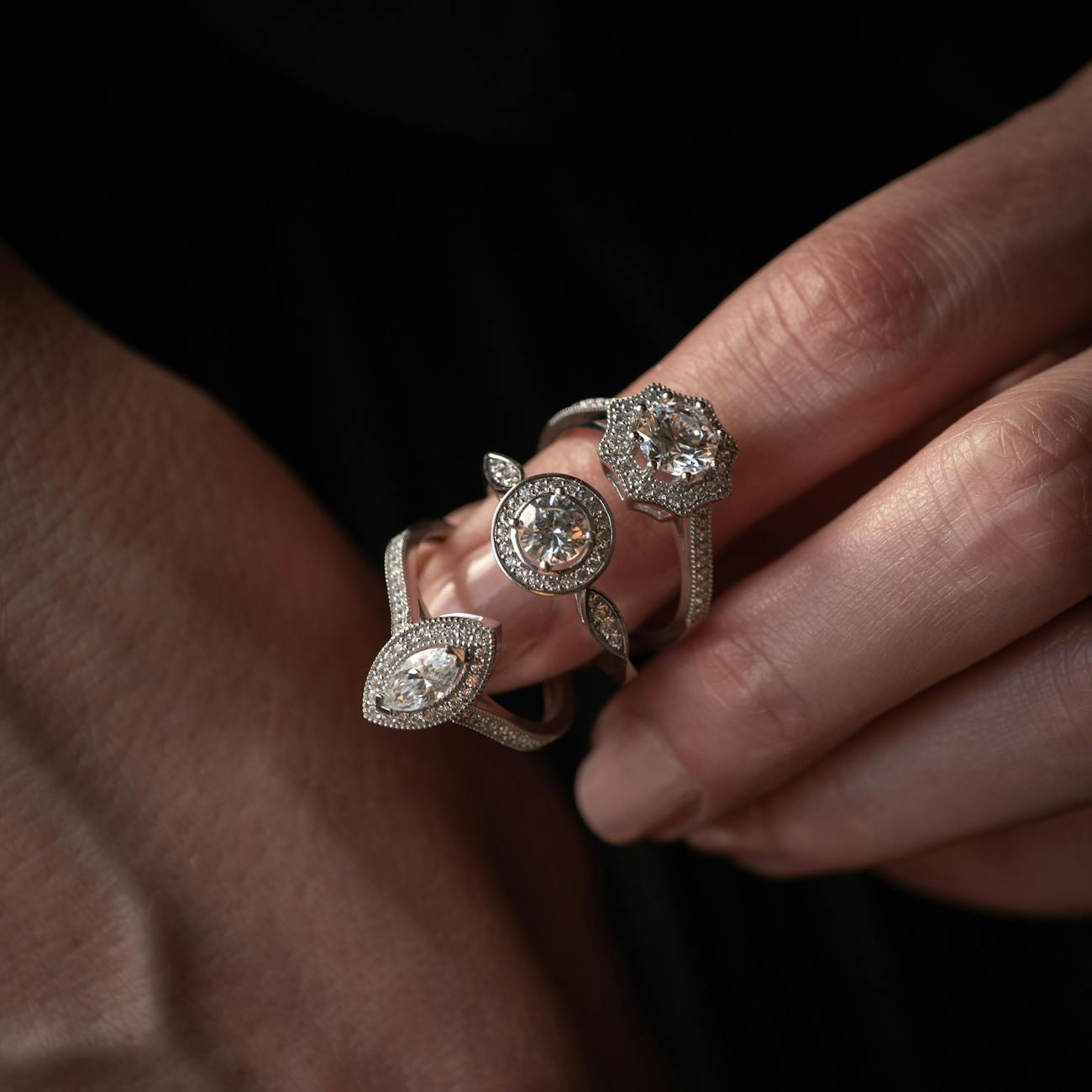
Halo settings, rings of smaller diamonds circling the centre stone, align perfectly with this sensibility. A halo magnifies the centre stone’s perceived size and fills the empty space around the band ornately without feeling clunky. Buyers wanting maximum presence without jumping to two-plus carats often choose a halo as the practical answer.
The double-halo pushes further. Two concentric rings of accent stones photograph beautifully (perhaps too beautifully). It’s striking, yet on smaller hands it can feel dominant. Try one on before committing.
4. Three-Stone Rings and Toi et Moi Styles
Three-stone rings carry symbolic weight (past, present, future), but today’s resurgence comes down to looks more than sentiment.
The contemporary take usually pairs a round or oval centre with two differently shaped side stones. A pear-shaped stone on each side of an oval centre ranks among the most desired combinations. The visual tension between the curve of the oval and the points of the pears gives what a matched trio wouldn’t. Lab-grown diamonds make this achievable since sourcing three high-colour, high-clarity stones costs considerably less than hunting for mined equivalents.
The toi et moi design sits nearby. Two stones inhabit one setting, angled slightly as they sit side by side. The French name means “you and me”, it goes back to Napoleon’s 1796 proposal to Josephine. Celebrity ring unveilings in 2022 and 2023 spiked its popularity, and it’s stayed strong since.
Both approaches work because design carries the story. Stones function as structure, not mere ornament.
5. Sculptural and Bezel-Set Designs
Sculptural rings treat metal as a design protagonist rather than a passive frame. The band wraps, tapers, or curves in ways that match the stone’s importance.
Bezel settings, metal rims encircling the stone’s edge, shifted from rare to top-five in just two years. They’re clean-lined and contemporary; they shield the diamond better than prongs; and they suit people whose hands stay active. A full yellow gold bezel holding an oval or round brilliant lab-grown diamond is probably the most requested version right now.
Tension settings and bypass styles belong here, too. A tension setting holds the stone between two band ends using pressure alone; no prongs, no bezel. Visually, it’s striking; the diamond appears suspended. Bypass rings wrap or cross around the centre stone, introducing asymmetry and movement.
These designs attract buyers, viewing the ring as a personal expression over convention. Someone asking for something “not like other engagement rings”? A sculptural or bezel-set piece almost always lands.
Photo by Zulfugar Karimov
Conclusion
Today’s most popular lab-grown diamond ring styles range from solitaire understatement to bezel and tension ring drama. Round brilliants lead sales still; east-west emerald cuts, vintage halos, toi et moi settings, and modern bezels are all contending hard. What’s right depends on the wearer’s lifestyle and taste, not which style is topping the charts that year. Choose the shape first; let the setting follow from there.
What Are the Most Popular Lab-Grown Diamond Ring Styles Today?
Lab-grown diamonds have shed their “budget alternative” reputation. They’re genuine diamonds, created in controlled labs rather than extracted from the earth, and they’re chemically and optically indistinguishable from mined stones. What once felt like a niche move a few years back has become central to how most couples shop for engagement rings today.
So what’s trending right now? Solitaires still dominate, true, but vintage-inspired cuts and sculptural settings have caught up surprisingly fast. Here’s what you’re seeing most often.
It remains the most popular lab-grown diamond ring style by a considerable margin. One stone. One setting. Nothing else vying for visual weight. There’s a reason: solitaires don’t date, they pair with virtually every wedding band, and they let the diamond’s light performance do all the talking.
Round brilliants dominate here. A well-cut one-carat round gives you more sparkle per dollar than almost any other shape, and lab-grown diamonds let you bump up colour and clarity grades without stretching your budget the way mined stones would. Most buyers choosing round aren’t settling. They’re upgrading.
The pear-shaped solitaire has gained real traction, though. That elongated look stretches the finger, and the soft point brings personality in a way a round brilliant can’t match. LOHR Jewellery’s Vestry design shows how a pear solitaire can feel both classical and distinctly contemporary.
2. East-West Settings Are Having a Moment
Rotating the stone 90 degrees, so it sits horizontally instead of pointing upward, creates an east-west setting. It’s a subtle move; the impact isn’t.
Right now, the east-west emerald cut is what people ask for most. Emerald cuts feature a long rectangular top and step-cut facets that bounce light like a hall of mirrors rather than the intense sparkle of brilliant cuts. Set sideways, the stone reads as architectural and genuinely unexpected. That’s exactly what appeals to style-conscious buyers. LOHR’s Perry design illustrates how polished this approach can look.
Ovals set horizontally rank close behind. An oval brilliant keeps its brightness while gaining the modern edge of a sideways orientation. Both sit flatter against the hand compared to vertically set elongated stones, which matters for people wearing rings through everyday life.
Buyers drawn to east-west designs want something unmistakably an engagement ring, just not the conventional version.
3. Vintage-Inspired Cuts and Settings
Rings pulling from early 20th-century aesthetics bring Art Deco angles, milgrain detailing, and filigree work into modern designs. This style appeals to people wanting a ring with built-in character, not just a pretty stone.
Old European cuts and cushion cuts are the stones these designs call for. An old European cut has a smaller table, higher crown, and larger culet than today’s round brilliant. The result? A softer, candlelit glow instead of sharp flashes. Specialist lab-grown growers now offer old European cuts, and demand’s been climbing steadily since 2024.
Halo settings, rings of smaller diamonds circling the centre stone, align perfectly with this sensibility. A halo magnifies the centre stone’s perceived size and fills the empty space around the band ornately without feeling clunky. Buyers wanting maximum presence without jumping to two-plus carats often choose a halo as the practical answer.
The double-halo pushes further. Two concentric rings of accent stones photograph beautifully (perhaps too beautifully). It’s striking, yet on smaller hands it can feel dominant. Try one on before committing.
4. Three-Stone Rings and Toi et Moi Styles
Three-stone rings carry symbolic weight (past, present, future), but today’s resurgence comes down to looks more than sentiment.
The contemporary take usually pairs a round or oval centre with two differently shaped side stones. A pear-shaped stone on each side of an oval centre ranks among the most desired combinations. The visual tension between the curve of the oval and the points of the pears gives what a matched trio wouldn’t. Lab-grown diamonds make this achievable since sourcing three high-colour, high-clarity stones costs considerably less than hunting for mined equivalents.
The toi et moi design sits nearby. Two stones inhabit one setting, angled slightly as they sit side by side. The French name means “you and me”, it goes back to Napoleon’s 1796 proposal to Josephine. Celebrity ring unveilings in 2022 and 2023 spiked its popularity, and it’s stayed strong since.
Both approaches work because design carries the story. Stones function as structure, not mere ornament.
5. Sculptural and Bezel-Set Designs
Sculptural rings treat metal as a design protagonist rather than a passive frame. The band wraps, tapers, or curves in ways that match the stone’s importance.
Bezel settings, metal rims encircling the stone’s edge, shifted from rare to top-five in just two years. They’re clean-lined and contemporary; they shield the diamond better than prongs; and they suit people whose hands stay active. A full yellow gold bezel holding an oval or round brilliant lab-grown diamond is probably the most requested version right now.
Tension settings and bypass styles belong here, too. A tension setting holds the stone between two band ends using pressure alone; no prongs, no bezel. Visually, it’s striking; the diamond appears suspended. Bypass rings wrap or cross around the centre stone, introducing asymmetry and movement.
These designs attract buyers, viewing the ring as a personal expression over convention. Someone asking for something “not like other engagement rings”? A sculptural or bezel-set piece almost always lands.
Conclusion
Today’s most popular lab-grown diamond ring styles range from solitaire understatement to bezel and tension ring drama. Round brilliants lead sales still; east-west emerald cuts, vintage halos, toi et moi settings, and modern bezels are all contending hard. What’s right depends on the wearer’s lifestyle and taste, not which style is topping the charts that year. Choose the shape first; let the setting follow from there.


Lab-grown diamonds have shed their “budget alternative” reputation. They’re genuine diamonds, created in controlled labs rather than extracted from the earth, and they’re chemically and optically indistinguishable from mined stones. What once felt like a niche move a few years back has become central to how most couples shop for engagement rings today.
So what’s trending right now? Solitaires still dominate, true, but vintage-inspired cuts and sculptural settings have caught up surprisingly fast. Here’s what you’re seeing most often.
1. The Solitaire Still Holds the Top Spot
Looking to buy lab-grown diamond engagement rings but not sure where to begin? A solitaire answers that question most of the time.
It remains the most popular lab-grown diamond ring style by a considerable margin. One stone. One setting. Nothing else vying for visual weight. There’s a reason: solitaires don’t date, they pair with virtually every wedding band, and they let the diamond’s light performance do all the talking.
Round brilliants dominate here. A well-cut one-carat round gives you more sparkle per dollar than almost any other shape, and lab-grown diamonds let you bump up colour and clarity grades without stretching your budget the way mined stones would. Most buyers choosing round aren’t settling. They’re upgrading.
The pear-shaped solitaire has gained real traction, though. That elongated look stretches the finger, and the soft point brings personality in a way a round brilliant can’t match. LOHR Jewellery’s Vestry design shows how a pear solitaire can feel both classical and distinctly contemporary.
2. East-West Settings Are Having a Moment
Rotating the stone 90 degrees, so it sits horizontally instead of pointing upward, creates an east-west setting. It’s a subtle move; the impact isn’t.
Right now, the east-west emerald cut is what people ask for most. Emerald cuts feature a long rectangular top and step-cut facets that bounce light like a hall of mirrors rather than the intense sparkle of brilliant cuts. Set sideways, the stone reads as architectural and genuinely unexpected. That’s exactly what appeals to style-conscious buyers. LOHR’s Perry design illustrates how polished this approach can look.
Ovals set horizontally rank close behind. An oval brilliant keeps its brightness while gaining the modern edge of a sideways orientation. Both sit flatter against the hand compared to vertically set elongated stones, which matters for people wearing rings through everyday life.
Buyers drawn to east-west designs want something unmistakably an engagement ring, just not the conventional version.
3. Vintage-Inspired Cuts and Settings
Rings pulling from early 20th-century aesthetics bring Art Deco angles, milgrain detailing, and filigree work into modern designs. This style appeals to people wanting a ring with built-in character, not just a pretty stone.
Old European cuts and cushion cuts are the stones these designs call for. An old European cut has a smaller table, higher crown, and larger culet than today’s round brilliant. The result? A softer, candlelit glow instead of sharp flashes. Specialist lab-grown growers now offer old European cuts, and demand’s been climbing steadily since 2024.
Halo settings, rings of smaller diamonds circling the centre stone, align perfectly with this sensibility. A halo magnifies the centre stone’s perceived size and fills the empty space around the band ornately without feeling clunky. Buyers wanting maximum presence without jumping to two-plus carats often choose a halo as the practical answer.
The double-halo pushes further. Two concentric rings of accent stones photograph beautifully (perhaps too beautifully). It’s striking, yet on smaller hands it can feel dominant. Try one on before committing.
4. Three-Stone Rings and Toi et Moi Styles
Three-stone rings carry symbolic weight (past, present, future), but today’s resurgence comes down to looks more than sentiment.
The contemporary take usually pairs a round or oval centre with two differently shaped side stones. A pear-shaped stone on each side of an oval centre ranks among the most desired combinations. The visual tension between the curve of the oval and the points of the pears gives what a matched trio wouldn’t. Lab-grown diamonds make this achievable since sourcing three high-colour, high-clarity stones costs considerably less than hunting for mined equivalents.
The toi et moi design sits nearby. Two stones inhabit one setting, angled slightly as they sit side by side. The French name means “you and me”, it goes back to Napoleon’s 1796 proposal to Josephine. Celebrity ring unveilings in 2022 and 2023 spiked its popularity, and it’s stayed strong since.
Both approaches work because design carries the story. Stones function as structure, not mere ornament.
5. Sculptural and Bezel-Set Designs
Sculptural rings treat metal as a design protagonist rather than a passive frame. The band wraps, tapers, or curves in ways that match the stone’s importance.
Bezel settings, metal rims encircling the stone’s edge, shifted from rare to top-five in just two years. They’re clean-lined and contemporary; they shield the diamond better than prongs; and they suit people whose hands stay active. A full yellow gold bezel holding an oval or round brilliant lab-grown diamond is probably the most requested version right now.
Tension settings and bypass styles belong here, too. A tension setting holds the stone between two band ends using pressure alone; no prongs, no bezel. Visually, it’s striking; the diamond appears suspended. Bypass rings wrap or cross around the centre stone, introducing asymmetry and movement.
These designs attract buyers, viewing the ring as a personal expression over convention. Someone asking for something “not like other engagement rings”? A sculptural or bezel-set piece almost always lands.
Conclusion
Today’s most popular lab-grown diamond ring styles range from solitaire understatement to bezel and tension ring drama. Round brilliants lead sales still; east-west emerald cuts, vintage halos, toi et moi settings, and modern bezels are all contending hard. What’s right depends on the wearer’s lifestyle and taste, not which style is topping the charts that year. Choose the shape first; let the setting follow from there.
What Are the Most Popular Lab-Grown Diamond Ring Styles Today?
Lab-grown diamonds have shed their “budget alternative” reputation. They’re genuine diamonds, created in controlled labs rather than extracted from the earth, and they’re chemically and optically indistinguishable from mined stones. What once felt like a niche move a few years back has become central to how most couples shop for engagement rings today.
So what’s trending right now? Solitaires still dominate, true, but vintage-inspired cuts and sculptural settings have caught up surprisingly fast. Here’s what you’re seeing most often.
1. The Solitaire Still Holds the Top Spot
Looking to buy lab-grown diamond engagement rings but not sure where to begin? A solitaire answers that question most of the time.
It remains the most popular lab-grown diamond ring style by a considerable margin. One stone. One setting. Nothing else vying for visual weight. There’s a reason: solitaires don’t date, they pair with virtually every wedding band, and they let the diamond’s light performance do all the talking.
Round brilliants dominate here. A well-cut one-carat round gives you more sparkle per dollar than almost any other shape, and lab-grown diamonds let you bump up colour and clarity grades without stretching your budget the way mined stones would. Most buyers choosing round aren’t settling. They’re upgrading.
The pear-shaped solitaire has gained real traction, though. That elongated look stretches the finger, and the soft point brings personality in a way a round brilliant can’t match. LOHR Jewellery’s Vestry design shows how a pear solitaire can feel both classical and distinctly contemporary.
2. East-West Settings Are Having a Moment
Rotating the stone 90 degrees, so it sits horizontally instead of pointing upward, creates an east-west setting. It’s a subtle move; the impact isn’t.
Right now, the east-west emerald cut is what people ask for most. Emerald cuts feature a long rectangular top and step-cut facets that bounce light like a hall of mirrors rather than the intense sparkle of brilliant cuts. Set sideways, the stone reads as architectural and genuinely unexpected. That’s exactly what appeals to style-conscious buyers. LOHR’s Perry design illustrates how polished this approach can look.
Ovals set horizontally rank close behind. An oval brilliant keeps its brightness while gaining the modern edge of a sideways orientation. Both sit flatter against the hand compared to vertically set elongated stones, which matters for people wearing rings through everyday life.
Buyers drawn to east-west designs want something unmistakably an engagement ring, just not the conventional version.
3. Vintage-Inspired Cuts and Settings
Rings pulling from early 20th-century aesthetics bring Art Deco angles, milgrain detailing, and filigree work into modern designs. This style appeals to people wanting a ring with built-in character, not just a pretty stone.
Old European cuts and cushion cuts are the stones these designs call for. An old European cut has a smaller table, higher crown, and larger culet than today’s round brilliant. The result? A softer, candlelit glow instead of sharp flashes. Specialist lab-grown growers now offer old European cuts, and demand’s been climbing steadily since 2024.
Halo settings, rings of smaller diamonds circling the centre stone, align perfectly with this sensibility. A halo magnifies the centre stone’s perceived size and fills the empty space around the band ornately without feeling clunky. Buyers wanting maximum presence without jumping to two-plus carats often choose a halo as the practical answer.
The double-halo pushes further. Two concentric rings of accent stones photograph beautifully (perhaps too beautifully). It’s striking, yet on smaller hands it can feel dominant. Try one on before committing.
4. Three-Stone Rings and Toi et Moi Styles
Three-stone rings carry symbolic weight (past, present, future), but today’s resurgence comes down to looks more than sentiment.
The contemporary take usually pairs a round or oval centre with two differently shaped side stones. A pear-shaped stone on each side of an oval centre ranks among the most desired combinations. The visual tension between the curve of the oval and the points of the pears gives what a matched trio wouldn’t. Lab-grown diamonds make this achievable since sourcing three high-colour, high-clarity stones costs considerably less than hunting for mined equivalents.
The toi et moi design sits nearby. Two stones inhabit one setting, angled slightly as they sit side by side. The French name means “you and me”, it goes back to Napoleon’s 1796 proposal to Josephine. Celebrity ring unveilings in 2022 and 2023 spiked its popularity, and it’s stayed strong since.
Both approaches work because design carries the story. Stones function as structure, not mere ornament.
5. Sculptural and Bezel-Set Designs
Sculptural rings treat metal as a design protagonist rather than a passive frame. The band wraps, tapers, or curves in ways that match the stone’s importance.
Bezel settings, metal rims encircling the stone’s edge, shifted from rare to top-five in just two years. They’re clean-lined and contemporary; they shield the diamond better than prongs; and they suit people whose hands stay active. A full yellow gold bezel holding an oval or round brilliant lab-grown diamond is probably the most requested version right now.
Tension settings and bypass styles belong here, too. A tension setting holds the stone between two band ends using pressure alone; no prongs, no bezel. Visually, it’s striking; the diamond appears suspended. Bypass rings wrap or cross around the centre stone, introducing asymmetry and movement.
These designs attract buyers, viewing the ring as a personal expression over convention. Someone asking for something “not like other engagement rings”? A sculptural or bezel-set piece almost always lands.
Conclusion
Today’s most popular lab-grown diamond ring styles range from solitaire understatement to bezel and tension ring drama. Round brilliants lead sales still; east-west emerald cuts, vintage halos, toi et moi settings, and modern bezels are all contending hard. What’s right depends on the wearer’s lifestyle and taste, not which style is topping the charts that year. Choose the shape first; let the setting follow from there.
Share this:
Like this: