Moving somewhere new is one of those decisions that feels romantic right up until you open the kitchen cupboards. New city, better light, maybe a place closer to the markets and little restaurants you moved for. Then you count eleven mugs you can’t part with and a stand mixer that weighs more than your carry-on, and the romance cools a bit.
Here’s the thing nobody tells you: packing a kitchen for a move is the part that decides how the whole thing feels. Get it right and the new place comes together fast. Get it wrong and you’re eating takeout off a paper towel for a week, surrounded by boxes you’re scared to open.
Why the Kitchen Is the Hardest Room to Pack
Every other room is mostly soft things and flat things. Clothes fold. Books stack. The kitchen is different. It’s heavy, it’s fragile, and it’s full of small awkward objects that refuse to sit neatly in a box. Ladles, lids that fit nothing, the baking dish you use twice a year and won’t give up.
And it’s almost always the last room packed and the first one you need working again. You can live out of a suitcase for a week. You can’t live without a way to make coffee and feed yourself.So the kitchen carries more weight than its square footage suggests, which is why it earns a plan instead of a midnight scramble with a roll of tape.
Anyway, a kitchen packs fine once you stop treating it as one enormous task and cut it into smaller ones, starting with the stuff you can get rid of.
Declutter Your Kitchen Before You Pack
The cheapest moving trick there is: own less before the truck shows up. You pay to move everything, in money or in effort, so every duplicate spatula is dead weight. Amove is also one of the few honest chances you get to keep only what you love and leave the rest behind.
Start with what’s easy to let go. Chipped plates. The three travel mugs from conferences you don’t remember attending. Spices that lost their smell two apartments ago. If you love to cook, be honest about the gadgets too, the pasta roller you used once, the second blender, the novelty tins shaped like things you’ll never bake.
The pantry is worth a second look. Unopened, non-perishable food you won’t take with you doesn’t have to go in the bin. A nonprofit called Move For Hunger works with movers across the US and Canada to collect that food on moving day and get it to a local food bank, which is a small, decent thing to do with the cans you’d otherwise waste.
A rough sorting system helps more than you’d expect:
Keep what you use, love, or would rebuy tomorrow
Give away anything that works but you never reach for
Toss what’s broken, expired, or missing its other half
Go room by room and don’t handle the same object twice. Pick it up, decide, move on. You pack faster, and you unpack into a kitchen that feels lighter, which is a good way to start over somewhere new.
How to Pack Kitchen Items in the Right Order
Pack the things you rarely touch first. Serving platters, holiday dishes, the kitchen appliances that live at the back of a cabinet. Leave your everyday plates, a pan, a knife, and your coffee setup for last, because you’ll want them until the final morning and again on the first.
Match the moving box to the job. Small boxes for heavy things like pans and full pantry jars, so nobody wrecks their back on moving day. Bigger boxes for light, bulky stuff. Gather your packing supplies before you start: packing paper, tape, a marker, so you’re not hunting for scissors mid-flow, and label every box on the top and one side with the room and a couple of words about what’s inside. Future you, standing in a hallway surrounded by identical brown boxes, will be grateful.
Keep one box aside as your first-night box. A couple of plates, mugs, a sharp knife, a pan, dish soap, the kettle or coffee maker. Tape it shut, mark it clearly, load it last so it comes off first.
How to Pack Dishes and Glassware Without Breakage
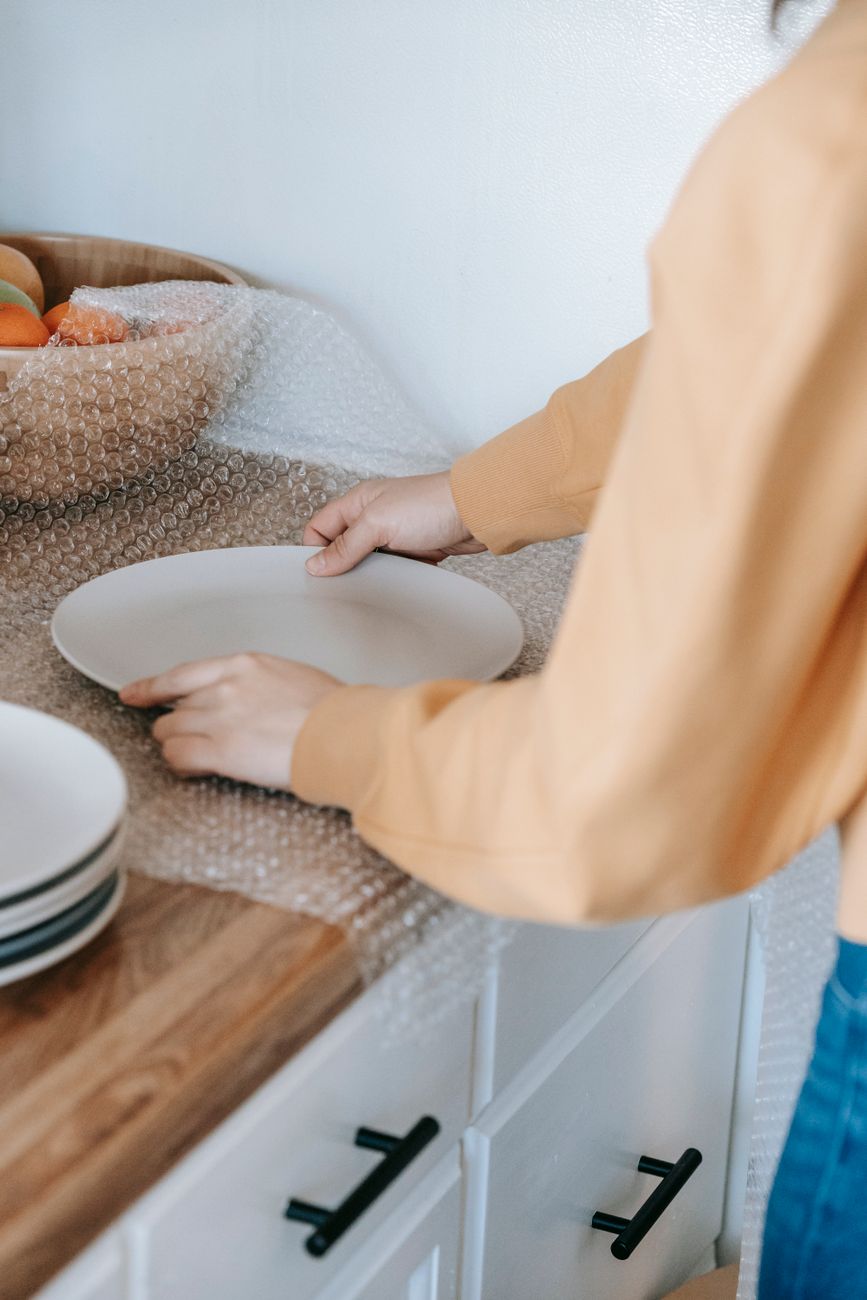
Glassware and dishes are where moves go wrong, so this part earns some patience and a bit more packing material than feels reasonable. Wrap each piece on its own. Stand plates on their edge like records rather than stacking them flat, since a plate on its side takes a bump far better than a tall stack does. Nest cups with paper between them, and give anything with a handle or a stem extra padding right where it’s weakest.
A few things the pros do that are worth copying. They use sturdy small-to-medium boxes for dishes, never oversized ones, because a big box of plates gets too heavy and caves in on itself. They fill every gap with paper so nothing rattles against anything. And they label the fragile kitchen items clearly, top and side, so whoever lifts the box knows to keep it upright. The short version: more paper, smaller boxes, and no fragile box so heavy you wince picking it up.
When Professional Packing Is Worth It
A fragile kitchen is exactly the kind of job that pays to hand to people who do it daily. Specialty cookware, a glassware collection you built over years, inherited china you can’t replace, that’s a lot of risk to carry yourself at the end of an already long week. Experienced packing crews tend to separate cookware, pantry goods, and fragile glassware into appropriate box types so nothing shifts against something it can crack, and they’ll often use double-walled dish packs for the pieces that matter most.
It’s a time thing as much as a safety one. Packing a kitchen well takes hours most people don’t have spare in the days before a move. Bringing in full-service packing solutions means a trained crew boxes up the breakables properly while you handle everything else a move throws at you, and you arrive with far fewer casualties at the bottom of the boxes.
There’s no wrong answer here. Some people find packing weirdly satisfying and want to wrap every plate themselves. Others would rather protect their good dishes and their weekend both. Either way, decide early, not the night before the truck comes.
How to Choose a Moving Company You Can Trust
If you do bring in help, spend twenty minutes on who you’re hiring. A reputable moving company is registered, has a track record you can look up, and gives you a written estimate instead of a vague number over the phone. Ask how they handle fragile kitchen items specifically. The good ones will have a real answer.
If your move crosses state lines, the federal government runs a consumer site called Protect Your Move where you can confirm an interstate mover is registered and look up any complaints against it. It covers state-to-state moves rather than local ones, so it won’t help much for a cross-town hop, but for a long-distance move it’s five minutes well spent. It’s not the most exciting part of planning a move, but it’s the difference between a smooth day and a story you tell for years for the wrong reasons.
Making the New Place Feel Like Home
Everyone talks about the packing. Nobody talks much about the other end, which is the part that stays with you. The first night in a new place is quiet in a strange way. Boxes everywhere, nothing where it should be, the particular echo of a home that isn’t yours yet.
But that feeling doesn’t last, and the kitchen is usually where it starts to lift. So make the first thing you unpack the basics: coffee in the morning, a real meal that first evening, even something small at the counter while the rest of the boxes wait. That’s the moment a new address starts turning into a home. Everything else can happen tomorrow.


Moving somewhere new is one of those decisions that feels romantic right up until you open the kitchen cupboards. New city, better light, maybe a place closer to the markets and little restaurants you moved for. Then you count eleven mugs you can’t part with and a stand mixer that weighs more than your carry-on, and the romance cools a bit.
Here’s the thing nobody tells you: packing a kitchen for a move is the part that decides how the whole thing feels. Get it right and the new place comes together fast. Get it wrong and you’re eating takeout off a paper towel for a week, surrounded by boxes you’re scared to open.
Why the Kitchen Is the Hardest Room to Pack
Every other room is mostly soft things and flat things. Clothes fold. Books stack. The kitchen is different. It’s heavy, it’s fragile, and it’s full of small awkward objects that refuse to sit neatly in a box. Ladles, lids that fit nothing, the baking dish you use twice a year and won’t give up.
And it’s almost always the last room packed and the first one you need working again. You can live out of a suitcase for a week. You can’t live without a way to make coffee and feed yourself. So the kitchen carries more weight than its square footage suggests, which is why it earns a plan instead of a midnight scramble with a roll of tape.
Anyway, a kitchen packs fine once you stop treating it as one enormous task and cut it into smaller ones, starting with the stuff you can get rid of.
Declutter Your Kitchen Before You Pack
The cheapest moving trick there is: own less before the truck shows up. You pay to move everything, in money or in effort, so every duplicate spatula is dead weight. A move is also one of the few honest chances you get to keep only what you love and leave the rest behind.
Start with what’s easy to let go. Chipped plates. The three travel mugs from conferences you don’t remember attending. Spices that lost their smell two apartments ago. If you love to cook, be honest about the gadgets too, the pasta roller you used once, the second blender, the novelty tins shaped like things you’ll never bake.
The pantry is worth a second look. Unopened, non-perishable food you won’t take with you doesn’t have to go in the bin. A nonprofit called Move For Hunger works with movers across the US and Canada to collect that food on moving day and get it to a local food bank, which is a small, decent thing to do with the cans you’d otherwise waste.
A rough sorting system helps more than you’d expect:
Go room by room and don’t handle the same object twice. Pick it up, decide, move on. You pack faster, and you unpack into a kitchen that feels lighter, which is a good way to start over somewhere new.
How to Pack Kitchen Items in the Right Order
Pack the things you rarely touch first. Serving platters, holiday dishes, the kitchen appliances that live at the back of a cabinet. Leave your everyday plates, a pan, a knife, and your coffee setup for last, because you’ll want them until the final morning and again on the first.
Match the moving box to the job. Small boxes for heavy things like pans and full pantry jars, so nobody wrecks their back on moving day. Bigger boxes for light, bulky stuff. Gather your packing supplies before you start: packing paper, tape, a marker, so you’re not hunting for scissors mid-flow, and label every box on the top and one side with the room and a couple of words about what’s inside. Future you, standing in a hallway surrounded by identical brown boxes, will be grateful.
Keep one box aside as your first-night box. A couple of plates, mugs, a sharp knife, a pan, dish soap, the kettle or coffee maker. Tape it shut, mark it clearly, load it last so it comes off first.
How to Pack Dishes and Glassware Without Breakage
Glassware and dishes are where moves go wrong, so this part earns some patience and a bit more packing material than feels reasonable. Wrap each piece on its own. Stand plates on their edge like records rather than stacking them flat, since a plate on its side takes a bump far better than a tall stack does. Nest cups with paper between them, and give anything with a handle or a stem extra padding right where it’s weakest.
A few things the pros do that are worth copying. They use sturdy small-to-medium boxes for dishes, never oversized ones, because a big box of plates gets too heavy and caves in on itself. They fill every gap with paper so nothing rattles against anything. And they label the fragile kitchen items clearly, top and side, so whoever lifts the box knows to keep it upright. The short version: more paper, smaller boxes, and no fragile box so heavy you wince picking it up.
When Professional Packing Is Worth It
A fragile kitchen is exactly the kind of job that pays to hand to people who do it daily. Specialty cookware, a glassware collection you built over years, inherited china you can’t replace, that’s a lot of risk to carry yourself at the end of an already long week. Experienced packing crews tend to separate cookware, pantry goods, and fragile glassware into appropriate box types so nothing shifts against something it can crack, and they’ll often use double-walled dish packs for the pieces that matter most.
It’s a time thing as much as a safety one. Packing a kitchen well takes hours most people don’t have spare in the days before a move. Bringing in full-service packing solutions means a trained crew boxes up the breakables properly while you handle everything else a move throws at you, and you arrive with far fewer casualties at the bottom of the boxes.
There’s no wrong answer here. Some people find packing weirdly satisfying and want to wrap every plate themselves. Others would rather protect their good dishes and their weekend both. Either way, decide early, not the night before the truck comes.
How to Choose a Moving Company You Can Trust
If you do bring in help, spend twenty minutes on who you’re hiring. A reputable moving company is registered, has a track record you can look up, and gives you a written estimate instead of a vague number over the phone. Ask how they handle fragile kitchen items specifically. The good ones will have a real answer.
If your move crosses state lines, the federal government runs a consumer site called Protect Your Move where you can confirm an interstate mover is registered and look up any complaints against it. It covers state-to-state moves rather than local ones, so it won’t help much for a cross-town hop, but for a long-distance move it’s five minutes well spent. It’s not the most exciting part of planning a move, but it’s the difference between a smooth day and a story you tell for years for the wrong reasons.
Making the New Place Feel Like Home
Everyone talks about the packing. Nobody talks much about the other end, which is the part that stays with you. The first night in a new place is quiet in a strange way. Boxes everywhere, nothing where it should be, the particular echo of a home that isn’t yours yet.
But that feeling doesn’t last, and the kitchen is usually where it starts to lift. So make the first thing you unpack the basics: coffee in the morning, a real meal that first evening, even something small at the counter while the rest of the boxes wait. That’s the moment a new address starts turning into a home. Everything else can happen tomorrow.
Share this:
Like this: