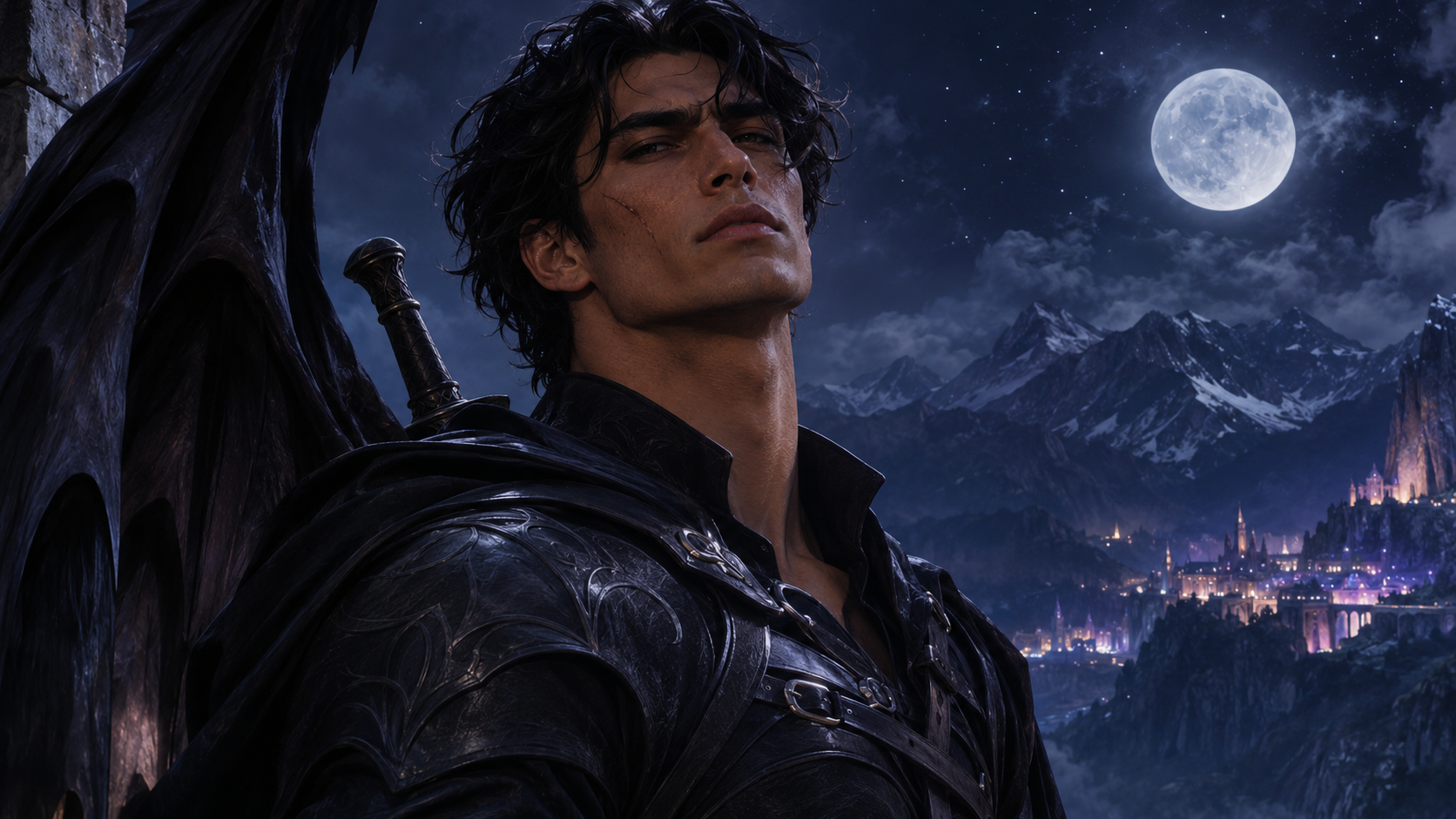
He’s mysterious, devastatingly handsome and has approximately 500 years of unresolved emotional baggage. Naturally, half of BookTok wants to marry him. But after the chaos of A Court of Splintered Harmony, perhaps it’s time we asked why women are so attracted to men who desperately need therapy.
Spoiler warning: This article contains major spoilers for A Court of Thorns and Roses, including A Court of Splintered Harmony.
There is a particular kind of man who should come with a warning label. He’s quiet, intense, emotionally complicated and looks like he hasn’t had a proper night’s sleep since 1847. He rarely discusses his feelings, has an unfortunate history of falling for unavailable women and seems to believe that staring moodily into the distance constitutes communication. In the real world, your friends would stage an intervention. In Sarah J. Maas’s A Court of Thorns and Roses universe, he’s called Azriel, and women are absolutely losing their minds over him. If you’ve been following the increasingly complicated romantic situation in our guide to Elain Archeron, Lucien and Azriel, you’ll know the Shadowsinger has quite a lot to answer for.
Because here’s the thing about Azriel. He’s gorgeous, powerful and has enormous wings, mysterious shadows and the sort of devastatingly tragic backstory that makes women immediately want to wrap him in a blanket and explain that he’s worthy of love. He is also, by almost every reasonable measure, an absolute romantic disaster. After centuries of unrequited longing, questionable romantic decisions and what appears to be a spectacular inability to communicate, he should probably be concentrating on his personal development rather than pursuing another complicated relationship. Instead, BookTok has collectively decided he’s husband material, and the argument over who deserves him has practically become an international sporting event.
Perhaps it’s time we had a serious conversation about ourselves, preferably before we all fall in love with another emotionally unavailable man who owns too many weapons and communicates exclusively through meaningful silences.
Azriel Is Basically Every Man You’ve Ever Tried to Fix, Except He Has Wings
Let’s examine the evidence. Azriel is more than 500 years old. Five centuries. He’s had longer to work through his emotional issues than most civilisations have existed, yet somehow he’s still approaching relationships with the confidence of a 22-year-old who has just discovered that vulnerability is frightening. He’s fiercely loyal, deeply sensitive beneath his intimidating exterior and capable of extraordinary acts of courage, but put him in a room with a woman he fancies and the whole thing becomes rather less impressive.
For hundreds of years, he harboured feelings for Mor, a woman who did not return his romantic interest. Not for a few months, not for a particularly difficult summer, but for centuries. At some point, surely somebody should have taken him aside and suggested moving on. Cassian could have organised a dating profile, Rhysand could have selected some photographs and Feyre could have gently explained that spending several hundred years yearning for the same unavailable woman might not be the healthiest romantic strategy.
And then along came Elain. Beautiful, gentle, complicated Elain, who happens to have a magical mating bond with another man. Naturally, Azriel was interested. Because why develop feelings for somebody who is straightforwardly available when you could become involved in a situation capable of destabilising diplomatic relations across multiple territories? It’s the fae equivalent of falling for your friend’s married colleague, only with substantially greater consequences and the potential for an actual duel to the death.
Now there’s Gwyn, whose connection with Azriel has become one of the biggest romantic debates in the fandom. At this point, his love life requires a spreadsheet, a qualified mediator and possibly an international peacekeeping force. Yet women remain obsessed, and perhaps that’s because Azriel represents something familiar: the deeply complicated man whose emotional walls appear so high that being the one to break through them would feel like the ultimate romantic achievement.
A Court of Splintered Harmony Has Made the Situation Considerably Worse
If you thought Azriel’s romantic life was complicated before A Court of Splintered Harmony, Sarah J. Maas has some unfortunate news for you. It’s now a complete shambles, and the sort of thing that would have a friendship group discussing the same incident over approximately seventeen consecutive dinners.
In the sixth ACOTAR book, Azriel and Elain are secretly pursuing their attraction despite Rhysand’s earlier warning that their relationship could have disastrous political consequences. Their connection is passionate, intense and apparently conducted without anyone giving sufficient consideration to what might happen if Lucien, Elain’s Cauldron-chosen mate, happened to discover what was going on. This is an especially questionable oversight considering Azriel is supposed to be one of the greatest spies in Prythian. You’d think he’d have considered the possibility of someone opening a bedroom door.
And then, inevitably, Lucien does exactly that. He discovers Elain and Azriel together, and to describe the resulting confrontation as awkward would be like describing the destruction of Pompeii as a minor inconvenience. Everyone becomes involved, Lucien is furious, Rhysand is furious, Azriel finds himself in disgrace and Elain is left dealing with the fallout. Lucien withdraws his support from the Night Court, threatening alliances that are already under considerable strain, while Elain eventually leaves with Mor on a diplomatic mission to Vallahan. It’s like a particularly disastrous episode of Love Island, except the contestants have centuries-old grudges, magical powers and the possibility of starting a war.
And somehow, despite all this, Azriel remains one of the most desirable men in the series. We have to admire the branding. In the real world, a man who’d managed to create this much chaos through his inability to make sensible romantic decisions would probably be described as a walking red flag. Give him a tragic childhood, a collection of magical shadows and an impressive wingspan, however, and suddenly women are writing passionate essays about why he deserves to be loved.
The Most Emotionally Intelligent Characters in This Relationship Might Be the Shadows
One of the most fascinating developments in A Court of Splintered Harmony involves Azriel’s shadows, those mysterious, sentient extensions of himself that gather information, protect him and occasionally appear to possess considerably better judgement than their owner.
Around Elain, his shadows retreat. Azriel appears to enjoy the quiet their absence brings, but there’s an unfortunate practical consequence: without them, he doesn’t notice Lucien approaching. An actual master spy, defeated by his own romantic preoccupation. The man can infiltrate enemy strongholds, uncover dangerous secrets and presumably detect an assassin from several streets away, but cannot manage to avoid being caught in a compromising position with somebody else’s mate. Not ideal.
Around Gwyn, however, his shadows behave very differently. They seem drawn towards her, responding to her presence and singing, which has understandably sent the fandom into a complete tailspin. Gwyn’s own relationship with music, her mysterious abilities and her growing connection to the Valkyries have only added fuel to the speculation. Readers have produced theories, diagrams and extraordinarily detailed analyses of what this could mean for Azriel’s romantic future. At this point, the shadows have probably received more psychological scrutiny than some actual people.
Of course, we shouldn’t automatically assume that a collection of unusually enthusiastic shadows confirms a future mating bond. But it’s hard not to find the situation deliciously entertaining. Imagine dating a man and discovering that his supernatural intelligence network seems to prefer somebody else. It’s the magical equivalent of bringing a boyfriend home and having your dog immediately decide your best friend would be a better match.
For readers who want to understand Gwyn beyond the romantic speculation, our guide to Nesta, Gwyn, Emerie and the ACOTAR Valkyries explores why her story is so much bigger than which man she might eventually love. And perhaps that’s precisely why she deserves someone capable of sorting out his feelings before dragging her into the emotional chaos.
Why Do Women Find Emotionally Unavailable Men So Attractive?
Here’s where Azriel stops being merely entertaining and starts becoming a little too relatable. Because almost every woman has encountered some version of this man. He’s charming but distant, affectionate but inconsistent, intensely interested one moment and apparently communicating with another dimension the next. He has a complicated childhood, a difficult relationship history or an unfortunate experience with someone who broke his heart, and naturally, you become convinced that underneath all that emotional armour is an extraordinary man waiting for the right woman to make him feel safe.
You, obviously. You’re different. You understand him in a way nobody else ever has. You can see the vulnerability beneath his carefully constructed indifference, and you’re absolutely certain that with enough patience, affection and perhaps a little encouragement, he’ll finally open up. Never mind that he’s mostly just mentioned his difficult relationship with his parents and said he doesn’t really like talking about feelings. The potential is enormous, and somehow you’ve begun treating his emotional development like an exciting home renovation project.
It’s a romantic fantasy built around the possibility that a difficult man might become wonderful if only somebody loved him properly. And while the attraction can come from several places, including mystery, chemistry and the excitement of earning someone’s trust, there’s a less flattering possibility worth considering. Sometimes the appeal isn’t simply the man himself, but the validation of becoming the person who finally changes him. Being chosen by someone who appears incapable of choosing anyone can feel like an extraordinary achievement, even when the actual relationship is making you miserable.
Of course, not every quiet or emotionally reserved person is unavailable. Some people simply take longer to trust, and there is nothing inherently wrong with being private. But there’s a substantial difference between a thoughtful man who needs time to open up and someone who repeatedly leaves you guessing about where you stand. One is a personality trait. The other can become a very disappointing six-month situationship.
We’ve Confused Emotional Unavailability With Depth
At some point, popular culture decided that men who don’t talk about their feelings must have particularly interesting feelings. It’s a strange assumption, really. A man sits silently in the corner, looking troubled, and suddenly we’re convinced he possesses an extraordinary inner world. Perhaps he does. Or perhaps he’s wondering whether he remembered to put petrol in the car. Either way, we’ve developed a remarkable talent for interpreting silence as evidence of emotional complexity.
Fiction makes brooding men irresistible because readers are given something their romantic partners often aren’t: access to their thoughts. We understand the trauma, the longing and the insecurity. We know about the childhood experiences, the self-loathing and the affection they’re too frightened to express. In Azriel’s case, we know he’s survived terrible things and that his apparent emotional distance conceals a deep need for connection. His suffering makes him sympathetic, while his loyalty and capacity for tenderness suggest that there’s an extraordinary romantic partner somewhere beneath all those layers of pain.
But here’s the problem with translating that fantasy into real life. When you’re dating an emotionally unavailable man, you don’t have access to the author’s notes. You cannot turn to Chapter 17 and discover that he actually adores you but has been struggling with feelings of inadequacy. You just have a man who hasn’t replied since Tuesday, and sometimes that isn’t a fascinating expression of unresolved trauma. Sometimes he’s simply not making you a priority.
This is why fictional men like Azriel can be so dangerous to our romantic expectations, even when we understand perfectly well that they’re fictional. We’re accustomed to seeing the explanation behind difficult behaviour and knowing that the emotional payoff is probably coming. Real life offers no such guarantee, and the man who seems mysterious today might turn out to be exactly as emotionally exhausting as he appears.
Women Are Not Rehabilitation Centres for Emotionally Complicated Men
There is a deeply seductive idea running through romantic fiction: the heroine is so special, understanding and uniquely suited to the hero that she succeeds where everyone else has failed. He has never loved like this before, never trusted anyone and never imagined a future with another person until her. It’s a wonderful fantasy, particularly when the man in question is impossibly handsome and the eventual emotional breakthrough comes with an appropriately dramatic declaration of love.
But in actual relationships, this can become a rather dangerous expectation. Women are not rehabilitation centres for emotionally complicated men, and we’re certainly not required to spend two years gently encouraging a grown adult to develop the ability to communicate. Love can help people heal, but it cannot do the emotional work on their behalf. A difficult childhood may explain why someone struggles with intimacy, but it doesn’t make every subsequent romantic disaster the responsibility of whichever woman happens to love him.
This is where Azriel becomes such an interesting character. His trauma deserves compassion, and his history helps us understand the man he has become. But it doesn’t automatically excuse his decisions, nor does it make the women around him responsible for fixing him. Elain shouldn’t have to become his salvation, Gwyn shouldn’t have to make him whole, and Mor certainly shouldn’t have been expected to manage centuries of unrequited feelings because Azriel struggled to let go.
Somebody needs to remind this man that emotional growth is a personal responsibility. Preferably Cassian, who could perhaps organise a quiet afternoon, a few beers and a long overdue conversation about why falling for unavailable women is not, in fact, a personality.
But Let’s Not Pretend Elain and Gwyn Are Just Competing for the Same Man
One of the more entertaining aspects of the Azriel debate is how quickly readers have begun treating the women involved as competing applicants for the position of Mrs Shadowsinger. Team Elain, Team Gwyn, and entire online communities passionately committed to proving that one woman is better suited to a fictional man whose relationship history is, at best, concerning. The arguments can become so intense that you’d be forgiven for thinking actual inheritance rights to the Night Court were at stake.
But amid the shipping wars, it’s worth remembering that these women have stories of their own. Elain didn’t choose her mating bond with Lucien, didn’t choose to become Fae and certainly didn’t ask for her love life to become a matter of international diplomacy. Her attraction to Azriel is her own, even if acting on it has consequences. Gwyn, meanwhile, is far more than a potential romantic alternative. She’s a survivor, a warrior and a woman rebuilding her confidence and independence. Her friendship with Nesta and Emerie is one of the most compelling aspects of A Court of Silver Flames, and reducing her to the woman who might finally fix Azriel seems rather unfair.
There’s also something faintly ridiculous about women spending enormous amounts of energy debating which female character deserves a man who has yet to demonstrate a particularly convincing ability to manage a straightforward relationship. Perhaps the more interesting question isn’t which woman deserves Azriel, but whether Azriel currently deserves either of them.
In Fiction, He’s a Dream. On Hinge, He’s a Red Flag With Excellent Bone Structure.
Let’s imagine, for a moment, that Azriel existed in Melbourne. He’s 35, because explaining that he’s actually more than 500 years old would probably get his dating profile removed. He works in intelligence, has several large tattoos and describes his interests as martial arts, flying and spending time outdoors. His profile says he’s looking for somebody who doesn’t take life too seriously, which is interesting considering he has never appeared relaxed for a single moment in his existence. He has four photographs, none of which show him smiling, and his bio contains something vague about loyalty being important.
You match, and things start well. The chemistry is extraordinary, he’s attentive in an intense, slightly unsettling way, and he remembers obscure details from conversations that make you feel wonderfully understood. Then you discover he’s spent several years emotionally attached to somebody else, has recently developed feelings for another woman who is technically unavailable and maintains a mysterious connection with someone he trains with at the gym. When you ask where things are going, he looks pained and explains that he has some things to work through. Somehow, you end up reassuring him.
It’s a tale as old as time, except this version owns a magical dagger. And while the fictional Azriel is fascinating precisely because his emotional complications are part of a larger narrative, the real-life equivalent would probably leave you crying in an Uber at one in the morning because he said he wasn’t ready for a relationship and then posted a photograph with another woman.
We know that man. We’ve dated that man. Some of us have even spent an embarrassing amount of time defending that man to our friends, who have been patiently waiting for us to develop some common sense. The difference is that in fiction, readers can trust the author to make the emotional turmoil meaningful. In real life, there is no guarantee that the man with all that wonderful potential will ever become the person we’ve imagined.
Maybe We’re Not Attracted to the Man. We’re Attracted to Being the Exception.
Here’s an uncomfortable possibility: perhaps the attraction to emotionally unavailable men isn’t entirely about the men themselves. Perhaps it’s about what winning their affection would mean. When somebody gives love freely, it’s lovely, but when somebody rarely allows themselves to be vulnerable, earning their affection can feel like an extraordinary achievement. You’re the exception, the one who understands him, the person who finally makes him abandon his emotional defences. Suddenly the relationship isn’t just about love, it’s about proving that you’re special enough to inspire it.
This is one of the reasons the emotionally unavailable hero remains such an enduring romantic fantasy. We don’t simply watch him fall in love; we watch him become capable of love through his connection with the heroine. It’s an incredibly satisfying narrative, particularly for readers who enjoy slow-burn romances and the delicious anticipation of a man finally admitting what everyone else has known for approximately 400 pages.
But real love shouldn’t feel like a competition you eventually win through sufficient patience, attractiveness and unpaid emotional labour. You shouldn’t have to convince someone that you’re worth choosing, and the amount of emotional difficulty involved in securing a relationship is not necessarily a reflection of how meaningful that relationship will become. Sometimes the most romantic thing a person can do is make it perfectly clear that they want to be with you, without requiring an elaborate psychological investigation to establish their intentions.
Which brings us back to Azriel, a man who has somehow convinced an entire readership that his inability to manage his feelings is one of his most attractive qualities. We don’t simply want him to fall in love. We want to witness the extraordinary moment when somebody finally breaks through those defences and makes him feel worthy of being loved.
It’s very romantic. It’s also the sort of thinking that has kept women in disappointing relationships for generations.
So, Who Should Azriel Actually End Up With?
This is the question currently threatening to tear BookTok apart. Elain? Gwyn? Somebody entirely unexpected? Personally, we’re beginning to think he should end up with a very good therapist. Not forever, obviously, just until he’s developed a reasonable understanding of his own emotional patterns and stopped making romantic decisions that threaten the political stability of an entire kingdom.
And perhaps that’s what makes A Court of Splintered Harmony so interesting. Azriel isn’t presented as a perfectly functioning romantic hero. His insecurity, longing and self-loathing are becoming increasingly difficult to separate from his decisions, and the consequences of his attraction to Elain are now affecting far more than his own happiness. He’s making mistakes, hurting people and discovering that wanting someone desperately doesn’t necessarily mean a relationship with them will work.
The story doesn’t yet tell us who he’ll eventually love, and the mysterious connection between him and Gwyn is certainly worth watching as A Court of Forgotten Melody approaches on 12 January 2027. Our guide to ACOTAR 6 and 7 and the Valkyrie Cycle explores the wider story and what we know about the next instalment.
But perhaps the romance we’re really waiting for isn’t simply Azriel finding the right woman. It’s Azriel becoming the sort of man who can love somebody without making the entire experience unnecessarily complicated. Wouldn’t that be refreshing?
We Don’t Really Want Emotionally Unavailable Men. We Want the Fantasy of Being the Exception.
Ultimately, the obsession with Azriel reveals something fascinating about romantic fantasy. We love watching a guarded character gradually become vulnerable. We love the tension of an impossible attraction, the longing, the meaningful glances and the intoxicating idea that someone might love us so deeply that centuries of emotional damage finally begin to unravel. It makes extraordinary fiction, particularly when the man in question looks like Azriel and has an impressive collection of supernatural abilities.
But in real life, love shouldn’t require somebody to be rescued from themselves. A man can be mysterious without being evasive, quiet without being emotionally absent and complicated without making every romantic interaction feel like the opening stages of a diplomatic incident. He can have a difficult past while still taking responsibility for how he treats people in the present, and he can be passionate, attractive and interesting without requiring his girlfriend to become his unofficial therapist.
Perhaps that’s the standard we should actually be taking from ACOTAR. Not the wings, the magical powers or even the impressive collection of expensive weapons, but the idea that love should make both people feel wanted, respected and free to be themselves. While Azriel’s mysterious silences are extremely attractive on the page, most women would eventually prefer a man who can look them in the eye and explain what he’s feeling, ideally without requiring three books, a supernatural intervention and a near-death experience.
Until then, we’ll continue reading, arguing over Elain and Gwyn, and examining the behaviour of Azriel’s shadows with the seriousness normally reserved for criminal investigations. We know he’s a romantic red flag, we know he has some work to do and we know perfectly well that if he walked into a bar tomorrow, all dark wings, devastating cheekbones and brooding intensity, we’d probably forget every sensible thing we’ve just said.


He’s mysterious, devastatingly handsome and has approximately 500 years of unresolved emotional baggage. Naturally, half of BookTok wants to marry him. But after the chaos of A Court of Splintered Harmony, perhaps it’s time we asked why women are so attracted to men who desperately need therapy.
Spoiler warning: This article contains major spoilers for A Court of Thorns and Roses, including A Court of Splintered Harmony.
There is a particular kind of man who should come with a warning label. He’s quiet, intense, emotionally complicated and looks like he hasn’t had a proper night’s sleep since 1847. He rarely discusses his feelings, has an unfortunate history of falling for unavailable women and seems to believe that staring moodily into the distance constitutes communication. In the real world, your friends would stage an intervention. In Sarah J. Maas’s A Court of Thorns and Roses universe, he’s called Azriel, and women are absolutely losing their minds over him. If you’ve been following the increasingly complicated romantic situation in our guide to Elain Archeron, Lucien and Azriel, you’ll know the Shadowsinger has quite a lot to answer for.
Because here’s the thing about Azriel. He’s gorgeous, powerful and has enormous wings, mysterious shadows and the sort of devastatingly tragic backstory that makes women immediately want to wrap him in a blanket and explain that he’s worthy of love. He is also, by almost every reasonable measure, an absolute romantic disaster. After centuries of unrequited longing, questionable romantic decisions and what appears to be a spectacular inability to communicate, he should probably be concentrating on his personal development rather than pursuing another complicated relationship. Instead, BookTok has collectively decided he’s husband material, and the argument over who deserves him has practically become an international sporting event.
Perhaps it’s time we had a serious conversation about ourselves, preferably before we all fall in love with another emotionally unavailable man who owns too many weapons and communicates exclusively through meaningful silences.
Azriel Is Basically Every Man You’ve Ever Tried to Fix, Except He Has Wings
Let’s examine the evidence. Azriel is more than 500 years old. Five centuries. He’s had longer to work through his emotional issues than most civilisations have existed, yet somehow he’s still approaching relationships with the confidence of a 22-year-old who has just discovered that vulnerability is frightening. He’s fiercely loyal, deeply sensitive beneath his intimidating exterior and capable of extraordinary acts of courage, but put him in a room with a woman he fancies and the whole thing becomes rather less impressive.
For hundreds of years, he harboured feelings for Mor, a woman who did not return his romantic interest. Not for a few months, not for a particularly difficult summer, but for centuries. At some point, surely somebody should have taken him aside and suggested moving on. Cassian could have organised a dating profile, Rhysand could have selected some photographs and Feyre could have gently explained that spending several hundred years yearning for the same unavailable woman might not be the healthiest romantic strategy.
And then along came Elain. Beautiful, gentle, complicated Elain, who happens to have a magical mating bond with another man. Naturally, Azriel was interested. Because why develop feelings for somebody who is straightforwardly available when you could become involved in a situation capable of destabilising diplomatic relations across multiple territories? It’s the fae equivalent of falling for your friend’s married colleague, only with substantially greater consequences and the potential for an actual duel to the death.
Now there’s Gwyn, whose connection with Azriel has become one of the biggest romantic debates in the fandom. At this point, his love life requires a spreadsheet, a qualified mediator and possibly an international peacekeeping force. Yet women remain obsessed, and perhaps that’s because Azriel represents something familiar: the deeply complicated man whose emotional walls appear so high that being the one to break through them would feel like the ultimate romantic achievement.
A Court of Splintered Harmony Has Made the Situation Considerably Worse
If you thought Azriel’s romantic life was complicated before A Court of Splintered Harmony, Sarah J. Maas has some unfortunate news for you. It’s now a complete shambles, and the sort of thing that would have a friendship group discussing the same incident over approximately seventeen consecutive dinners.
In the sixth ACOTAR book, Azriel and Elain are secretly pursuing their attraction despite Rhysand’s earlier warning that their relationship could have disastrous political consequences. Their connection is passionate, intense and apparently conducted without anyone giving sufficient consideration to what might happen if Lucien, Elain’s Cauldron-chosen mate, happened to discover what was going on. This is an especially questionable oversight considering Azriel is supposed to be one of the greatest spies in Prythian. You’d think he’d have considered the possibility of someone opening a bedroom door.
And then, inevitably, Lucien does exactly that. He discovers Elain and Azriel together, and to describe the resulting confrontation as awkward would be like describing the destruction of Pompeii as a minor inconvenience. Everyone becomes involved, Lucien is furious, Rhysand is furious, Azriel finds himself in disgrace and Elain is left dealing with the fallout. Lucien withdraws his support from the Night Court, threatening alliances that are already under considerable strain, while Elain eventually leaves with Mor on a diplomatic mission to Vallahan. It’s like a particularly disastrous episode of Love Island, except the contestants have centuries-old grudges, magical powers and the possibility of starting a war.
And somehow, despite all this, Azriel remains one of the most desirable men in the series. We have to admire the branding. In the real world, a man who’d managed to create this much chaos through his inability to make sensible romantic decisions would probably be described as a walking red flag. Give him a tragic childhood, a collection of magical shadows and an impressive wingspan, however, and suddenly women are writing passionate essays about why he deserves to be loved.
The Most Emotionally Intelligent Characters in This Relationship Might Be the Shadows
One of the most fascinating developments in A Court of Splintered Harmony involves Azriel’s shadows, those mysterious, sentient extensions of himself that gather information, protect him and occasionally appear to possess considerably better judgement than their owner.
Around Elain, his shadows retreat. Azriel appears to enjoy the quiet their absence brings, but there’s an unfortunate practical consequence: without them, he doesn’t notice Lucien approaching. An actual master spy, defeated by his own romantic preoccupation. The man can infiltrate enemy strongholds, uncover dangerous secrets and presumably detect an assassin from several streets away, but cannot manage to avoid being caught in a compromising position with somebody else’s mate. Not ideal.
Around Gwyn, however, his shadows behave very differently. They seem drawn towards her, responding to her presence and singing, which has understandably sent the fandom into a complete tailspin. Gwyn’s own relationship with music, her mysterious abilities and her growing connection to the Valkyries have only added fuel to the speculation. Readers have produced theories, diagrams and extraordinarily detailed analyses of what this could mean for Azriel’s romantic future. At this point, the shadows have probably received more psychological scrutiny than some actual people.
Of course, we shouldn’t automatically assume that a collection of unusually enthusiastic shadows confirms a future mating bond. But it’s hard not to find the situation deliciously entertaining. Imagine dating a man and discovering that his supernatural intelligence network seems to prefer somebody else. It’s the magical equivalent of bringing a boyfriend home and having your dog immediately decide your best friend would be a better match.
For readers who want to understand Gwyn beyond the romantic speculation, our guide to Nesta, Gwyn, Emerie and the ACOTAR Valkyries explores why her story is so much bigger than which man she might eventually love. And perhaps that’s precisely why she deserves someone capable of sorting out his feelings before dragging her into the emotional chaos.
Why Do Women Find Emotionally Unavailable Men So Attractive?
Here’s where Azriel stops being merely entertaining and starts becoming a little too relatable. Because almost every woman has encountered some version of this man. He’s charming but distant, affectionate but inconsistent, intensely interested one moment and apparently communicating with another dimension the next. He has a complicated childhood, a difficult relationship history or an unfortunate experience with someone who broke his heart, and naturally, you become convinced that underneath all that emotional armour is an extraordinary man waiting for the right woman to make him feel safe.
You, obviously. You’re different. You understand him in a way nobody else ever has. You can see the vulnerability beneath his carefully constructed indifference, and you’re absolutely certain that with enough patience, affection and perhaps a little encouragement, he’ll finally open up. Never mind that he’s mostly just mentioned his difficult relationship with his parents and said he doesn’t really like talking about feelings. The potential is enormous, and somehow you’ve begun treating his emotional development like an exciting home renovation project.
It’s a romantic fantasy built around the possibility that a difficult man might become wonderful if only somebody loved him properly. And while the attraction can come from several places, including mystery, chemistry and the excitement of earning someone’s trust, there’s a less flattering possibility worth considering. Sometimes the appeal isn’t simply the man himself, but the validation of becoming the person who finally changes him. Being chosen by someone who appears incapable of choosing anyone can feel like an extraordinary achievement, even when the actual relationship is making you miserable.
Of course, not every quiet or emotionally reserved person is unavailable. Some people simply take longer to trust, and there is nothing inherently wrong with being private. But there’s a substantial difference between a thoughtful man who needs time to open up and someone who repeatedly leaves you guessing about where you stand. One is a personality trait. The other can become a very disappointing six-month situationship.
We’ve Confused Emotional Unavailability With Depth
At some point, popular culture decided that men who don’t talk about their feelings must have particularly interesting feelings. It’s a strange assumption, really. A man sits silently in the corner, looking troubled, and suddenly we’re convinced he possesses an extraordinary inner world. Perhaps he does. Or perhaps he’s wondering whether he remembered to put petrol in the car. Either way, we’ve developed a remarkable talent for interpreting silence as evidence of emotional complexity.
Fiction makes brooding men irresistible because readers are given something their romantic partners often aren’t: access to their thoughts. We understand the trauma, the longing and the insecurity. We know about the childhood experiences, the self-loathing and the affection they’re too frightened to express. In Azriel’s case, we know he’s survived terrible things and that his apparent emotional distance conceals a deep need for connection. His suffering makes him sympathetic, while his loyalty and capacity for tenderness suggest that there’s an extraordinary romantic partner somewhere beneath all those layers of pain.
But here’s the problem with translating that fantasy into real life. When you’re dating an emotionally unavailable man, you don’t have access to the author’s notes. You cannot turn to Chapter 17 and discover that he actually adores you but has been struggling with feelings of inadequacy. You just have a man who hasn’t replied since Tuesday, and sometimes that isn’t a fascinating expression of unresolved trauma. Sometimes he’s simply not making you a priority.
This is why fictional men like Azriel can be so dangerous to our romantic expectations, even when we understand perfectly well that they’re fictional. We’re accustomed to seeing the explanation behind difficult behaviour and knowing that the emotional payoff is probably coming. Real life offers no such guarantee, and the man who seems mysterious today might turn out to be exactly as emotionally exhausting as he appears.
Women Are Not Rehabilitation Centres for Emotionally Complicated Men
There is a deeply seductive idea running through romantic fiction: the heroine is so special, understanding and uniquely suited to the hero that she succeeds where everyone else has failed. He has never loved like this before, never trusted anyone and never imagined a future with another person until her. It’s a wonderful fantasy, particularly when the man in question is impossibly handsome and the eventual emotional breakthrough comes with an appropriately dramatic declaration of love.
But in actual relationships, this can become a rather dangerous expectation. Women are not rehabilitation centres for emotionally complicated men, and we’re certainly not required to spend two years gently encouraging a grown adult to develop the ability to communicate. Love can help people heal, but it cannot do the emotional work on their behalf. A difficult childhood may explain why someone struggles with intimacy, but it doesn’t make every subsequent romantic disaster the responsibility of whichever woman happens to love him.
This is where Azriel becomes such an interesting character. His trauma deserves compassion, and his history helps us understand the man he has become. But it doesn’t automatically excuse his decisions, nor does it make the women around him responsible for fixing him. Elain shouldn’t have to become his salvation, Gwyn shouldn’t have to make him whole, and Mor certainly shouldn’t have been expected to manage centuries of unrequited feelings because Azriel struggled to let go.
Somebody needs to remind this man that emotional growth is a personal responsibility. Preferably Cassian, who could perhaps organise a quiet afternoon, a few beers and a long overdue conversation about why falling for unavailable women is not, in fact, a personality.
But Let’s Not Pretend Elain and Gwyn Are Just Competing for the Same Man
One of the more entertaining aspects of the Azriel debate is how quickly readers have begun treating the women involved as competing applicants for the position of Mrs Shadowsinger. Team Elain, Team Gwyn, and entire online communities passionately committed to proving that one woman is better suited to a fictional man whose relationship history is, at best, concerning. The arguments can become so intense that you’d be forgiven for thinking actual inheritance rights to the Night Court were at stake.
But amid the shipping wars, it’s worth remembering that these women have stories of their own. Elain didn’t choose her mating bond with Lucien, didn’t choose to become Fae and certainly didn’t ask for her love life to become a matter of international diplomacy. Her attraction to Azriel is her own, even if acting on it has consequences. Gwyn, meanwhile, is far more than a potential romantic alternative. She’s a survivor, a warrior and a woman rebuilding her confidence and independence. Her friendship with Nesta and Emerie is one of the most compelling aspects of A Court of Silver Flames, and reducing her to the woman who might finally fix Azriel seems rather unfair.
There’s also something faintly ridiculous about women spending enormous amounts of energy debating which female character deserves a man who has yet to demonstrate a particularly convincing ability to manage a straightforward relationship. Perhaps the more interesting question isn’t which woman deserves Azriel, but whether Azriel currently deserves either of them.
And if that sounds controversial, our examination of whether Rhysand is really the good guy might make you question the romantic appeal of a few other Night Court favourites.
In Fiction, He’s a Dream. On Hinge, He’s a Red Flag With Excellent Bone Structure.
Let’s imagine, for a moment, that Azriel existed in Melbourne. He’s 35, because explaining that he’s actually more than 500 years old would probably get his dating profile removed. He works in intelligence, has several large tattoos and describes his interests as martial arts, flying and spending time outdoors. His profile says he’s looking for somebody who doesn’t take life too seriously, which is interesting considering he has never appeared relaxed for a single moment in his existence. He has four photographs, none of which show him smiling, and his bio contains something vague about loyalty being important.
You match, and things start well. The chemistry is extraordinary, he’s attentive in an intense, slightly unsettling way, and he remembers obscure details from conversations that make you feel wonderfully understood. Then you discover he’s spent several years emotionally attached to somebody else, has recently developed feelings for another woman who is technically unavailable and maintains a mysterious connection with someone he trains with at the gym. When you ask where things are going, he looks pained and explains that he has some things to work through. Somehow, you end up reassuring him.
It’s a tale as old as time, except this version owns a magical dagger. And while the fictional Azriel is fascinating precisely because his emotional complications are part of a larger narrative, the real-life equivalent would probably leave you crying in an Uber at one in the morning because he said he wasn’t ready for a relationship and then posted a photograph with another woman.
We know that man. We’ve dated that man. Some of us have even spent an embarrassing amount of time defending that man to our friends, who have been patiently waiting for us to develop some common sense. The difference is that in fiction, readers can trust the author to make the emotional turmoil meaningful. In real life, there is no guarantee that the man with all that wonderful potential will ever become the person we’ve imagined.
Maybe We’re Not Attracted to the Man. We’re Attracted to Being the Exception.
Here’s an uncomfortable possibility: perhaps the attraction to emotionally unavailable men isn’t entirely about the men themselves. Perhaps it’s about what winning their affection would mean. When somebody gives love freely, it’s lovely, but when somebody rarely allows themselves to be vulnerable, earning their affection can feel like an extraordinary achievement. You’re the exception, the one who understands him, the person who finally makes him abandon his emotional defences. Suddenly the relationship isn’t just about love, it’s about proving that you’re special enough to inspire it.
This is one of the reasons the emotionally unavailable hero remains such an enduring romantic fantasy. We don’t simply watch him fall in love; we watch him become capable of love through his connection with the heroine. It’s an incredibly satisfying narrative, particularly for readers who enjoy slow-burn romances and the delicious anticipation of a man finally admitting what everyone else has known for approximately 400 pages.
But real love shouldn’t feel like a competition you eventually win through sufficient patience, attractiveness and unpaid emotional labour. You shouldn’t have to convince someone that you’re worth choosing, and the amount of emotional difficulty involved in securing a relationship is not necessarily a reflection of how meaningful that relationship will become. Sometimes the most romantic thing a person can do is make it perfectly clear that they want to be with you, without requiring an elaborate psychological investigation to establish their intentions.
Which brings us back to Azriel, a man who has somehow convinced an entire readership that his inability to manage his feelings is one of his most attractive qualities. We don’t simply want him to fall in love. We want to witness the extraordinary moment when somebody finally breaks through those defences and makes him feel worthy of being loved.
It’s very romantic. It’s also the sort of thinking that has kept women in disappointing relationships for generations.
So, Who Should Azriel Actually End Up With?
This is the question currently threatening to tear BookTok apart. Elain? Gwyn? Somebody entirely unexpected? Personally, we’re beginning to think he should end up with a very good therapist. Not forever, obviously, just until he’s developed a reasonable understanding of his own emotional patterns and stopped making romantic decisions that threaten the political stability of an entire kingdom.
And perhaps that’s what makes A Court of Splintered Harmony so interesting. Azriel isn’t presented as a perfectly functioning romantic hero. His insecurity, longing and self-loathing are becoming increasingly difficult to separate from his decisions, and the consequences of his attraction to Elain are now affecting far more than his own happiness. He’s making mistakes, hurting people and discovering that wanting someone desperately doesn’t necessarily mean a relationship with them will work.
The story doesn’t yet tell us who he’ll eventually love, and the mysterious connection between him and Gwyn is certainly worth watching as A Court of Forgotten Melody approaches on 12 January 2027. Our guide to ACOTAR 6 and 7 and the Valkyrie Cycle explores the wider story and what we know about the next instalment.
But perhaps the romance we’re really waiting for isn’t simply Azriel finding the right woman. It’s Azriel becoming the sort of man who can love somebody without making the entire experience unnecessarily complicated. Wouldn’t that be refreshing?
We Don’t Really Want Emotionally Unavailable Men. We Want the Fantasy of Being the Exception.
Ultimately, the obsession with Azriel reveals something fascinating about romantic fantasy. We love watching a guarded character gradually become vulnerable. We love the tension of an impossible attraction, the longing, the meaningful glances and the intoxicating idea that someone might love us so deeply that centuries of emotional damage finally begin to unravel. It makes extraordinary fiction, particularly when the man in question looks like Azriel and has an impressive collection of supernatural abilities.
But in real life, love shouldn’t require somebody to be rescued from themselves. A man can be mysterious without being evasive, quiet without being emotionally absent and complicated without making every romantic interaction feel like the opening stages of a diplomatic incident. He can have a difficult past while still taking responsibility for how he treats people in the present, and he can be passionate, attractive and interesting without requiring his girlfriend to become his unofficial therapist.
Perhaps that’s the standard we should actually be taking from ACOTAR. Not the wings, the magical powers or even the impressive collection of expensive weapons, but the idea that love should make both people feel wanted, respected and free to be themselves. While Azriel’s mysterious silences are extremely attractive on the page, most women would eventually prefer a man who can look them in the eye and explain what he’s feeling, ideally without requiring three books, a supernatural intervention and a near-death experience.
Until then, we’ll continue reading, arguing over Elain and Gwyn, and examining the behaviour of Azriel’s shadows with the seriousness normally reserved for criminal investigations. We know he’s a romantic red flag, we know he has some work to do and we know perfectly well that if he walked into a bar tomorrow, all dark wings, devastating cheekbones and brooding intensity, we’d probably forget every sensible thing we’ve just said.
Which is precisely the problem.
Where to Next?
Still hopelessly invested in the men of Prythian? Discover which ACOTAR character matches your star sign, revisit the major storylines in our A Court of Splintered Harmony refresher, or find another fictional man to ruin your romantic expectations with our best books to read after ACOTAR.
Because apparently, one emotionally complicated fae warrior simply isn’t enough.
Share this:
Like this: