There is a particular kind of holiday photograph that has become so familiar you can almost predict the rest of the hotel from a single image. Pale stone. White linen. An olive tree in an oversized terracotta pot. A striped umbrella beside a pool so blue it barely looks real. Breakfast arrives on handmade ceramic plates, the bathroom is stocked with amber bottles, and somewhere nearby bougainvillea is tumbling photogenically over a wall.
It could be a hotel in Greece. Or Mallorca. Bali. Mexico. Byron Bay. Puglia. Increasingly, it is difficult to tell.
We are arguably living through one of the most beautiful eras of travel. Boutique hotels have become extraordinarily design-conscious, restaurants understand lighting almost as well as food, holiday rentals are styled like magazine shoots, and even a tiny guesthouse might have linen sheets, handmade tiles and a locally produced candle waiting beside the bed.
Yet for all this beauty, something strange has happened. The more aesthetically sophisticated travel becomes, the more much of it starts to look the same.
The locations change, but the imagery barely does. Infinity pool. Linen shirt. Stone walls. Iced coffee. Beach club. Sunset. Repeat.
So why does every beautiful holiday now look the same? And more importantly, are we beginning to lose some of the very things that once made travel worth leaving home for?
We Have Created a Universal Version of Beautiful Travel
Today there is an almost universal visual language for a desirable holiday. Whitewashed walls suggest Mediterranean simplicity. Travertine signals luxury. Rough timber communicates authenticity. Linen is effortless. A handmade ceramic bowl containing three perfectly imperfect lemons tells us this place understands good taste.
None of those things is inherently a problem. Most are beautiful. The issue is how effectively the same aesthetic now travels across borders.
A villa in Indonesia can resemble a hotel in Ibiza. A restaurant in Melbourne might look as though it has been lifted from Copenhagen. A new coastal hotel in Australia can contain the same polished plaster, boucle furniture and dramatically oversized pendant lights as one in Mexico.
We have become incredibly good at creating beautiful spaces. We have become less good at allowing those spaces to reveal where in the world we actually are.
The contrast becomes obvious when you stay somewhere with a strong sense of identity. One of the reasons places such as Halcyon House in Cabarita Beach remain memorable is that their design has a recognisable personality. Its nostalgic Australian seaside references, pattern and colour make it difficult to confuse with a minimalist hotel on a Greek island.
Distinctiveness stays with us. Generic perfection often does not.
Instagram Changed What Kind of Beauty Gets Rewarded
Travel was photogenic long before social media. People have always wanted to document beaches, beautiful hotels, famous landmarks and spectacular meals. What Instagram, Pinterest and TikTok changed was not our desire to photograph travel, but the speed at which certain images became globally influential.
A beautiful hotel might once have been experienced by its guests and perhaps later appeared in a magazine. Now one carefully framed photograph can be seen by millions of people within days. Travellers save it. Influencers recreate it. Hotel owners notice it. Interior designers receive it on mood boards. New properties begin incorporating similar details.
Then those properties are photographed too.
The cycle repeats until a specific style stops belonging to one hotel or one destination and becomes the visual language of luxury travel itself.
This is partly why so many new hotels are immediately legible. You know exactly what kind of stay you are being sold before you have read a word about it. Soft neutrals mean calm. Striped umbrellas mean European summer. Dark timber and stone mean wellness. Pink plaster means somewhere hot and fashionable.
The image has to communicate quickly because online we give it perhaps two seconds of attention.
Subtle cultural details do not always survive that process quite as effectively as a spectacular pool.
Photo by Mikhail Nilov
The Algorithm Likes Familiarity More Than We Think
Social media appears to reward originality, but in practice we are often drawn to new versions of things we already know we like.
A whitewashed hotel overlooking turquoise water needs almost no explanation. We understand the fantasy immediately: sunshine, relaxation, Europe, romance, luxury. The photograph works before we even know where it was taken.
Over time, particular images become associated with the idea of a perfect holiday. Travellers save them and begin looking for destinations that reproduce the same feeling. Hotels naturally respond to what travellers want. Designers draw inspiration from the same enormous digital pool of references.
Nobody has to deliberately copy anyone. Everyone simply begins looking at the same things.
It creates a strange form of aesthetic convergence where different destinations arrive independently at almost identical solutions. The result is very attractive, but after enough exposure the beautifully styled hotels, beach clubs and restaurants can start to blur together. You have seen the pool before. Perhaps not this exact pool, but spiritually, you know it well.
The Mediterranean Is Now a Global Aesthetic
The Mediterranean has been particularly vulnerable to this flattening of identity.
The actual Mediterranean is enormous. Greece is not Sicily. Sicily is not Provence. Provence is not Mallorca. Mallorca is not Croatia. Turkey is not Puglia. Even neighbouring villages can have completely different architecture, food, landscapes and traditions.
Online, however, “Mediterranean” has increasingly become less of a geographic region and more of a mood board.
There are white walls, striped umbrellas, olive trees, tomatoes, natural wine, old stone, linen shirts, tinned fish and sparkling blue water. Someone is always carrying a woven basket. Someone else appears to be reading a book while looking suspiciously well dressed.
It is an incredibly seductive version of summer, but it compresses dozens of distinct cultures into one marketable aesthetic.
Actually travelling through these regions reminds you how different they are. Our Ultimate Andalusia Travel Guide explores a part of southern Spain shaped by Moorish architecture, flamenco, white villages, historic cities and a food culture entirely its own. Rome, meanwhile, is noisy, layered, ancient, chaotic and wonderfully imperfect rather than simply a backdrop for pasta and terracotta walls.
The more deeply you experience a destination, the harder it becomes to reduce it to a colour palette.
The Global Boutique Hotel Has Arrived
You probably know this hotel too. The lobby has pale plaster walls and natural stone floors. There is a sculptural sofa and one enormous pendant light. The reception desk is timber. Somewhere a vase contains a single branch that looks as though it was selected during a four-hour creative meeting.
The staff wear beige. The room has no obvious branding. The minibar contains locally made chocolate, sparkling water and perhaps something fermented. The bathroom products have restrained typography. Breakfast involves excellent coffee, sourdough and eggs served on ceramics that appear handmade because they probably are.
Again, none of this is bad. There is a reason it became popular. This version of contemporary boutique hospitality is calm, comfortable and often genuinely beautiful.But the formula has become so recognisable that a hotel can sometimes feel internationally tasteful before it feels local.
Compare that with the best boutique hotels, which use design to strengthen their setting rather than disguise it. Our guide to the best boutique hotels in Adelaide and surrounds includes vineyard stays and city hotels where the landscape, architecture, food and regional identity remain part of the experience.
That is the difference between a beautiful hotel and a beautiful hotel you actually remember.
Luxury Became Quieter Until Everything Went Beige
For decades, luxury hotels announced themselves loudly. There was marble, polished brass, enormous flower arrangements, heavy curtains, crystal chandeliers and enough gold to make subtlety seem vaguely suspicious. Then luxury changed.
Good taste became quieter. Logos disappeared. Colours softened. Natural materials replaced glossy surfaces. Linen became preferable to satin. Handcrafted objects replaced obvious extravagance. Instead of demonstrating wealth through excess, luxury began signalling sophistication through restraint.
The change was refreshing. Hotels started feeling calmer, more residential and less like marble-lined shopping centres.
But successful aesthetics rarely remain niche. Before long, understatement became its own formula. Pale oak. Travertine. Linen. Boucle. Beige. More beige. Perhaps one black chair for tension. At a certain point, minimalism became maximal in its repetition.
This helps explain why hotels separated by thousands of kilometres can now look surprisingly similar. A specific version of quiet luxury became internationally understood, and hospitality followed it. Perhaps the next truly luxurious hotel will be the one brave enough to have patterned curtains.
Restaurants Are Starting to Look the Same Too
The phenomenon does not stop at hotels. Travel long enough and you may eventually realise you have eaten dinner beneath the same linen pendant light in six different countries.
The contemporary beautiful restaurant has rough plaster walls, timber furniture, small plates and carefully placed candles. The wine is natural or at least looks as though it might be. There are handmade ceramics. The menu uses an elegant serif font. The kitchen is often open.
The food may be fantastic, but the room can feel strangely familiar.
This visual consistency is comforting. We instantly recognise the signals of a restaurant we are probably going to like. But travel becomes more interesting when a dining room tells us something about where we are.
Some of the most memorable places to eat are not particularly fashionable. They might have plastic chairs, old menus, fluorescent lights, faded photographs on the wall or furniture nobody has thought about replacing since 1986.
Yet years later, you remember them. Tasteful interiors are lovely. Personality is harder to manufacture.
Photo by Kadir Avşar
We Are Beginning to Travel Inside Mood Boards
Before booking a holiday now, we can inspect almost every detail.
We see the hotel lobby, the room, the bathroom, the beach, the breakfast, the restaurant, the pool, the sunset and possibly the exact cocktail we will order beside it.
We watch room tours. We read reviews. We study maps. We save restaurant tables. We know which beach club has the blue umbrellas and which one has the red ones.
There are obvious advantages to this. Few of us want to return to an era when a hotel brochure could describe a room as having “ocean views” only for guests to discover that the ocean could technically be seen by leaning dangerously from one corner of the balcony.
But all that certainty has a cost. We lose surprise. Sometimes arriving at a destination now feels less like discovering somewhere and more like physically stepping inside a mood board we assembled months earlier.
We already know the photograph we want. We are simply going there to take it ourselves.
The Holiday Photo Has Changed
Holiday photographs used to be primarily about memory. We took them because we wanted to remember where we had been, who was there and what happened. They still serve that purpose, of course, but they now have another potential audience. Everyone else.
That changes things in subtle ways. We choose the table with the best backdrop. We photograph breakfast before eating it. We wait for someone to move out of frame. We select a swimsuit because it will look good beside the pool. We walk to a famous viewpoint and discover a queue of people waiting to create almost exactly the same photograph.
There is something almost surreal about dozens of people travelling across the world to stand in precisely the same position.
The photograph stops being evidence of the holiday and becomes part of the holiday’s itinerary.
And sometimes we become so busy trying to capture the feeling of being somewhere that we forget to actually feel it.
The Most Memorable Travel Is Often Impossible to Photograph
Think about the trips you genuinely remember. Often the moments that remain are not the perfect ones. You remember getting lost and finding a tiny restaurant you never would have booked. You remember a waiter making everyone laugh. You remember swimming somewhere because you happened to drive past it. You remember a train journey through rain, a terrible hotel room that became a running joke, or a dinner that stretched three hours longer than planned.
You remember smells, conversations, weather and the strange feeling of waking up somewhere unfamiliar. Very few of those things fit neatly into a social media feed.
This is one reason slower travel is so appealing. In our piece on how unhurried journeys are transforming the way we travel, we look at the growing desire to stop racing between highlights and instead allow more time for the unexpected.
The irony is that slowing down often produces a much more individual trip. If everyone visits the same ten attractions, our holidays naturally begin to resemble one another. If we leave room for chance, they cannot.
Even the “Hidden Gem” Is Becoming Standardised
We are now permanently searching for the place nobody else knows about. The secret island. The undiscovered beach. The quiet village. The hotel nobody has posted yet. But the internet is exceptionally bad at keeping secrets.
A destination begins appearing online. Its beautiful coastline spreads across social media. Travel publications take notice. Hotels arrive. Then restaurants. Then beach clubs. Soon there are striped umbrellas, iced coffees and a shop selling expensive linen shirts.
Eventually somebody describes it as “the new Mykonos.”
And just like that, a place that became desirable because it felt different begins being encouraged to resemble the destination travellers were supposedly trying to escape.
This is why lesser-known destinations are most interesting when they are allowed to remain themselves. Our guide to quiet towns in Japan that still feel like traditional old Japan is appealing precisely because these places offer their own rhythm and character rather than trying to reproduce Tokyo or Kyoto on a smaller scale.
Travel should expand our visual vocabulary, not continuously return us to the same one.
Destination Dupes Have Made the Question Even More Interesting
The rise of the “destination dupe” makes sense. Famous places are expensive, crowded and increasingly difficult to experience spontaneously. Travellers naturally want alternatives.
Our guide to 10 destination dupes for popular travel hotspots includes alternatives to places such as Santorini, Bali, the Amalfi Coast and the French Riviera. Finding somewhere less crowded can lead to a better, more affordable holiday.
But the language around destination dupes reveals something about how we now choose travel. We often describe one place according to its resemblance to another. This island is like Santorini. This beach is the new Tulum. This town is Australia’s answer to somewhere in Europe.
There is nothing wrong with comparison. It helps us understand unfamiliar destinations. But a place becomes much more interesting when we eventually stop asking what famous destination it resembles and start asking what makes it unlike anywhere else.
“Authenticity” Has Become an Aesthetic of Its Own
The modern traveller is suspicious of anything that feels too touristy. We want local restaurants, independent hotels, artisan products, traditional neighbourhoods and experiences that feel genuine.
Naturally, the travel industry has noticed.
Now authenticity itself can be packaged.
The hotel is in a “restored” historic building. The ceramics are made locally. The bath products use native ingredients. The restaurant has a farm-to-table menu. Books about the region sit artfully beside the bed.
Sometimes this represents a genuine connection between a hotel and its destination.
Sometimes it is simply another layer of styling.
A useful test is to ask whether the hotel could be moved intact to another country without anybody noticing.
The best accommodation feels connected to its setting. Materials, architecture, food, landscaping and culture tell you something about where you are.
That does not mean every hotel needs to resemble a museum. Contemporary design can be completely modern while still responding intelligently to place. The difference is subtle, but you can usually feel it.
Some Places Still Have the Confidence to Be Themselves
The most interesting travel destinations often have contradictions.
Rome is magnificent and chaotic. Paris contains grand architecture alongside incredibly ordinary supermarkets. Tokyo can be serene and overwhelming within the same afternoon. The Gold Coast combines high-rise glamour, surf culture, boutique hotels and hinterland retreats.
In fact, our recent Ultimate Gold Coast Guide explores how the destination has evolved without completely discarding the slightly excessive, sun-soaked personality that made it famous in the first place.
That individuality matters.
The places we love most rarely feel entirely polished. They have beautiful streets and ugly streets. Wonderful restaurants and questionable ones. Historic architecture beside convenience stores. Locals getting on with normal life while visitors stand nearby photographing something they see every morning.
These contradictions give a destination texture.
When everything is curated to meet the expectations of visitors, that texture starts disappearing.
Overtourism Can Turn Places Into Versions of Themselves
There is another, more serious side to aesthetically driven travel.
When millions of travellers want the same image, they often want to visit the same places.
The same beaches.
The same islands.
The same streets.
The same sunset viewpoints.
A destination can become famous because it possesses a particular identity, only to gradually reshape itself around visitors attracted by that identity. Local stores become souvenir shops. Homes become short-term accommodation. Restaurants adjust menus. Streets fill with businesses designed primarily for tourism.
Eventually the thing travellers came looking for can become harder to find.
There is no simple answer to overtourism, and tourism provides enormous economic benefits to destinations around the world. But as travellers we can broaden where we go, travel outside peak periods and spend money with local businesses rather than treating a destination as a collection of photographic backdrops.
Sometimes the easiest way to have a more interesting holiday is simply to go one town further.
Why Do We Keep Choosing the Same Aesthetic?
Because we like it. This is the part that is easy to overlook. Nobody has forced us into a world of linen sheets, beautiful stone and infinity pools. We continue booking these places because they are attractive, calming and reassuring.
Travel is expensive. When we are spending thousands of dollars, familiarity reduces risk. We see a certain kind of hotel and understand immediately what sort of experience it is offering.
There is nothing wrong with wanting that.
Not every holiday needs to be culturally transformative. Sometimes we want a lovely room, a comfortable bed and somewhere beautiful to sit beside a pool with a cold drink.
The problem is not choosing beautiful places.
It is allowing one definition of beauty to crowd out every other one.
How to Find a Holiday That Doesn’t Look Like Everyone Else’s
Finding a more individual holiday does not require deleting Instagram or deliberately staying somewhere ugly. It simply requires widening the criteria you use when choosing where to go.
Look beyond the most photographed hotel. Search for places with history, unusual architecture or a clear connection to their location. Stay in neighbourhoods rather than only resort zones. Look at family-run hotels and older properties alongside the newest openings.
Read about a destination before you arrive. Understand what people eat, how the architecture developed and what makes one neighbourhood different from another.
And perhaps most importantly, leave some time completely unplanned.
Walk without knowing what is at the end of the street. Go into the restaurant that looks busy rather than the one you saved six months ago. Take a local train somewhere because the name sounds interesting. Stay long enough that you stop looking only at landmarks and start noticing ordinary life.
Our Refined Escapes guide is a good place to start if you are drawn to destinations that combine beautiful surroundings with architecture, food and neighbourhood character rather than simply famous sights.
The goal is not to avoid beauty. It is to find beauty you did not already expect.
Perhaps the Imperfect Holiday Is Ready for a Comeback
Maybe true travel luxury is beginning to shift again.
Perhaps the future belongs to hotels with strange wallpaper, restaurants that have not redesigned themselves in twenty years, old beach motels, family-run inns, mismatched furniture and places where every object has not been chosen because it looks good in a photograph.
There is something wonderfully liberating about destinations that do not seem particularly concerned with whether we approve of them.
They simply exist.
That might be why we remember them.
Years later, the perfectly styled hotel rooms can blur together. But we remember the eccentric owner of the tiny hotel in Sicily. The faded seaside restaurant where we ate spectacular fish. The balcony with the terrible chairs and astonishing view.
Imperfection gives memory something to hold onto.
Beauty Isn’t the Problem. Sameness Is
There is nothing wrong with wanting a beautiful holiday. Travel has always been partly about escaping into somewhere extraordinary, and we will continue wanting beautiful hotels, spectacular coastlines, excellent restaurants and rooms that make us stop for a second when we open the door.
But beauty becomes more interesting when it belongs somewhere.
A Greek island should feel unmistakably Greek. A Japanese inn should reveal something about Japan. An Australian beach hotel should not need to pretend it is in Ibiza before we consider it stylish.
The point of travelling thousands of kilometres should not be arriving somewhere that feels reassuringly similar to every other place saved on our phones.
The best holidays often contain images we could never have planned for.
A crooked table outside a tiny restaurant. A beach with faded umbrellas. A street discovered because we walked in the wrong direction. An unexpectedly perfect lunch. A strange little hotel we almost did not book. A view that looked completely ordinary online and somehow stopped us in our tracks when we saw it in person.
None of it made the mood board. And somehow, it becomes the entire reason we remember the trip.


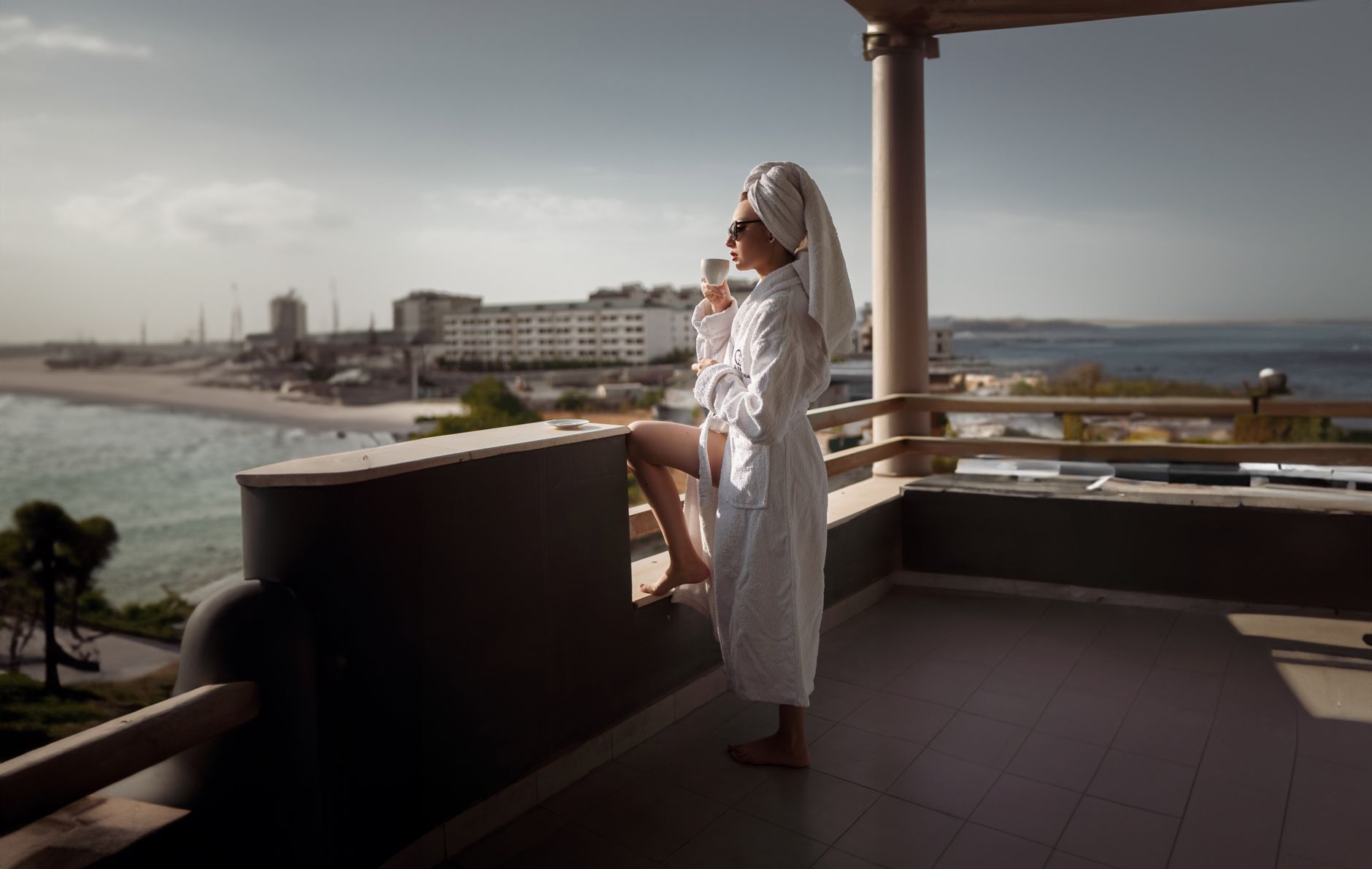
There is a particular kind of holiday photograph that has become so familiar you can almost predict the rest of the hotel from a single image. Pale stone. White linen. An olive tree in an oversized terracotta pot. A striped umbrella beside a pool so blue it barely looks real. Breakfast arrives on handmade ceramic plates, the bathroom is stocked with amber bottles, and somewhere nearby bougainvillea is tumbling photogenically over a wall.
It could be a hotel in Greece. Or Mallorca. Bali. Mexico. Byron Bay. Puglia. Increasingly, it is difficult to tell.
We are arguably living through one of the most beautiful eras of travel. Boutique hotels have become extraordinarily design-conscious, restaurants understand lighting almost as well as food, holiday rentals are styled like magazine shoots, and even a tiny guesthouse might have linen sheets, handmade tiles and a locally produced candle waiting beside the bed.
Yet for all this beauty, something strange has happened. The more aesthetically sophisticated travel becomes, the more much of it starts to look the same.
The locations change, but the imagery barely does. Infinity pool. Linen shirt. Stone walls. Iced coffee. Beach club. Sunset. Repeat.
So why does every beautiful holiday now look the same? And more importantly, are we beginning to lose some of the very things that once made travel worth leaving home for?
We Have Created a Universal Version of Beautiful Travel
Today there is an almost universal visual language for a desirable holiday. Whitewashed walls suggest Mediterranean simplicity. Travertine signals luxury. Rough timber communicates authenticity. Linen is effortless. A handmade ceramic bowl containing three perfectly imperfect lemons tells us this place understands good taste.
None of those things is inherently a problem. Most are beautiful. The issue is how effectively the same aesthetic now travels across borders.
A villa in Indonesia can resemble a hotel in Ibiza. A restaurant in Melbourne might look as though it has been lifted from Copenhagen. A new coastal hotel in Australia can contain the same polished plaster, boucle furniture and dramatically oversized pendant lights as one in Mexico.
We have become incredibly good at creating beautiful spaces. We have become less good at allowing those spaces to reveal where in the world we actually are.
The contrast becomes obvious when you stay somewhere with a strong sense of identity. One of the reasons places such as Halcyon House in Cabarita Beach remain memorable is that their design has a recognisable personality. Its nostalgic Australian seaside references, pattern and colour make it difficult to confuse with a minimalist hotel on a Greek island.
Distinctiveness stays with us. Generic perfection often does not.
Instagram Changed What Kind of Beauty Gets Rewarded
Travel was photogenic long before social media. People have always wanted to document beaches, beautiful hotels, famous landmarks and spectacular meals. What Instagram, Pinterest and TikTok changed was not our desire to photograph travel, but the speed at which certain images became globally influential.
A beautiful hotel might once have been experienced by its guests and perhaps later appeared in a magazine. Now one carefully framed photograph can be seen by millions of people within days. Travellers save it. Influencers recreate it. Hotel owners notice it. Interior designers receive it on mood boards. New properties begin incorporating similar details.
Then those properties are photographed too.
The cycle repeats until a specific style stops belonging to one hotel or one destination and becomes the visual language of luxury travel itself.
This is partly why so many new hotels are immediately legible. You know exactly what kind of stay you are being sold before you have read a word about it. Soft neutrals mean calm. Striped umbrellas mean European summer. Dark timber and stone mean wellness. Pink plaster means somewhere hot and fashionable.
The image has to communicate quickly because online we give it perhaps two seconds of attention.
Subtle cultural details do not always survive that process quite as effectively as a spectacular pool.
The Algorithm Likes Familiarity More Than We Think
Social media appears to reward originality, but in practice we are often drawn to new versions of things we already know we like.
A whitewashed hotel overlooking turquoise water needs almost no explanation. We understand the fantasy immediately: sunshine, relaxation, Europe, romance, luxury. The photograph works before we even know where it was taken.
Over time, particular images become associated with the idea of a perfect holiday. Travellers save them and begin looking for destinations that reproduce the same feeling. Hotels naturally respond to what travellers want. Designers draw inspiration from the same enormous digital pool of references.
Nobody has to deliberately copy anyone. Everyone simply begins looking at the same things.
It creates a strange form of aesthetic convergence where different destinations arrive independently at almost identical solutions. The result is very attractive, but after enough exposure the beautifully styled hotels, beach clubs and restaurants can start to blur together. You have seen the pool before. Perhaps not this exact pool, but spiritually, you know it well.
The Mediterranean Is Now a Global Aesthetic
The Mediterranean has been particularly vulnerable to this flattening of identity.
The actual Mediterranean is enormous. Greece is not Sicily. Sicily is not Provence. Provence is not Mallorca. Mallorca is not Croatia. Turkey is not Puglia. Even neighbouring villages can have completely different architecture, food, landscapes and traditions.
Online, however, “Mediterranean” has increasingly become less of a geographic region and more of a mood board.
There are white walls, striped umbrellas, olive trees, tomatoes, natural wine, old stone, linen shirts, tinned fish and sparkling blue water. Someone is always carrying a woven basket. Someone else appears to be reading a book while looking suspiciously well dressed.
It is an incredibly seductive version of summer, but it compresses dozens of distinct cultures into one marketable aesthetic.
Actually travelling through these regions reminds you how different they are. Our Ultimate Andalusia Travel Guide explores a part of southern Spain shaped by Moorish architecture, flamenco, white villages, historic cities and a food culture entirely its own. Rome, meanwhile, is noisy, layered, ancient, chaotic and wonderfully imperfect rather than simply a backdrop for pasta and terracotta walls.
The more deeply you experience a destination, the harder it becomes to reduce it to a colour palette.
The Global Boutique Hotel Has Arrived
You probably know this hotel too. The lobby has pale plaster walls and natural stone floors. There is a sculptural sofa and one enormous pendant light. The reception desk is timber. Somewhere a vase contains a single branch that looks as though it was selected during a four-hour creative meeting.
The staff wear beige. The room has no obvious branding. The minibar contains locally made chocolate, sparkling water and perhaps something fermented. The bathroom products have restrained typography. Breakfast involves excellent coffee, sourdough and eggs served on ceramics that appear handmade because they probably are.
Again, none of this is bad. There is a reason it became popular. This version of contemporary boutique hospitality is calm, comfortable and often genuinely beautiful.But the formula has become so recognisable that a hotel can sometimes feel internationally tasteful before it feels local.
Compare that with the best boutique hotels, which use design to strengthen their setting rather than disguise it. Our guide to the best boutique hotels in Adelaide and surrounds includes vineyard stays and city hotels where the landscape, architecture, food and regional identity remain part of the experience.
That is the difference between a beautiful hotel and a beautiful hotel you actually remember.
Luxury Became Quieter Until Everything Went Beige
For decades, luxury hotels announced themselves loudly. There was marble, polished brass, enormous flower arrangements, heavy curtains, crystal chandeliers and enough gold to make subtlety seem vaguely suspicious. Then luxury changed.
Good taste became quieter. Logos disappeared. Colours softened. Natural materials replaced glossy surfaces. Linen became preferable to satin. Handcrafted objects replaced obvious extravagance. Instead of demonstrating wealth through excess, luxury began signalling sophistication through restraint.
The change was refreshing. Hotels started feeling calmer, more residential and less like marble-lined shopping centres.
But successful aesthetics rarely remain niche. Before long, understatement became its own formula. Pale oak. Travertine. Linen. Boucle. Beige. More beige. Perhaps one black chair for tension. At a certain point, minimalism became maximal in its repetition.
This helps explain why hotels separated by thousands of kilometres can now look surprisingly similar. A specific version of quiet luxury became internationally understood, and hospitality followed it. Perhaps the next truly luxurious hotel will be the one brave enough to have patterned curtains.
Restaurants Are Starting to Look the Same Too
The phenomenon does not stop at hotels. Travel long enough and you may eventually realise you have eaten dinner beneath the same linen pendant light in six different countries.
The contemporary beautiful restaurant has rough plaster walls, timber furniture, small plates and carefully placed candles. The wine is natural or at least looks as though it might be. There are handmade ceramics. The menu uses an elegant serif font. The kitchen is often open.
The food may be fantastic, but the room can feel strangely familiar.
This visual consistency is comforting. We instantly recognise the signals of a restaurant we are probably going to like. But travel becomes more interesting when a dining room tells us something about where we are.
Some of the most memorable places to eat are not particularly fashionable. They might have plastic chairs, old menus, fluorescent lights, faded photographs on the wall or furniture nobody has thought about replacing since 1986.
Yet years later, you remember them. Tasteful interiors are lovely. Personality is harder to manufacture.
We Are Beginning to Travel Inside Mood Boards
Before booking a holiday now, we can inspect almost every detail.
We see the hotel lobby, the room, the bathroom, the beach, the breakfast, the restaurant, the pool, the sunset and possibly the exact cocktail we will order beside it.
We watch room tours. We read reviews. We study maps. We save restaurant tables. We know which beach club has the blue umbrellas and which one has the red ones.
There are obvious advantages to this. Few of us want to return to an era when a hotel brochure could describe a room as having “ocean views” only for guests to discover that the ocean could technically be seen by leaning dangerously from one corner of the balcony.
But all that certainty has a cost. We lose surprise. Sometimes arriving at a destination now feels less like discovering somewhere and more like physically stepping inside a mood board we assembled months earlier.
We already know the photograph we want. We are simply going there to take it ourselves.
The Holiday Photo Has Changed
Holiday photographs used to be primarily about memory. We took them because we wanted to remember where we had been, who was there and what happened. They still serve that purpose, of course, but they now have another potential audience. Everyone else.
That changes things in subtle ways. We choose the table with the best backdrop. We photograph breakfast before eating it. We wait for someone to move out of frame. We select a swimsuit because it will look good beside the pool. We walk to a famous viewpoint and discover a queue of people waiting to create almost exactly the same photograph.
There is something almost surreal about dozens of people travelling across the world to stand in precisely the same position.
The photograph stops being evidence of the holiday and becomes part of the holiday’s itinerary.
And sometimes we become so busy trying to capture the feeling of being somewhere that we forget to actually feel it.
The Most Memorable Travel Is Often Impossible to Photograph
Think about the trips you genuinely remember. Often the moments that remain are not the perfect ones. You remember getting lost and finding a tiny restaurant you never would have booked. You remember a waiter making everyone laugh. You remember swimming somewhere because you happened to drive past it. You remember a train journey through rain, a terrible hotel room that became a running joke, or a dinner that stretched three hours longer than planned.
You remember smells, conversations, weather and the strange feeling of waking up somewhere unfamiliar. Very few of those things fit neatly into a social media feed.
This is one reason slower travel is so appealing. In our piece on how unhurried journeys are transforming the way we travel, we look at the growing desire to stop racing between highlights and instead allow more time for the unexpected.
The irony is that slowing down often produces a much more individual trip. If everyone visits the same ten attractions, our holidays naturally begin to resemble one another. If we leave room for chance, they cannot.
Even the “Hidden Gem” Is Becoming Standardised
We are now permanently searching for the place nobody else knows about. The secret island. The undiscovered beach. The quiet village. The hotel nobody has posted yet. But the internet is exceptionally bad at keeping secrets.
A destination begins appearing online. Its beautiful coastline spreads across social media. Travel publications take notice. Hotels arrive. Then restaurants. Then beach clubs. Soon there are striped umbrellas, iced coffees and a shop selling expensive linen shirts.
Eventually somebody describes it as “the new Mykonos.”
And just like that, a place that became desirable because it felt different begins being encouraged to resemble the destination travellers were supposedly trying to escape.
This is why lesser-known destinations are most interesting when they are allowed to remain themselves. Our guide to quiet towns in Japan that still feel like traditional old Japan is appealing precisely because these places offer their own rhythm and character rather than trying to reproduce Tokyo or Kyoto on a smaller scale.
Likewise, our guide to eight hidden gem destinations for an Australian summer holiday focuses on places where the attraction is the landscape and experience rather than simply finding another version of Byron Bay.
Travel should expand our visual vocabulary, not continuously return us to the same one.
Destination Dupes Have Made the Question Even More Interesting
The rise of the “destination dupe” makes sense. Famous places are expensive, crowded and increasingly difficult to experience spontaneously. Travellers naturally want alternatives.
Our guide to 10 destination dupes for popular travel hotspots includes alternatives to places such as Santorini, Bali, the Amalfi Coast and the French Riviera. Finding somewhere less crowded can lead to a better, more affordable holiday.
But the language around destination dupes reveals something about how we now choose travel. We often describe one place according to its resemblance to another. This island is like Santorini. This beach is the new Tulum. This town is Australia’s answer to somewhere in Europe.
There is nothing wrong with comparison. It helps us understand unfamiliar destinations. But a place becomes much more interesting when we eventually stop asking what famous destination it resembles and start asking what makes it unlike anywhere else.
“Authenticity” Has Become an Aesthetic of Its Own
The modern traveller is suspicious of anything that feels too touristy. We want local restaurants, independent hotels, artisan products, traditional neighbourhoods and experiences that feel genuine.
Naturally, the travel industry has noticed.
Now authenticity itself can be packaged.
The hotel is in a “restored” historic building. The ceramics are made locally. The bath products use native ingredients. The restaurant has a farm-to-table menu. Books about the region sit artfully beside the bed.
Sometimes this represents a genuine connection between a hotel and its destination.
Sometimes it is simply another layer of styling.
A useful test is to ask whether the hotel could be moved intact to another country without anybody noticing.
The best accommodation feels connected to its setting. Materials, architecture, food, landscaping and culture tell you something about where you are.
That does not mean every hotel needs to resemble a museum. Contemporary design can be completely modern while still responding intelligently to place. The difference is subtle, but you can usually feel it.
Some Places Still Have the Confidence to Be Themselves
The most interesting travel destinations often have contradictions.
Rome is magnificent and chaotic. Paris contains grand architecture alongside incredibly ordinary supermarkets. Tokyo can be serene and overwhelming within the same afternoon. The Gold Coast combines high-rise glamour, surf culture, boutique hotels and hinterland retreats.
In fact, our recent Ultimate Gold Coast Guide explores how the destination has evolved without completely discarding the slightly excessive, sun-soaked personality that made it famous in the first place.
That individuality matters.
The places we love most rarely feel entirely polished. They have beautiful streets and ugly streets. Wonderful restaurants and questionable ones. Historic architecture beside convenience stores. Locals getting on with normal life while visitors stand nearby photographing something they see every morning.
These contradictions give a destination texture.
When everything is curated to meet the expectations of visitors, that texture starts disappearing.
Overtourism Can Turn Places Into Versions of Themselves
There is another, more serious side to aesthetically driven travel.
When millions of travellers want the same image, they often want to visit the same places.
The same beaches.
The same islands.
The same streets.
The same sunset viewpoints.
A destination can become famous because it possesses a particular identity, only to gradually reshape itself around visitors attracted by that identity. Local stores become souvenir shops. Homes become short-term accommodation. Restaurants adjust menus. Streets fill with businesses designed primarily for tourism.
Eventually the thing travellers came looking for can become harder to find.
There is no simple answer to overtourism, and tourism provides enormous economic benefits to destinations around the world. But as travellers we can broaden where we go, travel outside peak periods and spend money with local businesses rather than treating a destination as a collection of photographic backdrops.
Sometimes the easiest way to have a more interesting holiday is simply to go one town further.
Why Do We Keep Choosing the Same Aesthetic?
Because we like it. This is the part that is easy to overlook. Nobody has forced us into a world of linen sheets, beautiful stone and infinity pools. We continue booking these places because they are attractive, calming and reassuring.
Travel is expensive. When we are spending thousands of dollars, familiarity reduces risk. We see a certain kind of hotel and understand immediately what sort of experience it is offering.
There is nothing wrong with wanting that.
Not every holiday needs to be culturally transformative. Sometimes we want a lovely room, a comfortable bed and somewhere beautiful to sit beside a pool with a cold drink.
The problem is not choosing beautiful places.
It is allowing one definition of beauty to crowd out every other one.
How to Find a Holiday That Doesn’t Look Like Everyone Else’s
Finding a more individual holiday does not require deleting Instagram or deliberately staying somewhere ugly. It simply requires widening the criteria you use when choosing where to go.
Look beyond the most photographed hotel. Search for places with history, unusual architecture or a clear connection to their location. Stay in neighbourhoods rather than only resort zones. Look at family-run hotels and older properties alongside the newest openings.
Read about a destination before you arrive. Understand what people eat, how the architecture developed and what makes one neighbourhood different from another.
And perhaps most importantly, leave some time completely unplanned.
Walk without knowing what is at the end of the street. Go into the restaurant that looks busy rather than the one you saved six months ago. Take a local train somewhere because the name sounds interesting. Stay long enough that you stop looking only at landmarks and start noticing ordinary life.
Our Refined Escapes guide is a good place to start if you are drawn to destinations that combine beautiful surroundings with architecture, food and neighbourhood character rather than simply famous sights.
The goal is not to avoid beauty. It is to find beauty you did not already expect.
Perhaps the Imperfect Holiday Is Ready for a Comeback
Maybe true travel luxury is beginning to shift again.
Perhaps the future belongs to hotels with strange wallpaper, restaurants that have not redesigned themselves in twenty years, old beach motels, family-run inns, mismatched furniture and places where every object has not been chosen because it looks good in a photograph.
There is something wonderfully liberating about destinations that do not seem particularly concerned with whether we approve of them.
They simply exist.
That might be why we remember them.
Years later, the perfectly styled hotel rooms can blur together. But we remember the eccentric owner of the tiny hotel in Sicily. The faded seaside restaurant where we ate spectacular fish. The balcony with the terrible chairs and astonishing view.
Imperfection gives memory something to hold onto.
Beauty Isn’t the Problem. Sameness Is
There is nothing wrong with wanting a beautiful holiday. Travel has always been partly about escaping into somewhere extraordinary, and we will continue wanting beautiful hotels, spectacular coastlines, excellent restaurants and rooms that make us stop for a second when we open the door.
But beauty becomes more interesting when it belongs somewhere.
A Greek island should feel unmistakably Greek. A Japanese inn should reveal something about Japan. An Australian beach hotel should not need to pretend it is in Ibiza before we consider it stylish.
The point of travelling thousands of kilometres should not be arriving somewhere that feels reassuringly similar to every other place saved on our phones.
The best holidays often contain images we could never have planned for.
A crooked table outside a tiny restaurant. A beach with faded umbrellas. A street discovered because we walked in the wrong direction. An unexpectedly perfect lunch. A strange little hotel we almost did not book. A view that looked completely ordinary online and somehow stopped us in our tracks when we saw it in person.
None of it made the mood board. And somehow, it becomes the entire reason we remember the trip.
What to Read Next
If this has you reconsidering the way you choose your next holiday, explore Refined Escapes: Curated Destinations for the Discerning Traveller for destinations with genuine character, architecture and food; discover Quiet Towns in Japan That Still Feel Like Traditional Old Japan for a slower side of Japan; read Destination Dupes: 10 Budget-Friendly Alternatives to Popular Travel Hotspots if you want to escape some of the world’s busiest destinations; or explore How Unhurried Journeys Are Transforming the Way We Travel for a different approach to seeing the world.
Share this:
Like this: