There are places you visit for the landmarks, and then there are places you visit because the entire atmosphere makes you want to stay longer.
The Basque Country is firmly in the second category.
Tucked into northern Spain where green mountains meet the Atlantic Ocean, the Basque Country feels wonderfully different from the Spain many travellers imagine. Instead of endless dry landscapes and resort-lined beaches, you find dramatic cliffs, lush hills, elegant cities, fishing villages, golden beaches and a food culture that has earned a global reputation.
This is a region where lunch can easily become a long afternoon, where tiny bars serve beautifully prepared pintxos and where a coastal drive can take you from sophisticated city streets to wild Atlantic scenery in less than an hour.
Bilbao brings contemporary architecture, art and a revitalised riverside. San Sebastián combines elegant beaches with one of Europe’s most exciting food scenes. Beyond the cities, places such as Getaria, Zarautz and Hondarribia reveal a slower, more traditional side of the region.
The Basque Country is not somewhere to rush through.
It is a place to eat slowly, walk beside the sea, linger over coffee and allow yourself to become slightly obsessed with pintxos.
This complete Basque Country travel guide covers the best places to visit, the most beautiful coastal towns, what to eat, where to stay, how to get around and how to plan an unforgettable trip.
Why Visit the Basque Country?
The Basque Country brings together several things that travellers often search for separately: beautiful coastlines, fascinating cities, exceptional food, distinctive culture and dramatic natural landscapes.
You can begin the morning inside an extraordinary art museum in Bilbao, spend the afternoon walking beside the Atlantic and finish the evening moving between intimate pintxos bars in San Sebastián.
The landscape is one of the region’s greatest attractions. The coast is dramatic rather than tropical, with green hills falling towards deep blue water, sandy beaches tucked between headlands and small fishing towns scattered along the shoreline. The official Basque tourism board highlights the region’s rugged cliffs, beaches, fishing villages and coastal landscapes as some of its defining experiences.
Food is equally important. The Basque Country is famous for pintxos, cider houses, seafood, grilled fish and innovative restaurants, but you do not need to book an expensive tasting menu to experience its culinary culture. Some of the best memories can come from standing at a neighbourhood bar with a small plate in front of you and nowhere else you need to be.
The region is also perfect for travellers who prefer destinations that feel sophisticated without feeling overly polished. There is style, but it still feels lived in.
If you are planning a wider Spanish adventure, our Ultimate Andalusia Travel Guide is another beautiful way to experience Spain through food, history, architecture and landscapes.
When Is the Best Time to Visit the Basque Country?
The Basque Country has a greener and wetter climate than many other parts of Spain, and that is part of what makes it so beautiful.
Late spring and early summer are particularly appealing. May and June bring longer days, lush landscapes and comfortable temperatures for walking, sightseeing and coastal exploration.
July and August are the busiest months, particularly in San Sebastián and the popular beach towns. The atmosphere is lively and the beaches are at their best, but accommodation can become more expensive and popular restaurants may require advance reservations.
September is one of the best months to visit. The summer crowds begin to ease, the sea remains inviting and the weather can be ideal for combining city exploration with outdoor adventures.
Autumn brings a different mood. The hills become even more atmospheric, rainy days are possible and food becomes an even bigger part of the experience.
Winter is quieter and can be wonderfully atmospheric if you enjoy museums, restaurants and cosy city breaks. Just remember that some seasonal coastal businesses may operate reduced hours.
Bilbao: Where Art Meets the Atlantic
Photo by David Vives
Bilbao is often the first introduction to the Basque Country, and it is a city that has transformed itself dramatically.
Once strongly associated with industry, Bilbao has developed into one of northern Spain’s most interesting cultural destinations. Its most famous landmark is the Guggenheim Museum, whose striking architecture has become one of the defining images of modern Bilbao.
But the city is much more than one museum.
Spend time exploring the riverside before wandering into the city centre and towards Casco Viejo. Bilbao rewards travellers who are happy to explore on foot, with historic streets, traditional shops, lively bars and contemporary restaurants appearing around almost every corner.
The city also offers a wonderful introduction to Basque food culture. Rather than planning one enormous meal, you can spend an evening moving between bars, ordering one or two small dishes at each stop and allowing the atmosphere to guide you.
Explore Bilbao’s Casco Viejo
Casco Viejo is the historic heart of Bilbao and one of the best places to slow down.
The old quarter is built around seven historic streets, with atmospheric lanes and small squares connecting them. Traditional architecture sits beside modern cafés and independent shops, creating the kind of neighbourhood where it is easy to lose track of time.
Come during the day to explore the shops and historic streets, then return in the evening when the neighbourhood becomes much livelier.
People meet for drinks, conversations stretch late into the night and pintxos appear across bar counters.
Do not worry too much about finding the perfect restaurant.
Choose a place that looks busy with locals, order something that catches your attention and see where the evening takes you.
San Sebastián: The Elegant Star of the Basque Coast
Photo by Daniel Ledesma
San Sebastián, or Donostia, is arguably the jewel of the Basque coast.
The city curves around the beautiful La Concha Bay, with an elegant promenade following the shoreline and green hills rising behind it. The setting is spectacular, but what makes San Sebastián special is the way its beauty fits naturally into everyday life.
People swim in the bay, walk along the promenade, sit outside cafés and meet friends for food.
La Concha Beach is the city’s most recognisable stretch of sand, but you do not need perfect beach weather to appreciate it. Walking along the waterfront with the hills and bay surrounding you is one of those simple experiences that stays with you.
San Sebastián’s old town, Parte Vieja, is where food becomes the centre of the experience.
The narrow streets are packed with pintxos bars, restaurants and small shops, creating a lively atmosphere that continues well into the evening.
Instead of sitting down for a traditional three-course meal every night, try the local ritual of moving between bars. Order a pintxo, have a small glass of wine or cider, enjoy the atmosphere and continue to the next place.
Some pintxos are beautifully elaborate, while others are wonderfully simple.
The point is not to eat as much as possible.
It is to taste your way through the neighbourhood.
The Magic of Pintxos
Pintxos are one of the defining experiences of the Basque Country.
They are often compared with tapas, but the culture surrounding them is distinctive. You might find bread topped with seafood, cured meat, vegetables, cheese or beautifully arranged combinations of ingredients. Some are served cold, while others are prepared to order.
The best approach is to try a mixture.
Choose something familiar, something completely unfamiliar and something that simply looks too good to ignore.
Then move on.
Food in the Basque Country is not something to squeeze between sightseeing stops. It is one of the reasons to come in the first place.
If you love the idea of travelling at a slower pace and experiencing a destination through its everyday moments, our guide to How Unhurried Journeys Are Transforming the Way We Travel fits beautifully with the Basque approach to travel.
Getaria: A Beautiful Coastal Escape
Photo by Luis Peralta
Just along the coast from San Sebastián, Getaria is a small fishing town with enormous character.
Its harbour, narrow streets and hillside setting make it instantly photogenic, but Getaria is far more than a pretty day-trip destination. It has a strong maritime heritage and a long connection with fishing, food and the sea. The town is also associated with Cristóbal Balenciaga, whose work is celebrated at the Balenciaga Museum.
This is somewhere to arrive hungry.
Choose a restaurant close to the harbour, order freshly grilled fish and allow the meal to stretch longer than you originally planned.
Then walk through the old streets or towards the coast and take in the views.
The combination of seafood, history, fashion and Atlantic scenery makes Getaria one of the easiest places to fall in love with.
Zarautz: Beach Life With a Basque Twist
Zarautz is one of the Basque Country’s best-known beach destinations and a favourite with surfers.
Its long sandy beach stretches along the town, while cafés, restaurants and local streets create a relaxed atmosphere behind the waterfront.
Unlike some resort destinations, Zarautz does not feel completely built around tourism.
Surf culture is particularly strong here, and even if you do not surf, watching the waves and walking along the promenade is a lovely way to spend an afternoon.
Stay for lunch, find a café and let the day unfold without trying to fit another five attractions into your schedule.
Hondarribia: One of the Basque Country’s Prettiest Towns
Close to the French border, Hondarribia is one of the region’s most charming historic towns.
Its old quarter is filled with colourful buildings, balconies, cobbled streets and traditional Basque architecture. The town feels noticeably slower than Bilbao or San Sebastián, making it a wonderful place for travellers who prefer atmosphere over sightseeing checklists.
Spend time wandering without a strict plan before heading towards the waterfront and fishing district for seafood.
Hondarribia is also a useful base for exploring the wider area around the Spanish-French border.
The Basque Coast: Where the Landscape Steals the Show
The Basque coastline is one of the great pleasures of travelling through northern Spain.
Rather than one continuous resort strip, the landscape changes constantly. There are cliffs, sandy beaches, fishing ports, green hills and viewpoints that seem to appear around every bend.
A road trip is one of the best ways to experience it because you can stop whenever something catches your eye.
See a beautiful viewpoint? Stop.
Notice a tiny village below the road? Take the detour.
Find a beach that looks inviting? Stay for an hour.
That freedom is part of the magic.
The Basque coast is also an excellent alternative for travellers who love Mediterranean scenery but want something greener, wilder and less predictable. If you are comparing European summer destinations, our guide to The Ultimate Mediterranean Summer offers more inspiration.
Gaztelugatxe: The Dramatic Atlantic Landmark
Photo by Juan Pablo Serrano
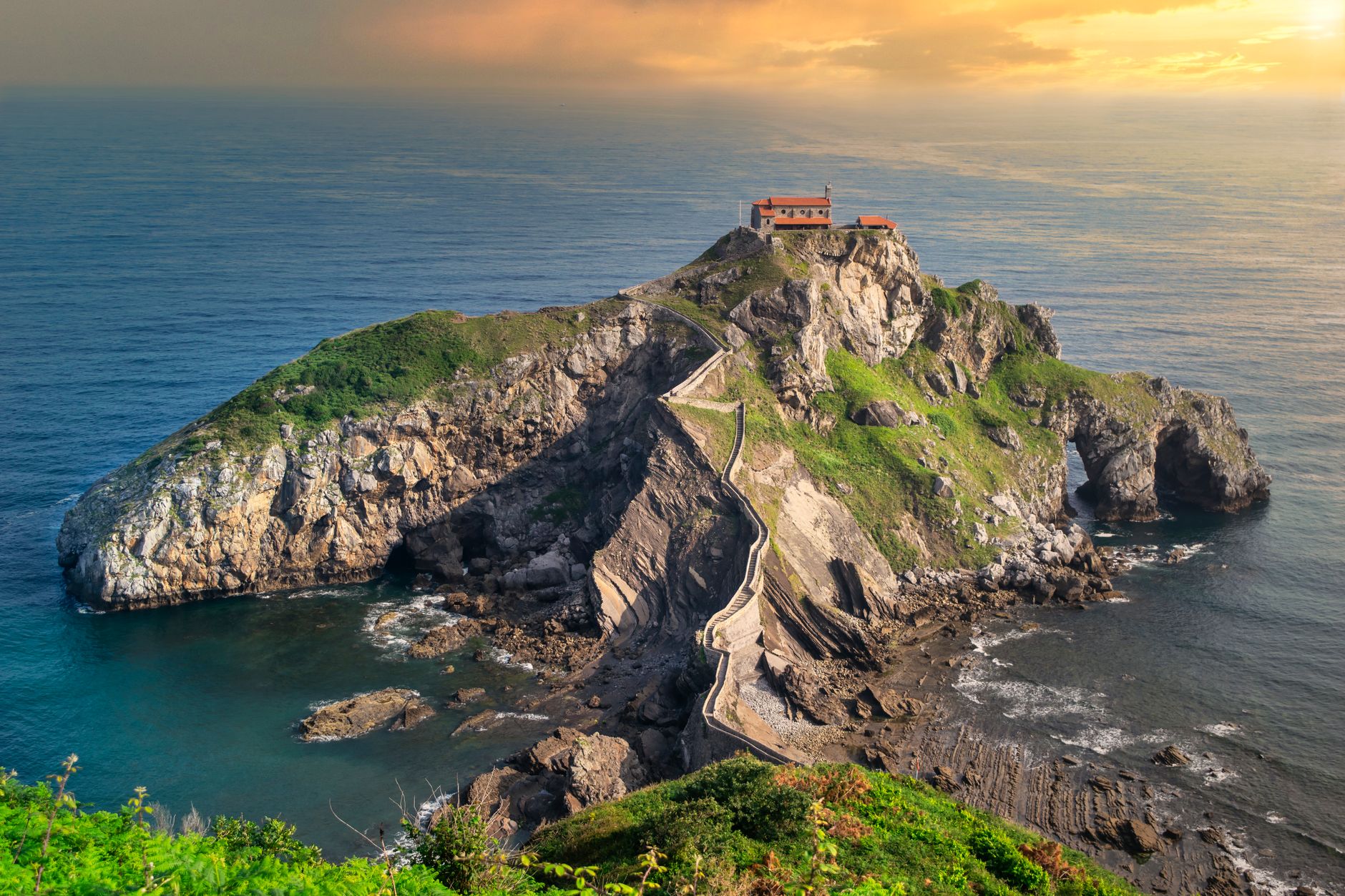
One of the Basque Country’s most recognisable landscapes is San Juan de Gaztelugatxe.
A stone bridge connects the rocky island to the mainland before a steep staircase leads towards the historic hermitage at the top. The combination of cliffs, sea, stone and sky makes the walk feel much more dramatic than a typical sightseeing stop.
Allow plenty of time and wear comfortable shoes.
The climb is part of the experience, so resist the temptation to rush. Stop occasionally to look back at the coastline and appreciate the landscape around you.
Because Gaztelugatxe is a popular attraction, check current access arrangements before visiting, particularly during busy periods. It is officially highlighted among the Basque Country’s major destinations.
Urdaibai: A Wild Side of the Basque Country
For travellers who want to escape the cities completely, the Urdaibai area offers an extraordinary combination of wetlands, forests, cliffs, beaches and small villages.
This is a place to slow down.
Hiking trails lead through green landscapes, while beaches such as Laida and Laga provide beautiful places to pause beside the Atlantic.
Rather than trying to see everything in one day, choose a small section of the area and explore it properly.
The official Basque tourism site lists Urdaibai among the region’s important destinations and natural experiences, making it an excellent addition for travellers who want to balance the cities with nature.
Basque Country Food: What You Should Try
Photo by Ana Lourenco
Food should be at the heart of your trip.
Start with pintxos, but do not stop there.
Look for bacalao al pil-pil, grilled fish, txangurro, local cheeses and Basque-style cheesecake. Gilda is another classic bite, combining an olive, anchovy and pickled chilli into something simple, salty and surprisingly addictive.
The region also has an extraordinary fine-dining tradition. San Sebastián in particular is known for its concentration of highly regarded restaurants, but the broader Basque Country offers everything from Michelin-starred dining to traditional grill restaurants and cider houses.
You do not need to spend hundreds of euros to appreciate the food culture.
Some of the best experiences can happen at a small bar with a plate of pintxos and a glass of local cider.
Cider is another important part of Basque food culture.
Traditional cider houses, known as sagardotegiak, are particularly associated with the area around San Sebastián and the surrounding countryside.
The experience is social and usually revolves around hearty food, conversation and cider served from large barrels.
The cider itself tends to be dry and tart rather than sweet, making it a wonderful companion to rich dishes.
If you have the opportunity to visit a traditional cider house, make it part of the trip rather than treating it as simply another meal.
It is the kind of experience that captures the social side of Basque culture beautifully.
Where to Stay in the Basque Country
Where you stay depends on the kind of experience you want.
San Sebastián is ideal for first-time visitors who want beautiful beaches, food, culture and easy access to coastal towns.
Bilbao works particularly well for travellers interested in contemporary art, architecture, shopping and urban culture.
If you are hiring a car, staying outside the major cities can create a completely different experience. A countryside guesthouse or small coastal hotel gives you the chance to wake up to green hills and sea views rather than city streets.
For a longer trip, consider splitting your stay between Bilbao and San Sebastián, then adding one or two nights in a smaller coastal town such as Getaria or Hondarribia.
This gives you a much better sense of the region without constantly packing and unpacking.
How to Get Around the Basque Country
Public transport is very useful between the major cities and towns. Bilbao and San Sebastián are well connected, while trains and buses make it possible to explore many popular destinations without hiring a car.
However, a rental car becomes extremely useful if you want to explore smaller coastal villages, countryside areas and natural attractions at your own pace.
Driving also gives you the freedom to stop whenever you discover a beautiful viewpoint.
If you rent a car, remember that historic town centres can have narrow streets and limited parking. It is often easier to park outside the centre and continue on foot.
For a short city break, you can comfortably rely on public transport. For a longer road trip, a car will give you much more freedom.
A Perfect 3-Day Basque Country Itinerary
Day One: Bilbao
Begin with the Guggenheim Museum before exploring Bilbao’s riverside and Casco Viejo.
Spend the afternoon wandering through the old quarter and finish the day with a pintxos evening.
Do not overplan the night. Bilbao is a city best enjoyed slowly.
Day Two: San Sebastián
Travel to San Sebastián and spend the morning around La Concha Bay.
Explore Parte Vieja in the afternoon and dedicate the evening to pintxos.
If the weather is clear, climb one of the city’s viewpoints for sunset before returning to the old town for dinner.
Day Three: Getaria and the Coast
Take a coastal trip towards Getaria and Zarautz.
Enjoy a long seafood lunch, walk beside the waterfront and continue exploring the coastline before returning to San Sebastián.
This itinerary gives you a taste of the region without trying to see everything.
A 5-Day Basque Country Itinerary
With five days, you can slow the pace considerably.
Spend two nights in Bilbao and two nights in San Sebastián, with the remaining night in a coastal town such as Getaria or Hondarribia.
Use one day to explore Gaztelugatxe and the surrounding coast, then dedicate another to San Sebastián and its food scene.
The final day can be used for a countryside drive through the Basque hills or a slower coastal journey.
Five days gives you enough time to see the highlights without making the trip feel like a race.
A 7-Day Basque Country Road Trip
With a full week, consider a route that combines Bilbao, the coast, San Sebastián and the countryside.
Begin in Bilbao before travelling towards Gaztelugatxe and the Urdaibai region.
Continue through the coastal towns towards Getaria and Zarautz before reaching San Sebastián.
Spend two nights in San Sebastián, then continue towards Hondarribia and the French border.
You could even cross briefly into French Basque Country if time allows.
The beauty of this route is that the journey becomes part of the holiday.
What to Pack for the Basque Country
The weather can change quickly, particularly along the coast.
Pack comfortable walking shoes, lightweight layers and a waterproof jacket. Even during summer, evenings can feel cool near the water.
If you plan to hike, bring proper footwear rather than relying on casual trainers.
A small day bag is useful for carrying water, a camera and an extra layer.
And leave some space in your suitcase.
You will probably come home with food, ceramics, wine or something beautiful you discovered in a tiny local shop.
If you want to build a polished but practical travel wardrobe before your trip, eleSTYLED has plenty of inspiration for creating versatile outfits that can work from sightseeing to dinner.
Is the Basque Country Expensive?
The Basque Country can be more expensive than some other regions of Spain, particularly San Sebastián.
Hotels in the city centre can be costly during peak season, while high-end restaurants can quickly increase the overall budget.
However, there are plenty of ways to experience the region without spending excessively.
Pintxos bars are a great example. Instead of committing to an expensive restaurant every evening, you can enjoy small plates across several different bars.
Travelling outside July and August can also make accommodation more affordable.
The best way to manage your budget is to mix experiences. Spend more on one memorable meal or hotel, then balance it with inexpensive local food, public transport and free coastal walks.
Basque Country Travel Tips
Give Yourself Time to Eat
Do not treat meals as something to fit between attractions.
Food is part of the destination, and some of your favourite memories may happen around a small table rather than at a famous landmark.
Expect Some Rain
The region is green for a reason.
Bring waterproof layers and do not let a cloudy forecast ruin your plans. Some of the most atmospheric coastal views appear when the sky is dramatic.
Book Popular Restaurants Early
If there is a particular restaurant you are determined to visit, especially a highly regarded tasting-menu restaurant, make a reservation well ahead.
For casual pintxos bars, you can be much more spontaneous.
Explore Beyond Bilbao and San Sebastián
The cities are wonderful, but the coastline and smaller towns are where the region’s personality becomes even more apparent.
Give yourself at least one day away from the major cities.
Try Something Unfamiliar
Order a pintxo you cannot identify.
Try a local cider.
Taste Basque cheesecake.
Ask a restaurant what is particularly good that day.
Travel becomes more memorable when you stop choosing only what you already know.
Frequently Asked Questions About the Basque Country
Is the Basque Country worth visiting?
Absolutely. The region combines dramatic Atlantic scenery, beautiful cities, exceptional food, historic towns and a distinctive local culture.
It is particularly appealing if you want a Spanish holiday that feels different from the country’s more traditional tourist routes.
How many days do you need in the Basque Country?
Three days gives you a good introduction, but five to seven days is ideal for combining Bilbao, San Sebastián, the coast and smaller towns.
A week also gives you enough time to slow down rather than spending the entire trip moving between attractions.
Is Bilbao or San Sebastián better?
Neither is necessarily better.
Bilbao is stronger for contemporary art, architecture and urban culture, while San Sebastián is particularly appealing for beaches, food and elegant coastal scenery.
Ideally, visit both.
What food is the Basque Country famous for?
Pintxos, grilled seafood, bacalao al pil-pil, Basque cheesecake, local cheeses, cider and fine dining are among the region’s most famous culinary experiences.
Is the Basque Country good for a road trip?
Yes.
A car is particularly useful for exploring the coastline, small villages, natural areas and countryside outside the main cities.
Can you visit the Basque Country without a car?
Yes.
Bilbao and San Sebastián are well connected by public transport, and many coastal towns can be reached by train or bus.
A car simply gives you more freedom, particularly if you want to explore smaller villages and remote coastal areas.
Is San Sebastián expensive?
It can be, especially during peak summer and around major events.
However, travellers can manage costs by staying outside the city centre, travelling in shoulder season and eating at casual pintxos bars.
What is the most beautiful place in the Basque Country?
That depends on your taste.
San Sebastián is famous for its bay and beaches, Gaztelugatxe offers dramatic coastal scenery and Urdaibai provides beautiful green landscapes.
The best approach is to experience several rather than trying to choose just one.
Where to Next?
Once you have explored the Basque Country, there are plenty of ways to continue your European journey.
If you are craving another destination where spectacular coastline, local food and slower island life come together, continue with The Ultimate Travel Guide to Sardinia. Sardinia offers another beautiful combination of beaches, food, culture and scenic road trips.
For a completely different kind of European coastal escape, discover The Travel Guide to the Cinque Terre, Italy, where colourful villages cling to the dramatic Italian Riviera.
If you prefer somewhere quieter and more authentic, A Complete Guide to Visiting Camogli, Italy offers another beautiful Italian coastal experience, with a fishing village atmosphere, seafood and a slower pace.
For turquoise water, dramatic mountains and a less polished Mediterranean atmosphere, head south with our Discover the Albanian Riviera guide.
And if you are ready for another Italian road-trip adventure filled with charming towns, beaches and extraordinary food, explore The Ultimate Travel Guide to Puglia. Puglia offers another slower, food-focused approach to European travel.
The Final Word
The Basque Country is the kind of destination that quietly gets under your skin. You might arrive because of Bilbao’s architecture or San Sebastián’s beaches. You might come because you have heard about the food. You might simply be looking for somewhere in Spain that feels a little different.
But it is the combination that stays with you. It is the green hills above the Atlantic, the sound of glasses being placed on a bar, the first bite of an unforgettable pintxo and the golden light across La Concha. It is a long seafood lunch in Getaria, a winding road beside the ocean and a quiet village where you stop simply because it looks beautiful.


There are places you visit for the landmarks, and then there are places you visit because the entire atmosphere makes you want to stay longer.
The Basque Country is firmly in the second category.
Tucked into northern Spain where green mountains meet the Atlantic Ocean, the Basque Country feels wonderfully different from the Spain many travellers imagine. Instead of endless dry landscapes and resort-lined beaches, you find dramatic cliffs, lush hills, elegant cities, fishing villages, golden beaches and a food culture that has earned a global reputation.
This is a region where lunch can easily become a long afternoon, where tiny bars serve beautifully prepared pintxos and where a coastal drive can take you from sophisticated city streets to wild Atlantic scenery in less than an hour.
Bilbao brings contemporary architecture, art and a revitalised riverside. San Sebastián combines elegant beaches with one of Europe’s most exciting food scenes. Beyond the cities, places such as Getaria, Zarautz and Hondarribia reveal a slower, more traditional side of the region.
The Basque Country is not somewhere to rush through.
It is a place to eat slowly, walk beside the sea, linger over coffee and allow yourself to become slightly obsessed with pintxos.
This complete Basque Country travel guide covers the best places to visit, the most beautiful coastal towns, what to eat, where to stay, how to get around and how to plan an unforgettable trip.
Why Visit the Basque Country?
The Basque Country brings together several things that travellers often search for separately: beautiful coastlines, fascinating cities, exceptional food, distinctive culture and dramatic natural landscapes.
You can begin the morning inside an extraordinary art museum in Bilbao, spend the afternoon walking beside the Atlantic and finish the evening moving between intimate pintxos bars in San Sebastián.
The landscape is one of the region’s greatest attractions. The coast is dramatic rather than tropical, with green hills falling towards deep blue water, sandy beaches tucked between headlands and small fishing towns scattered along the shoreline. The official Basque tourism board highlights the region’s rugged cliffs, beaches, fishing villages and coastal landscapes as some of its defining experiences.
Food is equally important. The Basque Country is famous for pintxos, cider houses, seafood, grilled fish and innovative restaurants, but you do not need to book an expensive tasting menu to experience its culinary culture. Some of the best memories can come from standing at a neighbourhood bar with a small plate in front of you and nowhere else you need to be.
The region is also perfect for travellers who prefer destinations that feel sophisticated without feeling overly polished. There is style, but it still feels lived in.
If you are planning a wider Spanish adventure, our Ultimate Andalusia Travel Guide is another beautiful way to experience Spain through food, history, architecture and landscapes.
When Is the Best Time to Visit the Basque Country?
The Basque Country has a greener and wetter climate than many other parts of Spain, and that is part of what makes it so beautiful.
Late spring and early summer are particularly appealing. May and June bring longer days, lush landscapes and comfortable temperatures for walking, sightseeing and coastal exploration.
July and August are the busiest months, particularly in San Sebastián and the popular beach towns. The atmosphere is lively and the beaches are at their best, but accommodation can become more expensive and popular restaurants may require advance reservations.
September is one of the best months to visit. The summer crowds begin to ease, the sea remains inviting and the weather can be ideal for combining city exploration with outdoor adventures.
Autumn brings a different mood. The hills become even more atmospheric, rainy days are possible and food becomes an even bigger part of the experience.
Winter is quieter and can be wonderfully atmospheric if you enjoy museums, restaurants and cosy city breaks. Just remember that some seasonal coastal businesses may operate reduced hours.
Bilbao: Where Art Meets the Atlantic
Bilbao is often the first introduction to the Basque Country, and it is a city that has transformed itself dramatically.
Once strongly associated with industry, Bilbao has developed into one of northern Spain’s most interesting cultural destinations. Its most famous landmark is the Guggenheim Museum, whose striking architecture has become one of the defining images of modern Bilbao.
But the city is much more than one museum.
Spend time exploring the riverside before wandering into the city centre and towards Casco Viejo. Bilbao rewards travellers who are happy to explore on foot, with historic streets, traditional shops, lively bars and contemporary restaurants appearing around almost every corner.
The city also offers a wonderful introduction to Basque food culture. Rather than planning one enormous meal, you can spend an evening moving between bars, ordering one or two small dishes at each stop and allowing the atmosphere to guide you.
Explore Bilbao’s Casco Viejo
Casco Viejo is the historic heart of Bilbao and one of the best places to slow down.
The old quarter is built around seven historic streets, with atmospheric lanes and small squares connecting them. Traditional architecture sits beside modern cafés and independent shops, creating the kind of neighbourhood where it is easy to lose track of time.
Come during the day to explore the shops and historic streets, then return in the evening when the neighbourhood becomes much livelier.
People meet for drinks, conversations stretch late into the night and pintxos appear across bar counters.
Do not worry too much about finding the perfect restaurant.
Choose a place that looks busy with locals, order something that catches your attention and see where the evening takes you.
San Sebastián: The Elegant Star of the Basque Coast
San Sebastián, or Donostia, is arguably the jewel of the Basque coast.
The city curves around the beautiful La Concha Bay, with an elegant promenade following the shoreline and green hills rising behind it. The setting is spectacular, but what makes San Sebastián special is the way its beauty fits naturally into everyday life.
People swim in the bay, walk along the promenade, sit outside cafés and meet friends for food.
La Concha Beach is the city’s most recognisable stretch of sand, but you do not need perfect beach weather to appreciate it. Walking along the waterfront with the hills and bay surrounding you is one of those simple experiences that stays with you.
For more European coastal inspiration, our guide to The Most Beautiful Coastal Destinations in Europe is a natural companion to planning a wider coastal journey.
Wander Through Parte Vieja
San Sebastián’s old town, Parte Vieja, is where food becomes the centre of the experience.
The narrow streets are packed with pintxos bars, restaurants and small shops, creating a lively atmosphere that continues well into the evening.
Instead of sitting down for a traditional three-course meal every night, try the local ritual of moving between bars. Order a pintxo, have a small glass of wine or cider, enjoy the atmosphere and continue to the next place.
Some pintxos are beautifully elaborate, while others are wonderfully simple.
The point is not to eat as much as possible.
It is to taste your way through the neighbourhood.
The Magic of Pintxos
Pintxos are one of the defining experiences of the Basque Country.
They are often compared with tapas, but the culture surrounding them is distinctive. You might find bread topped with seafood, cured meat, vegetables, cheese or beautifully arranged combinations of ingredients. Some are served cold, while others are prepared to order.
The best approach is to try a mixture.
Choose something familiar, something completely unfamiliar and something that simply looks too good to ignore.
Then move on.
Food in the Basque Country is not something to squeeze between sightseeing stops. It is one of the reasons to come in the first place.
If you love the idea of travelling at a slower pace and experiencing a destination through its everyday moments, our guide to How Unhurried Journeys Are Transforming the Way We Travel fits beautifully with the Basque approach to travel.
Getaria: A Beautiful Coastal Escape
Just along the coast from San Sebastián, Getaria is a small fishing town with enormous character.
Its harbour, narrow streets and hillside setting make it instantly photogenic, but Getaria is far more than a pretty day-trip destination. It has a strong maritime heritage and a long connection with fishing, food and the sea. The town is also associated with Cristóbal Balenciaga, whose work is celebrated at the Balenciaga Museum.
This is somewhere to arrive hungry.
Choose a restaurant close to the harbour, order freshly grilled fish and allow the meal to stretch longer than you originally planned.
Then walk through the old streets or towards the coast and take in the views.
The combination of seafood, history, fashion and Atlantic scenery makes Getaria one of the easiest places to fall in love with.
Zarautz: Beach Life With a Basque Twist
Zarautz is one of the Basque Country’s best-known beach destinations and a favourite with surfers.
Its long sandy beach stretches along the town, while cafés, restaurants and local streets create a relaxed atmosphere behind the waterfront.
Unlike some resort destinations, Zarautz does not feel completely built around tourism.
Surf culture is particularly strong here, and even if you do not surf, watching the waves and walking along the promenade is a lovely way to spend an afternoon.
Stay for lunch, find a café and let the day unfold without trying to fit another five attractions into your schedule.
Hondarribia: One of the Basque Country’s Prettiest Towns
Close to the French border, Hondarribia is one of the region’s most charming historic towns.
Its old quarter is filled with colourful buildings, balconies, cobbled streets and traditional Basque architecture. The town feels noticeably slower than Bilbao or San Sebastián, making it a wonderful place for travellers who prefer atmosphere over sightseeing checklists.
Spend time wandering without a strict plan before heading towards the waterfront and fishing district for seafood.
Hondarribia is also a useful base for exploring the wider area around the Spanish-French border.
The Basque Coast: Where the Landscape Steals the Show
The Basque coastline is one of the great pleasures of travelling through northern Spain.
Rather than one continuous resort strip, the landscape changes constantly. There are cliffs, sandy beaches, fishing ports, green hills and viewpoints that seem to appear around every bend.
A road trip is one of the best ways to experience it because you can stop whenever something catches your eye.
See a beautiful viewpoint? Stop.
Notice a tiny village below the road? Take the detour.
Find a beach that looks inviting? Stay for an hour.
That freedom is part of the magic.
The Basque coast is also an excellent alternative for travellers who love Mediterranean scenery but want something greener, wilder and less predictable. If you are comparing European summer destinations, our guide to The Ultimate Mediterranean Summer offers more inspiration.
Gaztelugatxe: The Dramatic Atlantic Landmark
One of the Basque Country’s most recognisable landscapes is San Juan de Gaztelugatxe.
A stone bridge connects the rocky island to the mainland before a steep staircase leads towards the historic hermitage at the top. The combination of cliffs, sea, stone and sky makes the walk feel much more dramatic than a typical sightseeing stop.
Allow plenty of time and wear comfortable shoes.
The climb is part of the experience, so resist the temptation to rush. Stop occasionally to look back at the coastline and appreciate the landscape around you.
Because Gaztelugatxe is a popular attraction, check current access arrangements before visiting, particularly during busy periods. It is officially highlighted among the Basque Country’s major destinations.
Urdaibai: A Wild Side of the Basque Country
For travellers who want to escape the cities completely, the Urdaibai area offers an extraordinary combination of wetlands, forests, cliffs, beaches and small villages.
This is a place to slow down.
Hiking trails lead through green landscapes, while beaches such as Laida and Laga provide beautiful places to pause beside the Atlantic.
Rather than trying to see everything in one day, choose a small section of the area and explore it properly.
The official Basque tourism site lists Urdaibai among the region’s important destinations and natural experiences, making it an excellent addition for travellers who want to balance the cities with nature.
Basque Country Food: What You Should Try
Food should be at the heart of your trip.
Start with pintxos, but do not stop there.
Look for bacalao al pil-pil, grilled fish, txangurro, local cheeses and Basque-style cheesecake. Gilda is another classic bite, combining an olive, anchovy and pickled chilli into something simple, salty and surprisingly addictive.
The region also has an extraordinary fine-dining tradition. San Sebastián in particular is known for its concentration of highly regarded restaurants, but the broader Basque Country offers everything from Michelin-starred dining to traditional grill restaurants and cider houses.
You do not need to spend hundreds of euros to appreciate the food culture.
Some of the best experiences can happen at a small bar with a plate of pintxos and a glass of local cider.
If you want to continue the Spanish food inspiration at home, try Eat Live Escape’s Deep Fried Calamari Sandwich Recipe.
Try Basque Cider
Cider is another important part of Basque food culture.
Traditional cider houses, known as sagardotegiak, are particularly associated with the area around San Sebastián and the surrounding countryside.
The experience is social and usually revolves around hearty food, conversation and cider served from large barrels.
The cider itself tends to be dry and tart rather than sweet, making it a wonderful companion to rich dishes.
If you have the opportunity to visit a traditional cider house, make it part of the trip rather than treating it as simply another meal.
It is the kind of experience that captures the social side of Basque culture beautifully.
Where to Stay in the Basque Country
Where you stay depends on the kind of experience you want.
San Sebastián is ideal for first-time visitors who want beautiful beaches, food, culture and easy access to coastal towns.
Bilbao works particularly well for travellers interested in contemporary art, architecture, shopping and urban culture.
If you are hiring a car, staying outside the major cities can create a completely different experience. A countryside guesthouse or small coastal hotel gives you the chance to wake up to green hills and sea views rather than city streets.
For a longer trip, consider splitting your stay between Bilbao and San Sebastián, then adding one or two nights in a smaller coastal town such as Getaria or Hondarribia.
This gives you a much better sense of the region without constantly packing and unpacking.
How to Get Around the Basque Country
Public transport is very useful between the major cities and towns. Bilbao and San Sebastián are well connected, while trains and buses make it possible to explore many popular destinations without hiring a car.
However, a rental car becomes extremely useful if you want to explore smaller coastal villages, countryside areas and natural attractions at your own pace.
Driving also gives you the freedom to stop whenever you discover a beautiful viewpoint.
If you rent a car, remember that historic town centres can have narrow streets and limited parking. It is often easier to park outside the centre and continue on foot.
For a short city break, you can comfortably rely on public transport. For a longer road trip, a car will give you much more freedom.
A Perfect 3-Day Basque Country Itinerary
Day One: Bilbao
Begin with the Guggenheim Museum before exploring Bilbao’s riverside and Casco Viejo.
Spend the afternoon wandering through the old quarter and finish the day with a pintxos evening.
Do not overplan the night. Bilbao is a city best enjoyed slowly.
Day Two: San Sebastián
Travel to San Sebastián and spend the morning around La Concha Bay.
Explore Parte Vieja in the afternoon and dedicate the evening to pintxos.
If the weather is clear, climb one of the city’s viewpoints for sunset before returning to the old town for dinner.
Day Three: Getaria and the Coast
Take a coastal trip towards Getaria and Zarautz.
Enjoy a long seafood lunch, walk beside the waterfront and continue exploring the coastline before returning to San Sebastián.
This itinerary gives you a taste of the region without trying to see everything.
A 5-Day Basque Country Itinerary
With five days, you can slow the pace considerably.
Spend two nights in Bilbao and two nights in San Sebastián, with the remaining night in a coastal town such as Getaria or Hondarribia.
Use one day to explore Gaztelugatxe and the surrounding coast, then dedicate another to San Sebastián and its food scene.
The final day can be used for a countryside drive through the Basque hills or a slower coastal journey.
Five days gives you enough time to see the highlights without making the trip feel like a race.
A 7-Day Basque Country Road Trip
With a full week, consider a route that combines Bilbao, the coast, San Sebastián and the countryside.
Begin in Bilbao before travelling towards Gaztelugatxe and the Urdaibai region.
Continue through the coastal towns towards Getaria and Zarautz before reaching San Sebastián.
Spend two nights in San Sebastián, then continue towards Hondarribia and the French border.
You could even cross briefly into French Basque Country if time allows.
The beauty of this route is that the journey becomes part of the holiday.
What to Pack for the Basque Country
The weather can change quickly, particularly along the coast.
Pack comfortable walking shoes, lightweight layers and a waterproof jacket. Even during summer, evenings can feel cool near the water.
If you plan to hike, bring proper footwear rather than relying on casual trainers.
A small day bag is useful for carrying water, a camera and an extra layer.
And leave some space in your suitcase.
You will probably come home with food, ceramics, wine or something beautiful you discovered in a tiny local shop.
If you want to build a polished but practical travel wardrobe before your trip, eleSTYLED has plenty of inspiration for creating versatile outfits that can work from sightseeing to dinner.
Is the Basque Country Expensive?
The Basque Country can be more expensive than some other regions of Spain, particularly San Sebastián.
Hotels in the city centre can be costly during peak season, while high-end restaurants can quickly increase the overall budget.
However, there are plenty of ways to experience the region without spending excessively.
Pintxos bars are a great example. Instead of committing to an expensive restaurant every evening, you can enjoy small plates across several different bars.
Travelling outside July and August can also make accommodation more affordable.
The best way to manage your budget is to mix experiences. Spend more on one memorable meal or hotel, then balance it with inexpensive local food, public transport and free coastal walks.
Basque Country Travel Tips
Give Yourself Time to Eat
Do not treat meals as something to fit between attractions.
Food is part of the destination, and some of your favourite memories may happen around a small table rather than at a famous landmark.
Expect Some Rain
The region is green for a reason.
Bring waterproof layers and do not let a cloudy forecast ruin your plans. Some of the most atmospheric coastal views appear when the sky is dramatic.
Book Popular Restaurants Early
If there is a particular restaurant you are determined to visit, especially a highly regarded tasting-menu restaurant, make a reservation well ahead.
For casual pintxos bars, you can be much more spontaneous.
Explore Beyond Bilbao and San Sebastián
The cities are wonderful, but the coastline and smaller towns are where the region’s personality becomes even more apparent.
Give yourself at least one day away from the major cities.
Try Something Unfamiliar
Order a pintxo you cannot identify.
Try a local cider.
Taste Basque cheesecake.
Ask a restaurant what is particularly good that day.
Travel becomes more memorable when you stop choosing only what you already know.
Frequently Asked Questions About the Basque Country
Is the Basque Country worth visiting?
Absolutely. The region combines dramatic Atlantic scenery, beautiful cities, exceptional food, historic towns and a distinctive local culture.
It is particularly appealing if you want a Spanish holiday that feels different from the country’s more traditional tourist routes.
How many days do you need in the Basque Country?
Three days gives you a good introduction, but five to seven days is ideal for combining Bilbao, San Sebastián, the coast and smaller towns.
A week also gives you enough time to slow down rather than spending the entire trip moving between attractions.
Is Bilbao or San Sebastián better?
Neither is necessarily better.
Bilbao is stronger for contemporary art, architecture and urban culture, while San Sebastián is particularly appealing for beaches, food and elegant coastal scenery.
Ideally, visit both.
What food is the Basque Country famous for?
Pintxos, grilled seafood, bacalao al pil-pil, Basque cheesecake, local cheeses, cider and fine dining are among the region’s most famous culinary experiences.
Is the Basque Country good for a road trip?
Yes.
A car is particularly useful for exploring the coastline, small villages, natural areas and countryside outside the main cities.
Can you visit the Basque Country without a car?
Yes.
Bilbao and San Sebastián are well connected by public transport, and many coastal towns can be reached by train or bus.
A car simply gives you more freedom, particularly if you want to explore smaller villages and remote coastal areas.
Is San Sebastián expensive?
It can be, especially during peak summer and around major events.
However, travellers can manage costs by staying outside the city centre, travelling in shoulder season and eating at casual pintxos bars.
What is the most beautiful place in the Basque Country?
That depends on your taste.
San Sebastián is famous for its bay and beaches, Gaztelugatxe offers dramatic coastal scenery and Urdaibai provides beautiful green landscapes.
The best approach is to experience several rather than trying to choose just one.
Where to Next?
Once you have explored the Basque Country, there are plenty of ways to continue your European journey.
If you are craving another destination where spectacular coastline, local food and slower island life come together, continue with The Ultimate Travel Guide to Sardinia. Sardinia offers another beautiful combination of beaches, food, culture and scenic road trips.
For a completely different kind of European coastal escape, discover The Travel Guide to the Cinque Terre, Italy, where colourful villages cling to the dramatic Italian Riviera.
If you prefer somewhere quieter and more authentic, A Complete Guide to Visiting Camogli, Italy offers another beautiful Italian coastal experience, with a fishing village atmosphere, seafood and a slower pace.
For turquoise water, dramatic mountains and a less polished Mediterranean atmosphere, head south with our Discover the Albanian Riviera guide.
And if you are ready for another Italian road-trip adventure filled with charming towns, beaches and extraordinary food, explore The Ultimate Travel Guide to Puglia. Puglia offers another slower, food-focused approach to European travel.
The Final Word
The Basque Country is the kind of destination that quietly gets under your skin. You might arrive because of Bilbao’s architecture or San Sebastián’s beaches. You might come because you have heard about the food. You might simply be looking for somewhere in Spain that feels a little different.
But it is the combination that stays with you. It is the green hills above the Atlantic, the sound of glasses being placed on a bar, the first bite of an unforgettable pintxo and the golden light across La Concha. It is a long seafood lunch in Getaria, a winding road beside the ocean and a quiet village where you stop simply because it looks beautiful.
Share this:
Like this: