We arrived in Niigata the day after the first snow of the season. Roofs, fields, and distant mountains were lightly dusted white, while autumn leaves still burned red and gold across the valleys. It was that rare crossover moment where two seasons overlap, and Niigata felt a little bit more magical because of it.
Set between the Sea of Japan and the Japanese Alps, Niigata Prefecture feels a world away from the pace of Tokyo or Osaka. There is space here, both physically and mentally. Snow defines this region, shaping how people live, cook, build, and welcome others. The hospitality feels natural and deeply sincere, not curated or rushed. You sense immediately that visitors are not treated as outsiders, but as guests.
Niigata is known across Japan for its rice and sake, and rightly so. But what makes the region special is how everything connects. Snow feeds the rivers, the rivers nourish the rice fields, and that rice and pure water become food and drink that anchor daily life. The result is a place where flavour, craft, and environment are inseparable.
Our journey through Niigata followed that connection from farm to table, mountain to plate, and tradition to everyday life.
Image: M.J Cowling
Minamiuonuma, Where Rice Is the Heart of Everything
Our introduction to Niigata began in Minamiuonuma, one of Japan’s most respected rice growing regions. Lunch at FARM FRONT SEKI NOEN was simple and unforgettable. Rice balls made from Seki Farm’s Koshihikari rice, a six time consecutive winner at Japan’s Rice and Taste Analysis Contest, were lightly salted and cooked in house. The texture was perfect, the aroma unmistakable. This was rice allowed to speak for itself.
Meeting rice farmer Tomoharu Seki added depth to the experience. His pride was calm and grounded, shaped by years of working with land that demands patience. In Niigata, rice is not just food, it is identity.
Tomoharu SekiFARM FRONT SEKINOEN – Image: M.J Cowling
The afternoon continued at Nakataya Textiles, a historic workshop preserving Niigata’s weaving heritage. It became clear how much of this region’s culture is built on repetition, skill, and time rather than speed.
Nearby, a visit to Imanari Pickles Store we learnt (and tasted!) how Niigata’s long winters shaped preservation techniques. The handmade pickles, fermented slowly, carried complex flavours that spoke directly to climate and tradition.
That evening, we checked in at Ryugon, a beautifully restored manor house ryokan in the heart of Snow Country. Traditional architecture sits comfortably alongside modern design, with hot springs, a tranquil garden, and spaces that invite stillness. Dinner followed at Ryuzushi, where the menu highlighted local seafood and produce. Each dish felt precise, confident, and deeply rooted in place.
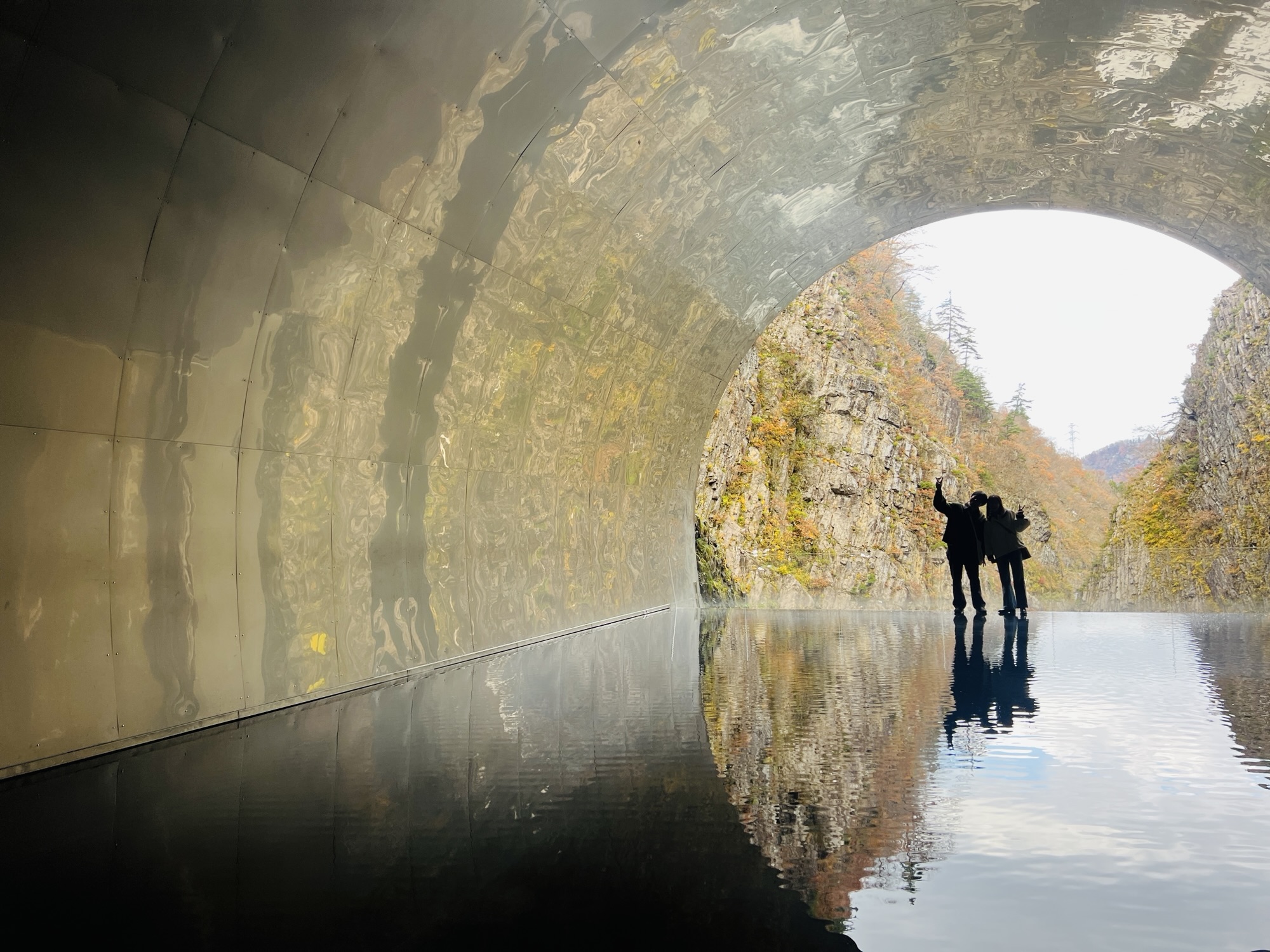
Our journey continued into Tokamachi, beginning at Kiyotsukyo Gorge Tunnel, one of Japan’s three great canyons. Redesigned for the Echigo Tsumari Art Triennale, the Tunnel of Light frames the dramatic gorge through minimalist architecture. At its centre, a shallow pool reflects the landscape beyond, turning the surrounding cliffs and river into a living artwork. It is quiet, powerful, and surprisingly emotional. It is a must-visit for any trip to the region.
Image: M.J Cowling Image: M.J Cowling
Lunch at Il Quattro Grill was relaxed and unfussy, blending Western influences with Niigata produce. It felt like a pause rather than a break, a moment to reset before heading back into the countryside. But first, we couldn’t continue exploring without trying traditional matcha at a loyal cafe. Expertly prepared using a traditional bamboo whisk and served alongside red bean sweets, it was a matcha lover’s highlight.
Our foodie adventure continued as we were taught how to make a local treat, Saso Dango. These dumplings are made from mugwort, filled with red bean paste and wrapped and steamed, allowing the bamboo leaves to impart a unique, fresh aroma to the dumplings.
That evening we enjoyed a home cooked Obanzai meal, prepared by a local Niigata mothers, reflected the principle of mottainai, using seasonal ingredients with care and minimal waste. It was warm, nourishing, and deeply human, the kind of meal that makes you feel looked after.
Checking in at New Greenpia Tsunan, an all-season resort set high on a plateau near Mount Naeba was the next stop on our trip through Niigata. Surrounded by open countryside, it reinforced how removed Niigata feels from urban Japan. It was quiet when we visited, as snow season hadn’t officially commenced, however once the season is underway, this resort is filled with with skiiers and families ready to hit to slopes. The rooms are generous in size with most looking out on to the slopes. The resort caters for families and accommodates groups travelling together.
Myoko, Where Mountains Shape Daily Life
Myoko introduced a more alpine side of Niigata. A guided rice terrace walk through satoyama landscapes shaped by centuries of cultivation was a highlight of the trip. The terraced paddies followed the natural contours of the land, each level telling a story of shared effort and continuity. Even when weather turns, the approach here remains flexible and welcoming. the rice paddies were dusted with snow while late autumn leaves glinted in the sunshine, giving us a glimpse of both seasons in one.
Lunch at the cafe terrace of Akakura Kanko Hotel came with sweeping views across Mt Madarao, the Shinshu mountains, and Lake Nojiri. With snow lingering on peaks and autumn colours still clinging to the trees, it was the kind of view that encourages long conversations and slow coffee. We met local guide Bill Ross from Dancing Snow Myoko, whose approach to outdoor experiences is grounded in respect for nature rather than conquest. He shared his experiences of living in the region, and insights in to the culture of this special region.
Myoko – Image: M.J Cowling
That same philosophy carried into our stay at Okayama Ryokan, where mineral rich onsen waters flow from Mount Myoko and dinner highlights included local Koshihikari rice, Kubiki beef, fresh seafood, and seasonal mountain vegetables. the well located ryokan is the perfect spot to experience traditional accommodation, while being well situated to experience everything the region has to offer.
Okayama Ryokan – Image: M.J Cowling
At the Myoko Kogen Visitor Centre, we learned more about the surrounding national park before strolling around Imori Pond. On calm days, Mount Myoko reflects perfectly in the water, a moment of stillness that feels almost unreal.
A guided nature walk with Bill, exploring forest paths was unhurried, thoughtful, and deeply grounding, a reminder that Niigata rewards those who slow down and take time to explore off the beaten track.
That afternoon, we checked in at Lotte Arai Resort, a modern mountain resort known for its deep snow and year-round adventure. Dinner that evening was at a local izakaya in Myoko City, where shared plates, local sake, and easy laughter summed up Niigata’s welcoming spirit perfectly.
A Thoughtful Farewell
Our final day brought Niigata’s defining elements together. After an exhilirating zipline experience at Lotte Arai, we headed to Mahora for a hands-on lunch, learning to make soba noodles guided by a professional. The process was simple, tactile, and quietly satisfying.
Zipping at Lotte Arai Resort – Image: M.J Cowling
The journey concluded at Kanzuri the sole producer of Kanzuri, a fermented chilli paste unique to the region. Made using snow bleaching and aged for three years, Kanzuri is the perfect example of how Niigata transforms harsh winters into flavour and depth.
Niigata feels miles away from the hustle and bustle of Japan’s major cities, both geographically and emotionally. Snow defines its people, shaping their patience, their food, and their generosity. The hospitality is genuine, the meals are exceptional, and the sake is every bit as good as its reputation.
This is not a place that demands attention. It earns it quietly. Long after leaving Snow Country, Niigata stays with you, not loudly, but deeply, through flavour, warmth, and a sense of having seen a more grounded side of Japan.
To see more and plan your Niigata trip, visit here.
“`html
Fast Facts
Niigata Prefecture, Japan
A region of big seasons, famous rice, exceptional sake, and snow covered mountain towns,
with a coastline that delivers seriously good seafood.
Best time to visit
Late October to mid November for autumn colour,
December to March for snow, ski trips, and onsen stays,
May to June for fresh greens and comfortable sightseeing.
How long to stay
3 to 5 days for a first trip, or 6 to 8 days if you want a mix of mountains,
coastal stops, and a slower food and sake focused itinerary.
Travel time from Tokyo
By Shinkansen, Tokyo to Niigata City is typically around 2 hours.
Tokyo to Echigo Yuzawa is roughly 75 to 90 minutes,
depending on the service.
Getting around
Trains are great for the main hubs, but if you want villages, viewpoints, and a more flexible itinerary,
a rental car is worth it, especially outside the cities.
Where to base yourself
Niigata City for food and markets, Echigo Yuzawa for easy ski and onsen access,
Myoko as a brilliant base for powder days and relaxed mountain town vibes,
and Sado Island for coastal scenery and slow travel.
Must do experiences
Onsen sessions after a cold day, sake tasting, snow season adventures, coastal seafood lunches,
and exploring towns that feel far removed from the pace of Tokyo.
Food and drink to try
Koshihikari rice, the pride of the region
Hegi soba, buckwheat noodles served in neat little bundles
Noppe, a comforting local stew, especially in colder months
Sasa dango, a traditional sweet wrapped in bamboo leaves
Seafood from the Sea of Japan, think crab, prawns, and seasonal catches
Niigata sake, crisp, clean, and dangerously easy to love
What to pack
Winter, waterproof boots, warm layers, gloves, and a proper coat,
other seasons, comfortable shoes and layers for changeable mountain weather.
Budget guide
City stays can be good value, onsen ryokan nights are a splurge but worth it,
add extra for tastings, transport, and seasonal activities like lift passes.
Quick planning tip: If you are visiting in snow season, book accommodation early,
especially in Myoko and around Echigo Yuzawa, weekends can sell out fast.


We arrived in Niigata the day after the first snow of the season. Roofs, fields, and distant mountains were lightly dusted white, while autumn leaves still burned red and gold across the valleys. It was that rare crossover moment where two seasons overlap, and Niigata felt a little bit more magical because of it.
Set between the Sea of Japan and the Japanese Alps, Niigata Prefecture feels a world away from the pace of Tokyo or Osaka. There is space here, both physically and mentally. Snow defines this region, shaping how people live, cook, build, and welcome others. The hospitality feels natural and deeply sincere, not curated or rushed. You sense immediately that visitors are not treated as outsiders, but as guests.
Niigata is known across Japan for its rice and sake, and rightly so. But what makes the region special is how everything connects. Snow feeds the rivers, the rivers nourish the rice fields, and that rice and pure water become food and drink that anchor daily life. The result is a place where flavour, craft, and environment are inseparable.
Our journey through Niigata followed that connection from farm to table, mountain to plate, and tradition to everyday life.
Minamiuonuma, Where Rice Is the Heart of Everything
Our introduction to Niigata began in Minamiuonuma, one of Japan’s most respected rice growing regions. Lunch at FARM FRONT SEKI NOEN was simple and unforgettable. Rice balls made from Seki Farm’s Koshihikari rice, a six time consecutive winner at Japan’s Rice and Taste Analysis Contest, were lightly salted and cooked in house. The texture was perfect, the aroma unmistakable. This was rice allowed to speak for itself.
Meeting rice farmer Tomoharu Seki added depth to the experience. His pride was calm and grounded, shaped by years of working with land that demands patience. In Niigata, rice is not just food, it is identity.
The afternoon continued at Nakataya Textiles, a historic workshop preserving Niigata’s weaving heritage. It became clear how much of this region’s culture is built on repetition, skill, and time rather than speed.
Nearby, a visit to Imanari Pickles Store we learnt (and tasted!) how Niigata’s long winters shaped preservation techniques. The handmade pickles, fermented slowly, carried complex flavours that spoke directly to climate and tradition.
That evening, we checked in at Ryugon, a beautifully restored manor house ryokan in the heart of Snow Country. Traditional architecture sits comfortably alongside modern design, with hot springs, a tranquil garden, and spaces that invite stillness. Dinner followed at Ryuzushi, where the menu highlighted local seafood and produce. Each dish felt precise, confident, and deeply rooted in place.
Where Nature, Food and Art Share the Same Space
Our journey continued into Tokamachi, beginning at Kiyotsukyo Gorge Tunnel, one of Japan’s three great canyons. Redesigned for the Echigo Tsumari Art Triennale, the Tunnel of Light frames the dramatic gorge through minimalist architecture. At its centre, a shallow pool reflects the landscape beyond, turning the surrounding cliffs and river into a living artwork. It is quiet, powerful, and surprisingly emotional. It is a must-visit for any trip to the region.
Lunch at Il Quattro Grill was relaxed and unfussy, blending Western influences with Niigata produce. It felt like a pause rather than a break, a moment to reset before heading back into the countryside. But first, we couldn’t continue exploring without trying traditional matcha at a loyal cafe. Expertly prepared using a traditional bamboo whisk and served alongside red bean sweets, it was a matcha lover’s highlight.
Our foodie adventure continued as we were taught how to make a local treat, Saso Dango. These dumplings are made from mugwort, filled with red bean paste and wrapped and steamed, allowing the bamboo leaves to impart a unique, fresh aroma to the dumplings.
That evening we enjoyed a home cooked Obanzai meal, prepared by a local Niigata mothers, reflected the principle of mottainai, using seasonal ingredients with care and minimal waste. It was warm, nourishing, and deeply human, the kind of meal that makes you feel looked after.
Checking in at New Greenpia Tsunan, an all-season resort set high on a plateau near Mount Naeba was the next stop on our trip through Niigata. Surrounded by open countryside, it reinforced how removed Niigata feels from urban Japan. It was quiet when we visited, as snow season hadn’t officially commenced, however once the season is underway, this resort is filled with with skiiers and families ready to hit to slopes. The rooms are generous in size with most looking out on to the slopes. The resort caters for families and accommodates groups travelling together.
Myoko, Where Mountains Shape Daily Life
Myoko introduced a more alpine side of Niigata. A guided rice terrace walk through satoyama landscapes shaped by centuries of cultivation was a highlight of the trip. The terraced paddies followed the natural contours of the land, each level telling a story of shared effort and continuity. Even when weather turns, the approach here remains flexible and welcoming. the rice paddies were dusted with snow while late autumn leaves glinted in the sunshine, giving us a glimpse of both seasons in one.
Lunch at the cafe terrace of Akakura Kanko Hotel came with sweeping views across Mt Madarao, the Shinshu mountains, and Lake Nojiri. With snow lingering on peaks and autumn colours still clinging to the trees, it was the kind of view that encourages long conversations and slow coffee. We met local guide Bill Ross from Dancing Snow Myoko, whose approach to outdoor experiences is grounded in respect for nature rather than conquest. He shared his experiences of living in the region, and insights in to the culture of this special region.
That same philosophy carried into our stay at Okayama Ryokan, where mineral rich onsen waters flow from Mount Myoko and dinner highlights included local Koshihikari rice, Kubiki beef, fresh seafood, and seasonal mountain vegetables. the well located ryokan is the perfect spot to experience traditional accommodation, while being well situated to experience everything the region has to offer.
At the Myoko Kogen Visitor Centre, we learned more about the surrounding national park before strolling around Imori Pond. On calm days, Mount Myoko reflects perfectly in the water, a moment of stillness that feels almost unreal.
A guided nature walk with Bill, exploring forest paths was unhurried, thoughtful, and deeply grounding, a reminder that Niigata rewards those who slow down and take time to explore off the beaten track.
That afternoon, we checked in at Lotte Arai Resort, a modern mountain resort known for its deep snow and year-round adventure. Dinner that evening was at a local izakaya in Myoko City, where shared plates, local sake, and easy laughter summed up Niigata’s welcoming spirit perfectly.
A Thoughtful Farewell
Our final day brought Niigata’s defining elements together. After an exhilirating zipline experience at Lotte Arai, we headed to Mahora for a hands-on lunch, learning to make soba noodles guided by a professional. The process was simple, tactile, and quietly satisfying.
The journey concluded at Kanzuri the sole producer of Kanzuri, a fermented chilli paste unique to the region. Made using snow bleaching and aged for three years, Kanzuri is the perfect example of how Niigata transforms harsh winters into flavour and depth.
Why Niigata Stays With You
Niigata feels miles away from the hustle and bustle of Japan’s major cities, both geographically and emotionally. Snow defines its people, shaping their patience, their food, and their generosity. The hospitality is genuine, the meals are exceptional, and the sake is every bit as good as its reputation.
This is not a place that demands attention. It earns it quietly. Long after leaving Snow Country, Niigata stays with you, not loudly, but deeply, through flavour, warmth, and a sense of having seen a more grounded side of Japan.
To see more and plan your Niigata trip, visit here.
“`htmlFast Facts
Niigata Prefecture, Japan
A region of big seasons, famous rice, exceptional sake, and snow covered mountain towns, with a coastline that delivers seriously good seafood.
Best time to visit
Late October to mid November for autumn colour, December to March for snow, ski trips, and onsen stays, May to June for fresh greens and comfortable sightseeing.
How long to stay
3 to 5 days for a first trip, or 6 to 8 days if you want a mix of mountains, coastal stops, and a slower food and sake focused itinerary.
Travel time from Tokyo
By Shinkansen, Tokyo to Niigata City is typically around 2 hours. Tokyo to Echigo Yuzawa is roughly 75 to 90 minutes, depending on the service.
Getting around
Trains are great for the main hubs, but if you want villages, viewpoints, and a more flexible itinerary, a rental car is worth it, especially outside the cities.
Where to base yourself
Niigata City for food and markets, Echigo Yuzawa for easy ski and onsen access, Myoko as a brilliant base for powder days and relaxed mountain town vibes, and Sado Island for coastal scenery and slow travel.
Must do experiences
Onsen sessions after a cold day, sake tasting, snow season adventures, coastal seafood lunches, and exploring towns that feel far removed from the pace of Tokyo.
Food and drink to try
What to pack
Winter, waterproof boots, warm layers, gloves, and a proper coat, other seasons, comfortable shoes and layers for changeable mountain weather.
Budget guide
City stays can be good value, onsen ryokan nights are a splurge but worth it, add extra for tastings, transport, and seasonal activities like lift passes.
Useful links
Add your key planning links here, Niigata tourism site, Myoko area info, Echigo Yuzawa guide, JR rail planning.
Share this:
Like this: