There’s a reason sourdough has such a devoted following. In With Love, Meghan Season 2, Meghan Markle shows that baking bread at home is about more than the end result—it’s about the process, the patience, and the simple joy of creating something from scratch. With just flour, water, and time, you can nurture a starter that feels alive and bake a loaf that’s rustic, fragrant, and deeply satisfying.
At first glance, the method can seem daunting, with days of feeding and folding before you ever switch on the oven. But if you follow the steps one at a time, it becomes surprisingly manageable. Each stage builds on the last, guiding you from mixing the starter to pulling a golden loaf from the oven. Stick with it and you’ll not only have fresh sourdough to slice and share, you’ll also gain the quiet satisfaction of mastering a timeless kitchen ritual.
Ingredients
To create the active starter: 113 grams rye flour 113 grams room-temperature water, plus more for growing and feeding 113 grams all-purpose flour, plus more for growing and feeding
To feed the active starter: 113 grams active starter 113 grams room-temperature water 113 grams all-purpose flour
For the sourdough loaf: 300 grams room-temperature water 100 grams active starter 10 grams kosher salt 320 grams bread flour 80 grams whole wheat flour Rice flour or all-purpose flour, for dusting
Method
Create the active starter:
Day 1 – Combine 113 grams rye flour and 113 grams room-temperature water in your sourdough starter jar. Mix with a spatula until smooth; the consistency will be thick and pasty. Loosely cover with cheesecloth and a rubber band. Let it sit in a warm spot on the counter for 24 hours.
Day 2 – Weigh out 113 grams of starter. Discard the rest of the jar’s contents. Combine with 113 grams of all-purpose flour and 113 grams of room-temperature water. Loosely cover with cheesecloth and a rubber band and let sit on the counter for 24 hours.
Day 3, Pt. 1 – Weigh out 113 grams of starter. Discard the rest of the jar’s contents. Combine with 113 grams of all-purpose flour and 113 grams of room-temperature water. Loosely cover with cheesecloth and let sit on the counter for 12 hours.
Day 3, Pt. 2 – Repeat feeding with the same measurements and let sit for another 12 hours.
Day 4 – Repeat the same two steps from Day 3.
Day 5 – Repeat the same two steps from Day 4. At the end of Day 5, your start is “active” and you can now use it to make bread.
Feed the active starter:
The night before you are ready to bake a loaf, feed your active starter.
Stir together the active starter, water, and all-purpose flour in a jar that is large enough for the mixture to double in size. Wrap a rubber band around the jar where the top of the mixture is, so you can get a sense of how much it is growing.
Cover the jar loosely with a lid, cheesecloth, or plastic wrap. Leave in a warm place (80 degrees Fahrenheit) for at least 4 hours and up to 12 hours. Note: If you want to start your bread first thing in the morning, feed your starter the night before and it will be ready to use when you wake up.
Make the dough: 1. In a large bowl, mix together the water, starter, and salt. Add the bread flour and whole wheat flour and stir until combined. The result will be a wet, sticky dough ball. Cover with a tea towel and let rest for 30 minutes. 2. Take the remaining starter and feed it equal parts flour and water to maintain it. Keep it covered with cheesecloth or plastic wrap and a rubber band. This is now the starter that you are maintaining, and it can live on your counter or in your fridge.
Stretch and fold the dough:
After 30 minutes, grab a corner of the dough and pull it up and into the center. Repeat until you’ve performed this same action 4-5 times around the circumference of the dough.
Cover and let rest for another 30 minutes.
Repeat the stretching and folding action 3 more times every 30 minutes.
After the fourth time folding the dough, let the dough rest in a warm place (80 degrees Fahrenheit) until the dough doubles. The timing will depend on the temperature that day. If it’s warm, it can take just 1 1/2 hours. If it’s a colder day, it can take up to 3-4 hours.
Shape the sourdough:
Gently transfer the dough to a clean work surface dusted with some all-purpose flour.
Fold the dough envelope-style: top third over to the center; bottom third up and over the center. Then repeat from left to right.
Turn your dough over and use a bench scraper to push the dough up, then back towards you to create a tight ball. Repeat this pushing and pulling until you feel you have some tension in your ball.
Place the boule on some flour and let it rest for 40 minutes on the counter covered with a tea towel.
Line the bread banneton with a clean tea towel. Lightly dust with some rice flour or all-purpose flour.
After the dough has rested, repeat the envelope-style fold as well as the shaping with the bench scraper, pushing and pulling until you have a tight ball again.
Place the dough ball presentation side down (seam side up) in your prepared tea towel-lined banneton.
Pull the ends of the tea towel over the dough to cover. Transfer the dough to the refrigerator overnight. Note: You can leave the dough in the fridge for up to 2 days before baking.
Bake the sourdough:
Preheat the oven to 500 degrees Fahrenheit with the 7 1/4 quart Dutch oven inside. While the oven is preheating, take your sourdough out of the fridge.
Sprinkle the exposed dough with white rice flour or all-purpose flour and turn it out onto a sheet of parchment paper.
Sift some all-purpose flour over the dough, making sure to cover it well. Rub off any excess flour, taking care not to press down on the dough.
Use a thread to mark the bread into quadrants. This will help keep the decorative scoring consistent.
Using a sharp razor blade or lame and quick fluid motion, score the dough as you like. Be sure to not press too deeply or to go too close to the base of the dough, as this will not allow it to rise vertically and will cause it to spread horizontally.
Grab the ends of the parchment and carefully transfer the dough into the hot Dutch oven.
Put the lid on. Lower the oven temperature to 450 degrees Fahrenheit. Bake, covered, for 30 minutes.
Remove the lid and lower the oven to 400 degrees Fahrenheit. Bake for another 20 minutes or until the bread has darkened to your liking.
Carefully lift the loaf out of the Dutch oven and cool for 45 minutes before cutting.


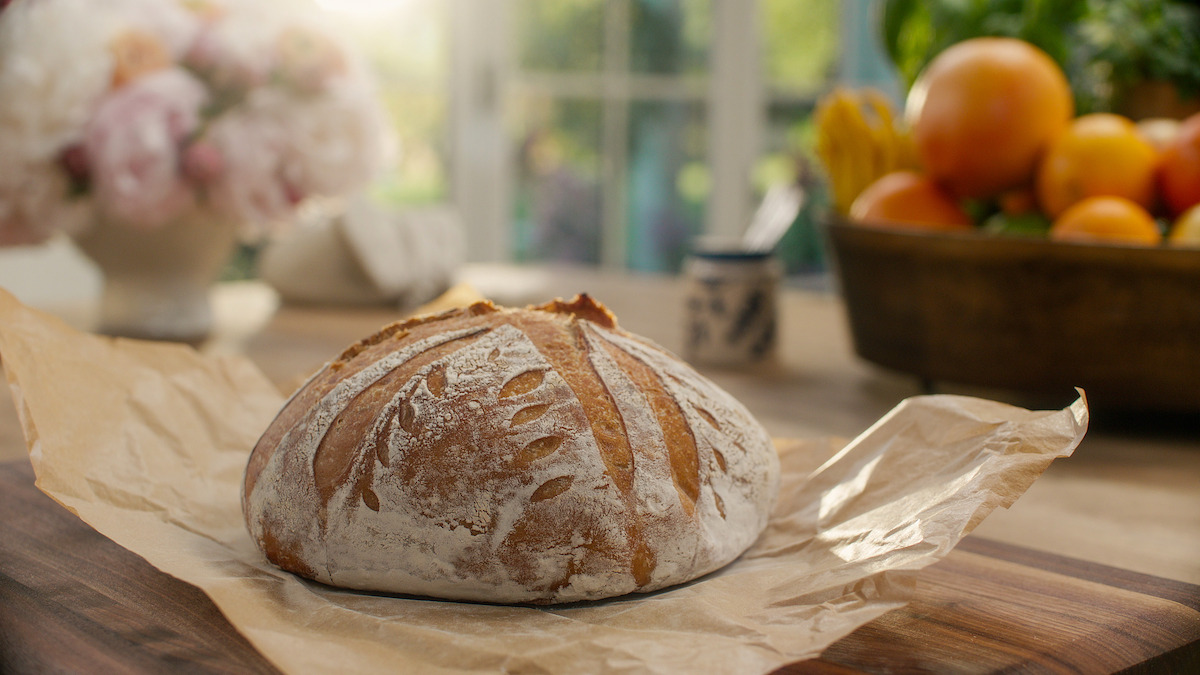
There’s a reason sourdough has such a devoted following. In With Love, Meghan Season 2, Meghan Markle shows that baking bread at home is about more than the end result—it’s about the process, the patience, and the simple joy of creating something from scratch. With just flour, water, and time, you can nurture a starter that feels alive and bake a loaf that’s rustic, fragrant, and deeply satisfying.
At first glance, the method can seem daunting, with days of feeding and folding before you ever switch on the oven. But if you follow the steps one at a time, it becomes surprisingly manageable. Each stage builds on the last, guiding you from mixing the starter to pulling a golden loaf from the oven. Stick with it and you’ll not only have fresh sourdough to slice and share, you’ll also gain the quiet satisfaction of mastering a timeless kitchen ritual.
Ingredients
To create the active starter:
113 grams rye flour
113 grams room-temperature water, plus more for growing and feeding
113 grams all-purpose flour, plus more for growing and feeding
To feed the active starter:
113 grams active starter
113 grams room-temperature water
113 grams all-purpose flour
For the sourdough loaf:
300 grams room-temperature water
100 grams active starter
10 grams kosher salt
320 grams bread flour
80 grams whole wheat flour
Rice flour or all-purpose flour, for dusting
Method
Create the active starter:
Feed the active starter:
Make the dough:
1. In a large bowl, mix together the water, starter, and salt. Add the bread flour and whole wheat flour and stir until combined. The result will be a wet, sticky dough ball. Cover with a tea towel and let rest for 30 minutes.
2. Take the remaining starter and feed it equal parts flour and water to maintain it. Keep it covered with cheesecloth or plastic wrap and a rubber band. This is now the starter that you are maintaining, and it can live on your counter or in your fridge.
Stretch and fold the dough:
Shape the sourdough:
Bake the sourdough:
Share this:
Like this: